AMERICA’S LEFT
depends on the support of young people. In 2008 it was they who powered
Barack Obama’s primary campaign against Hillary Clinton and were
critical in securing his landslide win against John McCain. In 2020, Joe
Biden repeated his predecessor’s success with the group—who were
largely motivated by disapproval of his opponent, Donald Trump—and won the White House.
The election was so close that every young voter counted. But Mr
Biden’s failure to impress the young now threatens his presidency.
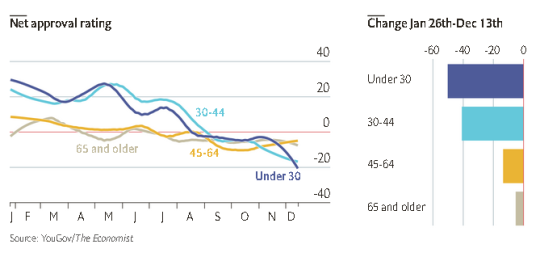
According to The Economist’s
analysis of polling conducted with YouGov, an online survey firm, an
average of 29% of American adults under the age of 30 approve of the job
Mr Biden is doing as president. But that compares with 50% who
disapprove. The net rating of -21 points is the worst for any age group.
Adults aged between 30 and 44 give Mr Biden a -17 rating; those aged 45
to 64 come in at -5; and among adults aged 65 and over, the president
is eight points underwater. This is a sharp reversal from the beginning
of the year, when young voters gave Mr Biden a net approval rating 32
points higher than older people did. And Mr Biden is falling out of
favour fastest with the youngest groups.
Why have the young turned on him? Many told YouGov that their biggest
concerns were climate change and health care. Here the president has
promised much but so far delivered little. Younger Americans also care
more about civil rights and abortion—and may be energised by recent Supreme Court rulings
on the latter. Others are angry about student-loan debt and Mr Biden’s
unfulfilled promise to cancel at least $10,000 owed by every borrower.
What we’re doing now, though nobody is likely to admit it, is a form
of this inflation-fighting. The implicit idea is that, by removing
purchasing power from college grads and families, we reduce demand for
consumer goods, which will trigger a reduction (or slower growth) in
prices. Instead of doing this through Federal Reserve interest rate
policy, we’re doing it by directly burdening individuals with student
loan costs, and reducing their share of a child allowance, rather than
the indirect rate-setting mechanism.
Either way, the effect is the same: putting people out of work (which
is what would happen if you reduce consumer spending) and
indiscriminately damaging a lot of lives. And in this case, it’s
extremely unlikely to bring about any kind of inflation-fighting goal.
We currently have a supply problem that has little to do with consumer
demand. If your staple items that you can’t cut from your budget can’t
get to the store, relative demand isn’t likely to fix the scarcity or
bring the prices down.
In fact, in the current crunch, it could worsen the problem. Companies have been double-ordering
inventory because of the uncertainty of getting goods smoothly. The
slightest reduction in demand could leave them stuck with a bunch of
items that nobody wants or can afford. This is a ticking time bomb that
could prompt those companies to lay off workers. It’s a function of an
unstable supply chain, and pushing austerity on millions of people could
light the fuse.
So you have a form of inflation-fighting that won’t actually fight
inflation, doesn’t deal with the supply issues at the heart of the
problem, and instead stumbles into austerity for no good reason. A
combination of overconfidence, reluctant corporate Democrats, and
wrong-headed political strategy has Democrats moving in a disastrous
direction.
There’s time for them to pull out of this deadspin. Progressives have suggested
extending the student loan payment pause, and the Senate is mulling
over a short-term CTC extension to bridge to Build Back Better passage.
Maybe focusing on fixing supply chains can lower prices and raise real wages. Whatever the solution, some decisions need to be made, and soon.
if that generation keeps insisting on things so far from reality eventually they’ll have to face a realization