For those who have overactive guilt complexes like me…
For those who have overactive guilt complexes like me…
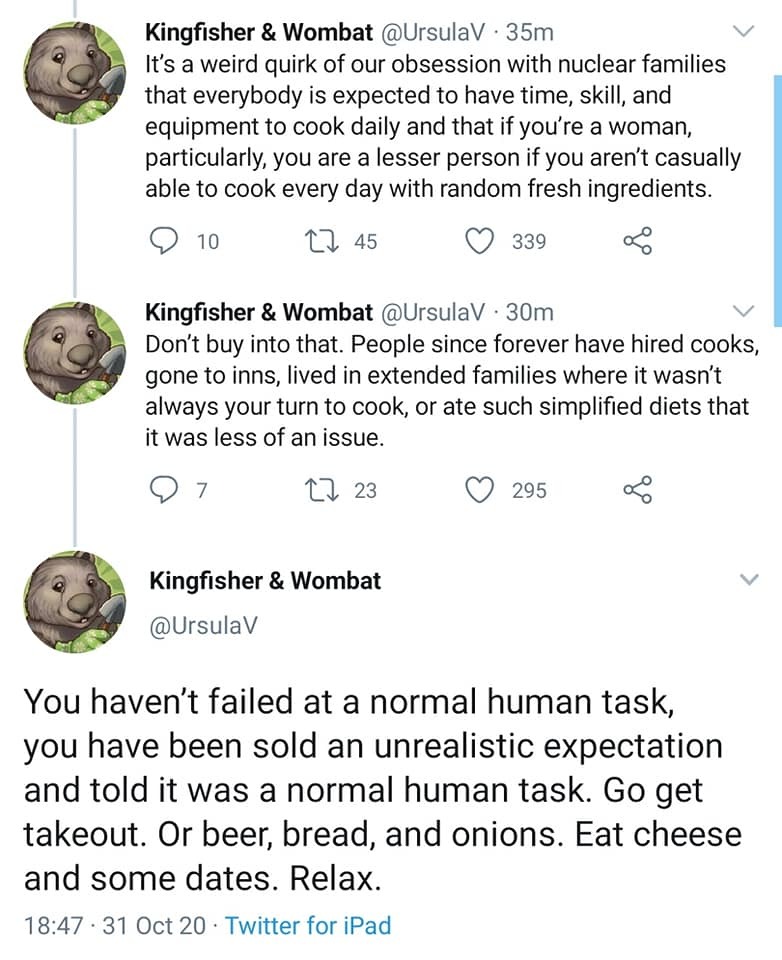
[Image ID: a series of tweets from author Ursula Vernon, @UrsulaV
If you’re ever feeling guilty about not cooking a fresh home-cooked meal, a reminder that people in cities historically either had cooks or ate at food stalls, going back to Ancient Greece. Ancient Egypt, too, although since everybody ate bread, beer, and onions, less of a thing.
It’s a weird quirk of our obsession with nuclear families that everybody is expected to have time, skill, and equipment to cook daily and that if you’re a woman, particularly, you are a lesser person if you aren’t casually able to cook every day with random fresh ingredients.
Don’t buy into that. People since forever have hired cooks, gone to inns, lived in extended families where it wasn’t always your turn to cook, or ate such simplified diets that it was less of an issue.
You haven’t failed at a normal human task, you have been sold an unrealistic expectation and told it was a normal human task. Go get takeout. Or beer, bread, and onions. Eat cheese and some dates. Relax.
/End ID]
also just going to other countries makes me suspicious of US takeout prices.
This is a conflict between T and her boyfriend. T grew up in Taiwan and thinks takeout is a routine part of life, her boyfriend grew up in a poor Chinese immigrant family in the USA and thinks takeout is an extravagant luxury reserved for special occasions.
Takeout really is more expensive in the US, but why? Taiwan has half the GDP per capita, is that all there is to it?
Anyway I’m pretty sure takeout in the US could be cheap. Like this isn’t just “a quirk of our obsession with the nuclear family”, it’s economics and policy.
My assumption has always been that it’s a minimum wage issue— in Taiwan it’s 160NT/hr ($5.77 US although it’s slightly variable), but I guess that’s not actually a huge difference when compared to US federal minimum.
My only other theory is that most cheap Taiwanese take out is something that can be made in large batches with relatively little effort. Most take out places have just a few menu items, and most stuff can be prepared in advance, so maybe with high volume and quick turnaround it works out?
Taco trucks work the same way, and pizzarias in NYC make whole pizzas and sell individual slices (most pizzarias didn’t work that way in Houston). I’ve seen a dollar taco truck in Houston and dollar pizza places in NYC, so these can get very cheap. Cafeteria style places like Chipotle also work like this, and so do buffets. But the really cheap places are rare (the dollar taco truck raised their prices and eventually shut down, and only expensive ones were left in that area), and chipotle or a lunch buffet is pretty expensive, although cheaper than other options.
Volume is definitely an issue, and I figure thats why Houston didnt have NYC-style slice shops, there’s not enough people coming in to quickly sell all the slices from a pie.
None of these things should be taken for granted as if they’re things like climate. Population density is affected by zoning and immigration law. Minimum wage is set by law but it’s not just that, a living wage in the US depends heavily on rent, which again is affected by zoning, and other restrictions on development, and also on transportation options since that affects where you can live while still working in the city. Transportation also affects the number of customers and potential employees in a given area. Everything could be different, and may soon be different, depending on people’s choices.
Minimum wage probably matters, but real estate matters more. Food trucks aren’t a big thing in most places - Portlandia used to go in hard on them, but I don’t know if that’s held up as it’s gotten more expensive since I left - and if you’re not a food truck, it’s basically unheard of to have a restaurant without sit-down or at least a pretty large order counter/line space, which makes them more expensive than somewhere that can be pure kitchen.
I’m not sure that gap is caused by regulatory issues, but it’s a pretty good bet. And we definitely have much less efficient use of space than any of the major East Asian cities. (Maybe excepting mainland China? I don’t know how the big PRC cities work, it wouldn’t surprise me if they’re substantially different.) So some combination of “poor use of space > expensive square footage costs” and “it’s illegal to operate a cheap takeout place” is probably the main cause.
They’re still a thing in Portland, largely because setting up a food court-like" pod" of several of them is a productive use of an undeveloped lot or subprime commercial property with a lot of asphalt out front that adds amenities to a neighborhood and makes nearby residential more valuable, like a lot of Portland lately it’s really a property play
Now when I was back in LA in the late 2000s, food trucks were mobile, and different ones would pull by your workplace each day, it was an early productive use of Twitter for them to announce where they were that day