arihndas-pryce replied to your post “I feel like early (and late?) Christianity might be underestimated as…”
what do you mean by civilizing? not to be snotty, not sure how to phrase is smarter, but it’s a genuine question.
I think I mean the obvious meaning that lots of people overlook because they’re so used to civilization – ‘a thing that causes a society to move towards a state of civilization’. Civilization is a state of affairs that is less likely to have things like human sacrifices, slavery, and more likely to have things like art and multi-nation scientific research collaborations.
I’m not sure if my original post is right. My knowledge of early Christianity’s history is pretty patchy, and I may have made incorrect assumptions. And I definitely don’t think Christianity has an unambiguous record as ‘psychological/cultural event that decreases evil in the world’. But if I had to say whether Christianity is better on this front than the things it was usually competing with, I’d bet yes.
My question is why, if Christianity was so memetically fit, did it take as long as it did to be invented and propagate?
Christianity propagated extremely rapidly!
Here’s Rodney Stark’s The Rise of Christianity (Princeton, NJ: Princeton University Press, 1996):
Studies of the rise of Christianity all stress the movement’s
rapid growth, but rarely are any figures offered. Perhaps this
reflects the prevalence among historians of the notion, recently
expressed by Pierre Chuvin, that “ancient history remains
wholly refractory to quantitative evaluations” (1990:12).
Granted, we shall never discover “lost” Roman census data giving authoritative statistics on the religious composition of the
empire in various periods. Nevertheless, we must quantify – at
least in terms of exploring the arithmetic of the possible – if we
are to grasp the magnitude of the phenomenon that is to be
explained. For example, in order for Christianity to have
achieved success in the time allowed, must it have grown at
rates that seem incredible in the light of modern experience? If so, then we may need to formulate new social scientific propositions about conversion. If not, then we have some well-tested
propositions to draw upon. What we need is at least two plausible numbers to provide the basis for extrapolating the probable rate of early Christian growth. Having achieved such a rate
and used it to project the number of Christians in various years,
we can then test these projections against a variety of historical
conclusions and estimates.
For a starting number, Acts 1:14-15 suggests that several months after the Crucifixion there were 120 Christians. Later,
in Acts 4:4, a total of 5,000 believers is claimed. And, according
to Acts 21:20, by the sixth decade of the first century there were
“many thousands of Jews” in Jerusalem who now believed.
These are not statistics. Had there been that many converts in Jerusalem, it would have been the first Christian city, since
there probably were no more than twenty thousand inhabitants at this time – J. C. Russeli (1958) estimated only ten thousand. As Hans Conzelmann noted, these numbers are only “meant to
render impressive the marvel that here the Lord himself is at
work” (1973:63). Indeed, as Robert M. Grant pointed out, “one
must always remember that figures in antiquity … were part of
rhetorical exercises” (1977:7–8) and were not really meant to
be taken literally. Nor is this limited to antiquity. In 1984 a
Toronto magazine claimed that there were 10,000 Hare
Krishna members in that city But when Irving Hexham, Raymond F. Currie, and Joan B. Townsend (1985) checked on the
matter, they found that the correct total was 80.
Origen remarked, “Let it be granted that Christians were few in the beginning” (Against Celsus 3.10, 1989 ed.), but how many would that have been? It seems wise to be conservative here, and thus I shall assume that there were 1,000 Christians in the year 40. I shall qualify this assumption at several later points in the chapter.
Now for an ending number. As late as the middle of the third
century, Origen admitted that Christians made up “just a few”
of the population. Yet only six decades later, Christians were so
numerous that Constantine found it expedient to embrace the
church. This has caused many scholars to think that something
really extraordinary, in terms of growth, happened in the latter half of the third century (cf. Gager 1975). This may explain
why, of the few numbers that have been offered in the literature, most are for membership in about the year 300.
Edward Gibbon may have been the first to attempt to estimate the Christian population, placing it at no more than “a twentieth part of the subjects of the empire” at the time of Constantine’s conversion ( [1776–1788] 1960:187). Later writers
have rejected Gibbon’s figure as far too low. Goodenough (1931) estimated that 10 percent of the empire’s population
were Christians by the time of Constantine. lf we accept 60 million as the total population at that time –which is the most
widely accepted estimate (Boak 1955a; Russell 1958; MacMullen 1984; Wilken 1984) – this would mean that there were 6
million Christians at the start of the fourth century. Von Hertling (1934) estimated the maximum number of Christians in
the year 300 as 15 million. Grant (1978) rejected this as far too
high and even rejected von Hertling’s minimum estimate of 7.5
million as high. MacMullen (1984) placed the number of Christians in 300 at 5 million. Fortunately, we do not need greater
precision; we assume that the actual number of Christians in
the year 300 lay within the range of 5–7.5 million, we have an
adequate basis for exploring what rate of growth is needed for
that range to reached in 260 years.
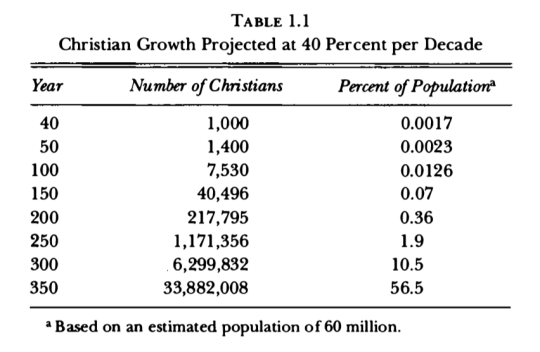
Given our starting number, if Christianity grew at the rate of
40 percent per decade, there would have been 7,530 Christians in
the year 100, followed by 217,795 Christians in the year 200 and
by 6,299,832 Christians in the year 300. If we cut the rate of
grow to 30 percent a decade, by the year 300 there would
have been only 917,334 Christians – a figure far below what anyone would accept. On the other hand, if we increase the growth
rate to 50 percent a decade, then there would have been
37,876,752 Christians in the year 300 – or more than twice von
Hertling’s maximum estimate. Hence 40 percent per decade
(or 3.42 percent per year) seems the most plausible estimate of
the rate at which Christianity actually grew during the first several centuries.
This is a very encouraging finding since it is exceedingly
dose to the average growth rate of 43 percent per decade that
the Mormon church has maintained over the past century
(Stark 1984, 1994). Thus we know that the numerical goals
Christianity needed to achieve are entirely in keeping with
modern experience, and we are not forced to seek exceptional
explanations. Rather, history allows time for the normal processes of conversion, as understood by contemporary social science, to take place.
Rodney Stark reviews estimates of Christian populations during this period, and finds them generally consistent with this general framework:
There was a
greater increase in numbers by the middle of the second century, but still the projection amounts to only slightly more than 40,000 Christians. This projection is in extremely dose agreement with Robert L. Wilken’s estimate of “less than fifty thousand Christians” at this time–“an infinitesimal number in a society comprising sixty million” (1984:31). Indeed, according to
L. Michael White (1990:110), Christians in Rome still met in
private homes at this time. Then, early in the third century, the
projected size of the Christian population picks up a bit and by
250 reaches 1.9 percent. This estimate is also sustained by a
prominent historian’s “feel” for the times. Discussing the process of conversion to Christianity, Robin Lane Fox advised that
we keep “the total number of Christians in perspective: their
faith was much the most rapidly growing religion in the Mediterranean, but its total membership was still small in absolute
terms, perhaps (at a guess) only 2 percent of the Empire’s total
population by 250” (1987:317).
As an additional test of these projections, Robert M. Grant
has calculated that there were 7,000 Christians in Rome at the
end of the second century (1977:6) . If we also accept Grant’s
estimate of 700,000 as the population of Rome for that year,
then l percent of the population of Rome had been converted
by the year 200. If we set the total population of the empire at
60 million in 200, then, based on the projection for that year,
Christians constituted 0.36 percent of the empire’s population.
This seems to be an entirely plausible matchup, since the proportion Christian should have been higher in Rome than in the
empire at large. First of all, historians assume that the church in
Rome was exceptionally strong – it was well known for sending
funds to Christians elsewhere. In about 170, Dionysius of
Corinth wrote to the Roman church: “From the start it has been
your custom to treat all Christians with unfailing kindness, and
to send contributions to many churches in every city, some
times alleviating the distress of those in need, sometimes providing for your brothers in the mines” (Eusebius, Ecclesiastical History 4.23.6, 1965 ed.). Second, by 200 the Christian proportion of the population of the city of Rome must have been substantially larger than that in the whole of the empire because Christianity had not yet made much headway in the more westerly provinces.
Now, let us peek just a bit further into the future of Christian
growth. If growth held at 40 percent per decade for the first half
of the fourth century, there would have been 33,882,008 Christians by 350. In an empire having a population of at least 60
million, there might well have been 33 million Christians by
350 – for by then some contemporary Christian wriiters were
claiming a majority (Harnack 1908: 2:29). Looking at the rise of
a Christian majority as purely a function of a constant rate of
growth calls into serious question the emphasis given by
Eusebius and others to the conversion of Constantine as the
factor that produced the Christian majority (Grant 1977). So
long as nothing changed in the conditions that sustained the
40-percent-a-decade growth rate, Constantine’s conversion
would better be seen as a response to the massive exponential wave in progress, not as its cause.
Several years after I had completed this exploration of the
arithmetic of early Christian growth, when this book was nearly finished, my colleague Michael Willaims made me aware of
Roger S. Bagnall’s remarkable reconstruction of the growth of
Christianity in Egypt (1982, 1987). Bagnall examined Egyptian
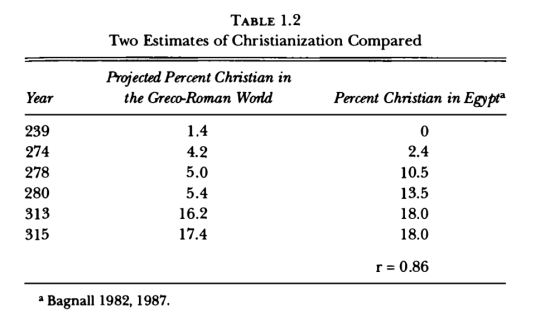
papyri to identify the proportion of persons with identifiably Christian names in various years, and from these he reconstructed a curve of the Christianization of Egypt. Here are real
data, albeit from only one area, against which to test my projections. Two of Bagnall’s data points are much later than the end
of my projections. However, a comparison of the six years
within my time frame shows a level of agreement that can only
be described as extraordinary–as can be seen in table 1.2.
Bagnali’s finding no Christians in 239 can be disregarded.
Obviously there were Christians in Egypt then, but because
their numbers would still have been very small it is not surprising that none turned up in Bagnall’s data. But for later years
the matchups are striking, and the correlation of 0.86 between
the two curves borders on the miraculous. The remarkable fit
between these two estimates, arrived at via such different
means and sources, seems to me a powerful confirmation of
both.