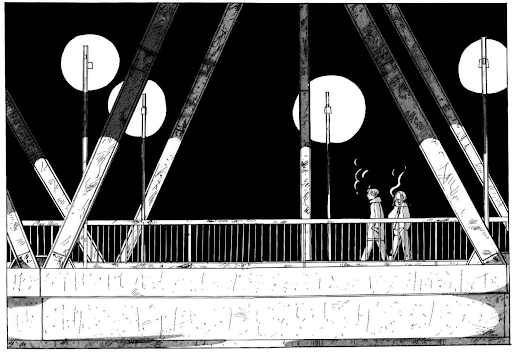
River’s Edge, a 1993 josei manga by Kyoko Okazaki, is something I picked up primarily due to hearing through the ‘net-vine of its influence on FLCL. Which is clearly there – adrift teens smoking on a bridge?
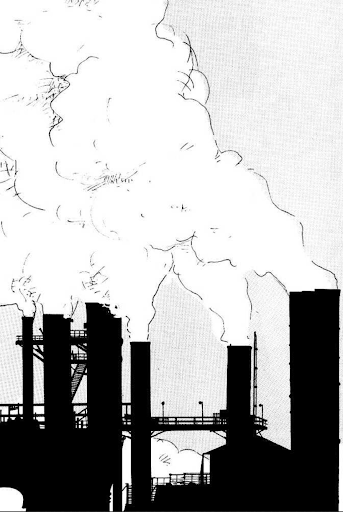
A smog-belching factory defining the grim normality of the town they live in, whose purpose is commented on to be unknown to the characters?
FLCL is a hodgepodge of cultural symbols and River’s Edge certainly part of the, uh, hodge. The parallels end there though – River’s Edge is *peak* josei in that it is utterly engulfed in the edgy drama of its high school protagonists. There is no way around the fact that this just isn’t a very good story, when it has plotlines such as boyfriend of Haruna, the main character:
1: cheating on her with her close friend,
2: which they do while doing hard drugs together,
3: resulting her getting knocked up,
4: which her hikikomori sister finds out via reading her diary (the 90’s!)
5: prompting them to get into a *knife fight*, the wounds of which abort the baby
And that is the most tame of these plotlines, trust me. By the time the gay character’s fake-but-she-doesn’t-know-it girlfriend *immolates herself* for attention you are willing to flee to the nearest monastic order to just chill out for life. This manga is 14 chapters y’all, you can finish it in under an hour, there is not enough character screen time to justify this level of drama. Its a classic early-adolescent fiction problem; your first time hearing about sex and death is so cool! So *real*! But once the novelty wears off there are no characters underneath, the shock is a magician’s misdirect so you don’t notice the hollowness behind the curtain.
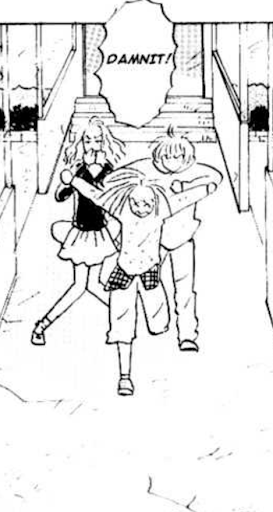
We also forget how much the digital revolution has changed art in fast-paced, low-cost genres like manga by allowing consistency and polish; Okazaki is an accomplished, well known mangaka and some of these panels are so messy and detail-less:
Which isn’t a criticism per se as this was what the genre looked like at the time, and much of the art is great, but it’s just to say overall this isn’t a visuals-first affair. It relies on writing that just doesn’t deliver.
——
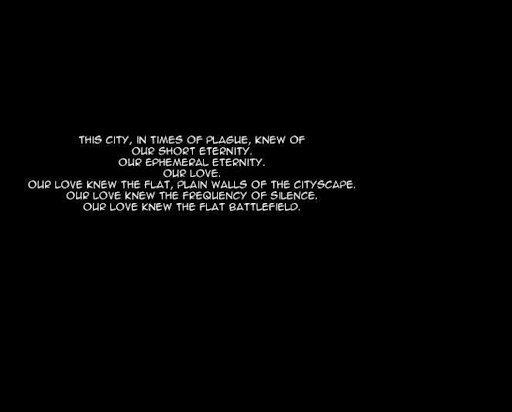
At least most of the time, because in its overwhelmingly maudlin current are ripples of some really good moments. My standout is when the narrator voice goes poetic, setting up a repeated motif:
Even as it is a bit cheesy this motif still spoke to me, the “flat battlefield”, the power of that phrase the story imbued into it. A fight with no contours to its course, no metrics to measure victory by? You don’t need to experience a knife-fight abortion to get that struggle, my daily mundane life is that (obliquely, through a certain lens at a certain time when the mood is just right/wrong). That is the universal feeling of ennui and social displacement these kinds of stories aim to have empathy for, and that the rest of this story failed to achieve. And credit where it is due – main girl Haruna, who narrates this and through whose eyes most of this story happens, doesn’t really have much drama at all in comparison to her peers. While they do insane shit she just watches and helps where she can from the sidelines, defined by her listlessness as opposed to everyone else’s tragedy. The flat battlefield is exactly the kind of pain someone like Haruna would feel – this arc works.
From the social critic lens, what I think is more notable about this story is what it does not contain. Its universal aspirations are betrayed by how utterly of its time it is. River’s Edge falls into the edgy-punk sphere, but original punk was defined by its targets. The Man, The Establishment, the polluted cityscapes and imprisoned activists, Thatcher’s & Reagan’s right wing triumphalism, original punk knew what it stood against. In the post cold-war, mass-culture era of the 90’s, however, the appeal of those causes faded – how could things so distant and so temporal be the cause of such deep personal ills? It’s often said that Japan predicts America’s cultural movements ten years out, but in this case it was right on time – 1993’s River’s Edge flows neatly alongside the 90’s American counterculture void.
But we no longer live in those liminal 90’s, that void between the intensity of the 60’s+ social revolution and today – we now have causes, but they are, ahem, as personal as they are political. Sad edgy teens are no longer sad or edgy – they instead fall somewhere on the Depressed/Oppressed axis, their condition diagnosed. Alienation is now a mental health issue (with treatments, certainly always effective yep yep, criminally underfunded and denied to those who need them), gay teens struggle for acceptance as a political cause. Even if the problems are inwardly focused, the solution can be translocated outward – change media, change language, change executive leadership, only then can the struggle be resolved. It’s the grand cycle of history – the teen edginess is activist again, even if the targets are wildly different.
River’s Edge never mentions the word ‘depression’. No one mentions therapy, or acceptance, or really any solution to their various problems - the problems are experienced internally but exist externally, a world broken only by a vague sense of ‘modernity’, if anything at all. The language in which this state of mind is discussed is now antiquated, a sort of radical acceptance of hopelessness as the natural state of man. Its aspirations to universalism have already been left in the dust of the changing times, an ill-fitting, out-of-fashion way of thinking even as Depression Fics dominates its former niche.
Which is why this otherwise-silly story still spoke to me, as I still resonate with that way of thinking more than anything else in vogue. I keep being told something is out there, but all I ever see is an endless horizon - and I am glad to once again share the view.
——
Anyway, happy 30th anniversary to Smells Like Teen Spirit!