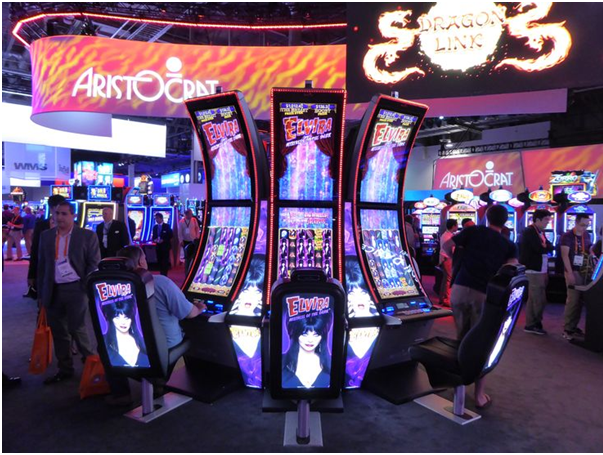
Since you worked on casino games, how similar is casino game development to video game development? Also, since you have...
Anonymous asked:
Since you worked on casino games, how similar is casino game development to video game development? Also, since you have experience making actual gambling machines, how does the design process of making literal slot machines compare to the development of loot boxes in video games?
First, designing a loot box system is very different from designing a slot machine. It’s important to understand how slot machines actually work. Slot machines results are driven purely by the math of the pay tables. This is why casino game companies employ a lot of mathematicians - it is the mathematicians’ job to come up with mathematically equivalent pay tables in order to make sure that the overall payout numbers work out correctly. The casino sets their desired payout percentage for the slot machine and the machine uses those tables to determine how big the jackpots can be and their chances of triggering in order to match those desired payout percentages. The design of a slot machine is primarily about making it look visually appealing to a specific segment of the audience. Slot machine mechanics are built on established government rules that set their behavior - we cannot create things like game mechanics that incorporate skill into slot machines by law. The math of the payouts is all handled by mathematicians constructing pay tables and engineers who build the system according to the government regulations (more on that later).
The main difference between a slot machine and a loot box system is the value generated to the user. Casino games pay out one single thing - cash in various amounts. There is no additional value for the player. You can’t meaningfully win anything else - no movie tickets, hotel accommodations, restaurant credit, etc. for playing casino games. There are no diminishing returns on gambling, as mandated by law. There is no difference in value for players - $10,000 is $10,000, no matter who wins it. You either win more money than you lost or you don’t. This is very different from designing a loot box system. Loot boxes can’t exist on their own like casino games can, the loot boxes exist as a means to distribute different elements of value to players within a greater game whole. Loot boxes hold no value without the rest of the game, and the items that a player obtains from a loot box - the skins, emotes, sprays, characters, items, etc. - all hold varying amounts of value to different players. New and casual players , for example, find the more common loot box results more useful than deeply enfranchised players who already have them. It is up to us as game designers to create value within the loot box system for players to engage with it. Designing a loot box system for resource distribution is a whole deep-dive topic for another day.
There is very little actual game design crossover between casino games and video games. The underlying logic for casino games are built on existing game rules (e.g. Blackjack, Keno, Poker, Bingo, etc.) that are enforced by the state and federal government so we literally cannot change the game rules for the casino games proper. Any game design - game mechanics, etc. - is reserved solely for bonus games, the small flash-style mini-games that appear every so often for a big winner. The trick with bonus games is that they actually don’t matter - the amount of the player’s win is determined by the server RNG, so bonus game performance generally has no effect on the amount of money they win from the machine - you can’t win more by being a better player. The game designer’s job at a casino games company is to make sure that the bonus game is engaging for those few seconds the winner gets to play them (and maybe attract other players who are watching).
Art for casino games is almost entirely simplistic 2D and flash-style graphics. The vast majority of casino games are reskins of each other - they have different facades, but the underlying math, mechanics, and systems are all identical. Engineering-wise, there is more crossover with gamedev - all modern casino games are client/server setups with network connections because they must be able to reproduce all prior transactions by law in case of things like power outages at various stages of the game. This is necessary in order to avoid lawsuits - if the player sees a jackpot right before the power goes out, the casino system must be able to reproduce the result when the power returns in order to validate the win. All of these edge cases and legal requirements makes working on games very much like constantly fixing cert bugs. Most tasks are about meeting the legal requirements for the machine to run properly.
The field of recreational game design that crosses over most with casino gaming is pinball. Basically until the invention of flippers, pinball was pachinko-style gambling, and the industry did historically have Chicago mob ties. Bally Pinball is the same Bally as Bally Casinos (and, weirdly, Bally Gyms), and Williams still exists even if they no longer make pinball – with the spread of tribal casinos they found it more profitable to focus on gaming machines.