You Aren't Actually Mad at the SATs
The University of California system is getting rid of its SAT/ACT requirement. More will follow.
There’s a lot to say. First, we must distinguish between two types of tests, or really two types of testing. When people say “standardized tests,” they think of the SAT, but they also think of state-mandated exams (usually bought, at great taxpayer expense, from Pearson and other for-profit companies) that are designed to serve as assessments of public K-12 schools, of aggregates and averages of students. The SAT, ACT, GRE, GMAT, LSAT, MCAT, and similar tests are oriented towards individual ability or aptitude; they exist to show prerequisite skills to admissions officers. (And, in one of the most essential purposes of college admissions, to employers, who are restricted in the types of testing they can perform thanks to Griggs v Duke Power Co.) Sure, sometimes researchers will use SAT data to reflect on, for example, the fact that there’s no underlying educational justification for higher graduation rates1, but SATs are really about the individual. State K-12 testing is about cities and districts, and exists to provide (typically dubious) justification for changes to education policy2. SATs and similar help admissions officers sort students for spots in undergraduate and graduate programs. This post is about those predictive entrance tests like the SAT.
Liberals repeat several types of myths about the SAT/ACT with such utter confidence and repetition that they’ve become a kind of holy writ. But myths they are.
1. SATs/ACTs don’t predict college success. They do, indeed. This one is clung to so desperately by liberals that you’d think there was some sort of compelling empirical basis to believe this. There isn’t. There never has been. They’re making it up. They want it to be true, and so they believe it to be true.
…
2. The SATs only tell you how well a student takes the SAT. This is perhaps a corollary to 1., and is equally wrong. They tell us what they were designed to tell us: how well students are likely to perform in college. But the SATs tell us about much more than college success. Let me run this graphic again.
…
3. SATs just replicate the income distribution. No. Again, asserted with utter confidence by liberals despite overwhelming evidence that this is not true. I believe that this research represents the largest publicly-available sample of SAT scores and income information, with an n of almost 150,000, and the observed correlation between family income and SAT score is .25. This is not nothing. It is a meaningful predictor. But it means that the large majority of the variance in SAT scores is not explainable by income information. A correlation of .25 means that there are vast numbers of lower-income students outperforming higher-income students. Other analyses find similar correlations. If SAT critics wanted to say that “there is a relatively small but meaningful correlation between family income and SAT scores and we should talk about that,” fair game. But that’s not how they talk. The routinely make far stronger claims than that in an effort to dismiss these tests all together, such as here by Yale’s Paul Bloom. (Whose work I generally like.) It’s just not that hard to correlate two variables together, guys. I don’t know why you wouldn’t ever ask yourselves “is this thing I constantly assert as absolute fact actually true?” Well, maybe I do.
In general, progressive and left types routinely overstate the power of the relationship between family wealth and academic performance on all manner of educational outcomes. The political logic is obvious: if you generally want to redistribute money (as I do) then the claim that educational problems are really economic problems provides ammo for your position. But the fact that there is a generic socioeconomic effect does not mean that giving people money will improve their educational outcomes very much, particularly if richer people are actually mildly but consistently better at school than poorer for sorting reasons that are not the direct product of differences in income. That is, what correlation does exist between SES and academic indicators might simply be the metrics accurately measuring the constructs they were designed to measure.
And throwing money at our educational problems, while noble in intent, hasn’t worked. (People react violently to this, but for example poorer and Blacker public schools receive significantly higher per-pupil funding than richer and whiter schools, which should not be a surprise given that the policy apparatus has been shoveling money at the racial performance gap for 40 years.) All manner of major interventions in student socioeconomic status, including adoption into dramatically different home and family conditions, have failed to produce the benefits you’d expect if academic outcomes were a simple function of money. I believe in redistribution as a way to ameliorate the consequences of poor academic performance. There is no reason to think that redistribution will ameliorate poor academic performance itself.
5. SATs are easily gamed with expensive tutoring. They are not. This one is perhaps less empirically certain than the prior two and on which I’m most amenable to counterargument, but the preponderance of the evidence seems clear to me in saying that the benefits of tutoring/coaching for these tests are vastly overstated. Again, a simplistic proffered explanation for a troublesome set of facts that then implies simplistic solutions that would not work.
6. Going test optional increases racial diversity. This one, I think, must be called scientifically unsettled. However both Sweitzer, Blalock, and Sharma and Belasco, Rosinger, and Hearn find no appreciable increase in racial diversity after universities go test-optional. “Holistic” application criteria like admissions essays almost certainly benefit richer students anyway. What’s more, we have to ask ourselves what “diversity” really means in this context. Private colleges and universities keep the relevant data close to the vest, for obvious reasons, but it’s widely believed that many elite schools satisfy their internal diversity goals for Black students by aggressively pursuing wealthy Kenyan and Nigerian international students, whose parents have the means to be the kind of reliable donors that such schools rely on so heavily. I’m not aware of a really comprehensive study that examines this issue, and it would be hard to pull off, but the relevant question is “do various policies intended to improve diversity on campus actually increase the enrollment of American-born descendants of African slaves?” I can’t say, but you can guess where my suspicions lie.
…
All of that is prologue to the bigger point: the controversy over college entrance examinations stems not from the examinations themselves, but from the fact that they reveal profound differences in human capital that make progressives uncomfortable. The SATs don’t create inequality. They reveal inequality.
…
The racial achievement/performance gap is a curious thing even in the context of an American political discourse that seems to get more bizarre by the day. That the gap exists is, on balance, not controversial. Gaps in performance are observed on essentially every measured academic metric, though the size of the effects vary from context to context, and the general distribution is Asian American students at the top, white students next, then Hispanic, then Black. The Black-white gap in particular has shrunk from the era of (explicitly) segregated schools but progress has not been consistent or linear. Most people in academia and politics admit it exists: prominent Black politicians like Barack Obama and Kamala Harris reference it, every major think tank and foundation operating in the educational space identifies it as a major priority, and the NAACP used to address if often, though their Education and Education Strategy pages have recently disappeared so it’s hard to know where they stand now. These things are faddish but once upon a time every other dissertation written by someone getting a PhD in Education was about the gap. We can observe it even outside of reference to controversial tests, such as noting that the white high school graduation rate is 10% higher than that for Black students. The achievement gap is a thing.
And yet I also find a rapidly-congealing social prohibition against talking about these gaps in progressive spaces. If you refer to a racial achievement gap in a lot of liberal or left contexts now, you’ll find that people clam up fast and get visibly uncomfortable, even if you take pains to point out that an academic achievement gap does not imply an academic potential gap. People just don’t want to acknowledge that gaps exist at all; our racial discourse appears to have become such a blunt instrument that the acknowledgement of racial difference is controversial even when you preface discussion with the belief (that I hold) that the gap is the product of innumerable environmental and sociocultural factors rather than genetics or other inherent differences. Simply saying “Black students consistently score lower on tests like the SATs, have lower average GPAs, and have worse metrics on ancillary concerns like truancy” - again, Barack Obama’s position, Kamala Harris’s position, Cory Booker’s position - is enough for people to start launching into harangues about the inherent violence of those comparisons. People just do not want to talk about this stuff.
…
Those concerns with group differences, at least, have some sort of basic political logic and are amenable to complaints that they are the product of systemic inequality. (They are, but not the inequalities that people think, and again the SAT gap is a result of systemic inequality, not a cause of systemic inequality.) More disturbing to me is the rise of resistance within academia to the notion of inequalities between individuals. When I was in grad school more than a half-decade ago, I observed with some considerable unhappiness that it had become increasingly socially unacceptable to speak of some students as simply better students than others, as being more talented, harder working, or more prepared. All of this was seen as inegalitarian and, eventually, as “white supremacist” even if every student being compared in a given context was white. There were many instructors back then who bragged about giving all students As, etc., and I must assume this practice has only grown over time. In the humanities and social sciences especially there is a growing movement to reject assessment, including grading - the means through which we sort better students from worse - as the hand of illegitimate power that “does violence” to the students who voluntarily attend college.
…
Of course, that complicity in the neoliberal machine is not some recent injustice; it is the very reason that colleges and universities are funded by our society at all. If this trend continues, not just eliminating SAT requirements or increasingly refusing to hierarchize students with grades but in rejecting the entire sorting function of the university, academia will collapse. Wealthy parents aren’t paying Harvard to enrich their children in the humanistic sense. They’re paying Harvard to act as a marker of their child’s superiority in the labor market and the social hierarchy. Employers value college because it provides at least some meaningful information about who will succeed as a worker; remove that function and the financial justification for a hideously expensive system dies. I would love if education dropped its association with meritocracy, but that cannot occur within our current system. The professors who self-aggrandize through their rejection of their hierarchizing function, if successful, would cause the doom of the modern university. (These tenured radicals, of course, never are so moved by the inherent inequities of academia that they quit the profession.)
Today, it is somehow controversial to say “some people are smarter than others,” a reflection of one of the simple brute realities of human life and something that has been accepted as true for thousands of years.
Here is the essence of it: hierarchies of relative academic performance are remarkably stable throughout life, due to differences in inherent or intrinsic academic ability of whatever origin, and the SATs and similar mechanisms reveal those differences in a way that liberal America is increasingly unable to accept. This is the source of all of this angst, not the technical details of whether a test is fair or valid or just, but a liberal intelligentsia that is incapable of honestly confronting the fact that different human beings have fundamentally different intrinsic abilities. I believe in political equality, social equality, equality of rights, equality of dignity, equality of protection under the law. But the notion that all people are equally talented, in academics or anything else, is an absurdity, and as much as people will rush to deny intrinsic difference, I suspect that pretty much everybody knows that they are real. When you were a child you casually assumed that some of your classmates were naturally better at school than others, and you did because it was true.
This is the conversation that I tried, and failed, to force with my book: left-of-center political movements, from center-left to radically socialist, cannot achieve the goal of the greater good for everyone, including greater political and economic equality, while pretending that we believe in equality of human ability. The only way to intelligently address various social, economic, and political equalities related to differences in human potential is to acknowledge that those differences exist. The current rending of garments regarding inequalities within our education system has led to certifiably bizarre situations like the movement, currently gathering steam, to teach math as if it is as subjective as literature or art. But this won’t make Black kids or poor kids or girls or anyone else actually better at math. And if the universities really give up their function of creating an academic hierarchy for political reasons, employers will find new systems that do that, or a lot of people will get hired and quickly fired for not being competent. This is not an intelligent policy approach. Getting rid of the SATs won’t make unprepared kids prepared. It won’t make naturally untalented students naturally talented. It won’t make kids who aren’t smart into smart kids. All it will do is hide the reality of those unpleasant inequalities.
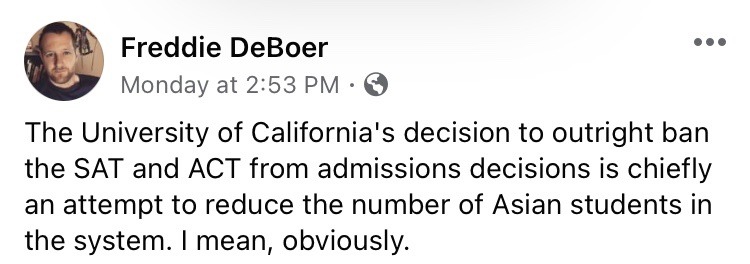
I don’t think he mentioned it, but… Was the point of eliminating the SAT in the University of California system to enable anti Asian discrimination? California seems to really be uncomfortable with how successful Asians are and has been desperately trying to find ways to legally academically discriminate against them.
No the point was to enable anti-white discrimination. I know multiple asian people who attended University of California campuses, have broadly left-progressive policy preferences, and politically support eliminating the SAT. They are very clear that the reason they support it is because they think standardized testing is white supremacist, that eliminating white supremacist policies is good for all non-white people including asians, and that people who talk about university admission policies in terms of anti-asian discrimination are really right-wingers who are using it as an excuse to be anti-black. This is the same thing that many non-asian left-progressives I know think about this issue.
Lofi Aleph to chill/work to (@woke8yearold)
woke8yearold making the same point
We canonically know his take on the matter