RAND guys just playing tabletop games to test out NATO strategy The research documented in this report was conducted in...
RAND guys just playing tabletop games to test out NATO strategy
The research documented in this report was conducted in a series of wargames conducted between the summer of 2014 and early spring 2015. Players included RAND analysts and both uniformed and civilian members of various Department of Defense organizations, including the U.S. Army, U.S. Air Force, U.S. Navy, U.S. Marine Corps, Joint Staff, U.S. Army in Europe, and U.S. Air Forces, Europe, as well as NATO Naval Command, Europe.
RAND developed this map-based tabletop exercise because existing models were ill-suited to represent the many unknowns and uncertainties surrounding a conventional military campaign in the Baltics, where low force-to-space ratios and relatively open terrain meant that maneuver between dispersed forces—rather than pushing and shoving between opposing units arrayed along a linear front—would likely be the dominant mode of combat. Further, the novelty of the scenario meant that there was little to go on in terms of strategic or operational concepts for either side; the free play of experts was needed to begin developing reasonable plans, branches, and sequels.
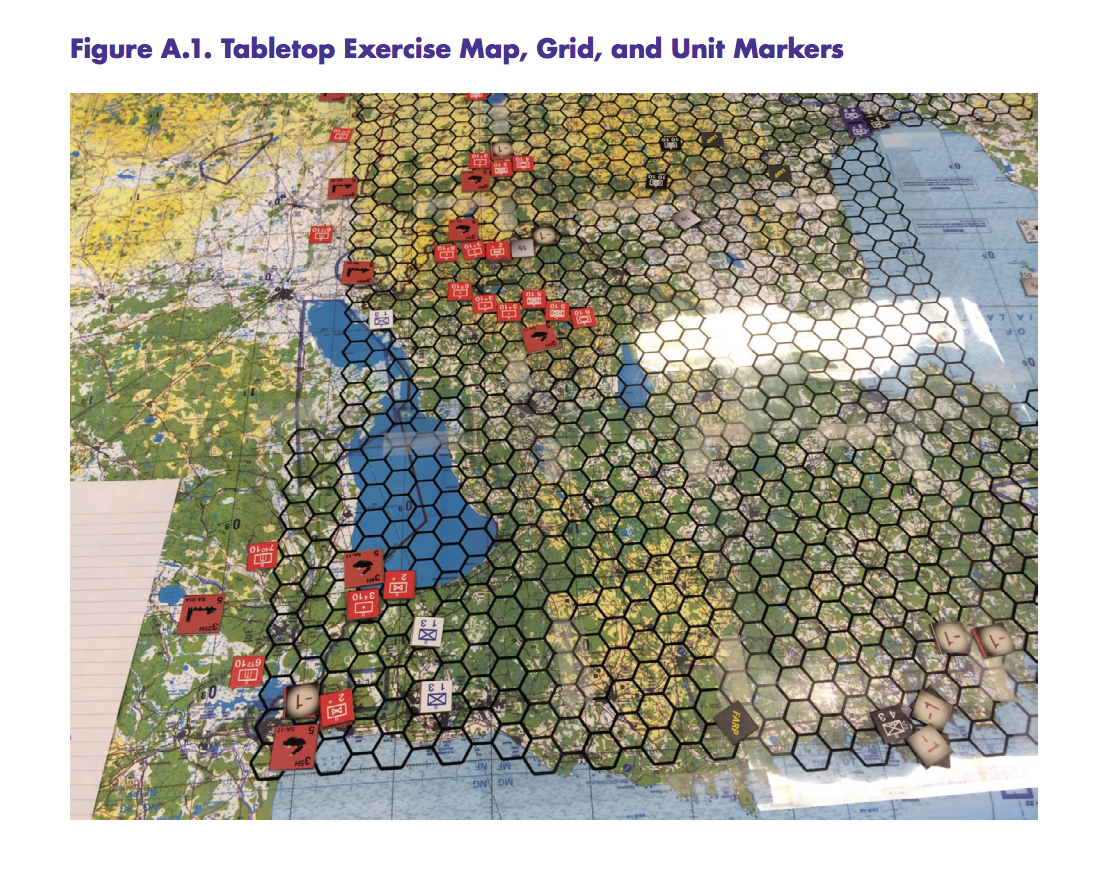
The general game design was similar to that of traditional board wargames, with a hex grid governing movement superimposed on a map. Tactical Pilotage Charts (1:500,000 scale) were used, overlaid with 10-km hexes, as seen in Figure A.1. Land forces were represented at the battalion level and air units as squadrons; movement and combat were governed and adjudicated using rules and combat-result tables that incorporated both traditional gaming principles (e.g., Lanchester exchange rates) and the results of offline modeling. We also developed offline spreadsheet models to handle both inter- and intratheater mobility. All these were subject to continual refinement as we repeatedly played the game, although the basic structure and content of the platform proved sound.
Orders of battle and tables of organization and equipment were developed using unclassified sources. Ground unit combat strengths were based on a systematic scoring of individual weapons, from tanks and artillery down to light machine guns, which were then aggregated according to the tables of organization and equipment for the various classes of NATO and Russian units. Overall unit scores were adjusted to account for differences in training, sustainment, and other factors not otherwise captured. Air unit combat strengths were derived from the results of offline engagement, mission, and campaign-level modeling.
Full documentation of the gaming platform will be forthcoming in a subsequent report.
*bangs on table* RELEASE THE GAMING PLATFORM
I do not know with which weapons WWIII will be fought, but I sure hope it involves a ton of dice.
Is there even supposed to be traditional maneuver warfare in the hypothetical epic showdown between NATO and Russia? Don’t they just annihilate each other’s forces with tactical nukes?
Modern front-line ground forces are highly resistant to nuclear weapons. Getting around this was what neutron bombs were invented for, since even back then tanks would be but briefly rattled anywhere but in or near the fireball itself, and were later abandoned because tank armor got thick enough to protect against their radiation as well (unless they were close enough to be destroyed by the other effects anyway).
At the same time, that tank can still be destroyed by a conventional bomb that lands directly on it.
I’m sure nukes would have their place, but they’re not the kind of magic unit erasers they’re depicted as in fiction.
The company owned by the family across the street that made ColdEeze basically worked by sorting through a pile of scams and woo and finding “health” things that had actual potential (problem being you were still in business with scammers and woo artists then)
And one of the other things they were working on was like a nuclear sunscreen for radiation protection that they got a DoD grant to look into, because the military intends to survivably operate forces in proximity to high radiation