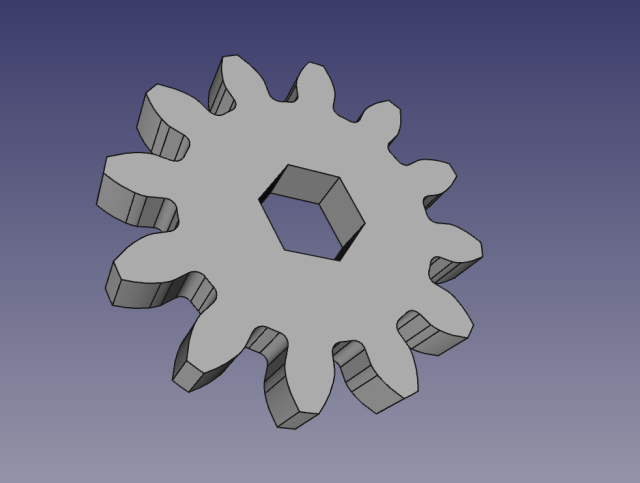
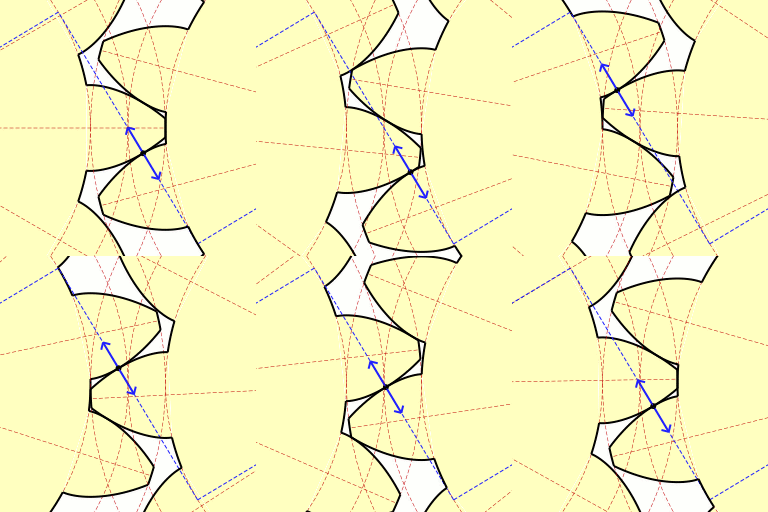
The fundamental purpose of a modern precision gear is to allow a wheel to spin smoothly against another different sized wheel to transmit torque as efficiently as possible, especially along with a gearing ratio to adjust speed and torque. The involute-tooth solves the most important problem in gears, which is how to make a tooth shape that transmits power smoothly without speeding up and slowing down all over the place. It does this by ensuring that there’s a straight line along which power is transmitted when the teeth mesh. I will now do what everyone does and borrow That One GIF off wikipedia to show you how this works.
That arrow line shows where ideal involute gear touch and the axis along which power is transmitted. You can see that it’s held at a stead angle and it moves at a constant speed, which is important: this means that no matter what size a gear is and which point in the rotation you are, turning one degree on the input gear will always produce the same rotation on the output gear. If this wasn’t true, precision machines wouldn’t be able to rely on gears, and high speed machines would suffer bumpy irregular operation.