I’ve come to notice, in listening to reels of Americans speaking in the 30′s, 40′s, and 50′s, that in certain subtle ways some constructions in English resembled what some Romance languages do, in ways that would sound strange to my ears now. In this way it seems like English may have “de-Romanticized” a little bit in past decades. (Although it should be pointed out that I don’t know how the following constructions generally work in non-Romance languages and wonder if what’s really happened is that English de-Europeanized.)
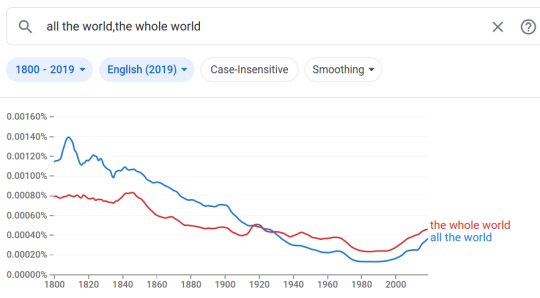
For instance, in Spanish and Italian (and I’m pretty sure also in French and Portuguese), when talking about the entirety of something one says “all the X” – for instance Spanish todo el mundo or Italian tutto il mondo, translating literally to “all the world”, which seems to have been standard English 70 years ago but sounds a little quaint today. During my lifetime, we prefer to say “the whole world”. Similarly, it seems normal in a speech from the earlier half of the 20th century to hear “all the day”, “all the time” (in contexts like “I knew it all the time”), and “in all the land”, which today would be rendered “the whole day”, “the whole time”*, and “in the whole country” respectively.
When verbally specifying dates, in Italian (and I think in Spanish, although I’m having trouble remembering this from Spanish class) the day of the month is given as a bare number without putting it in its ordinal form – for instance, “the four of July” instead of what we would call “the fourth of July”. I haven’t specifically heard “the [number] of [month]” in 1950-ish English speech, but I recently noticed that it was apparently common to say “[month] [number]” as in “July four” instead of “July fourth”. Also, it seems that, at least in formal speeches, it was normal to state the name of a year as a single four-digit number rather than two two-digit numbers, e.g. “Today in the year nineteen hundred and fifty-four…” vs. nowadays “Back in the year nineteen fifty-four…”. Of course, Spanish and Italian, and I imagine most European languages, do the former. (To be fair, we did refer to the first ten years of the 2000′s almost exclusively as single numbers and many people still do this for the years in the 2010′s and beyond. But I don’t remember either in my childhood in the 90′s or since then hearing someone refer to a year in the 1900′s with a single number.)
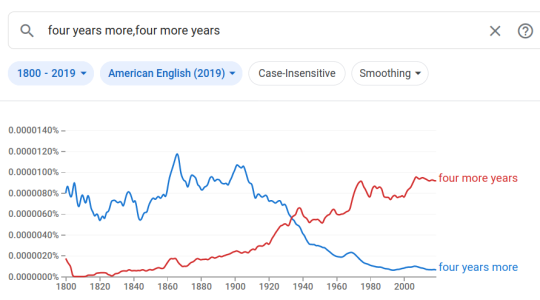
Another thing that has bemused me, as someone who has watched footage of American political conventions and speeches from the first half of the 20th century, is that instead of chanting “Four more years!” in support of a president seeking reelection, back in the 40′s or so American’s would chant, “Four years more!” This again more closely resembles what I think is the usual construction in Romance languages – I don’t remember for certain whether “Four more years!” is rendered “Cuatro años más!” rather than “Cuatro más
años!”
in Spanish (although I think it is?) but I know that it would be “Quattro anni in più!” in Italian, at least as the closest grammatical equivalent.
I feel like I noticed more examples of de-Romanticization and might edit them in if I remember. Has anyone else noticed examples of this trend?
* Another subtlety I’ve become aware of with “all the time” is that in contexts where its use is normal in today’s English – e.g. “I do it all the time” – Italian at least prefers to use the word for “always”. I had it pointed out to me early on when I was in Italy and constantly using the phrase tutto il tempo “all the time” that this wasn’t exactly incorrect but saying this instead of sempre “always” made my speech sound a bit peculiar and foreign; it was only then that I consciously noticed how Italians when speaking English often seem to use “always” a bit excessively.
“All the time” vs. “always” in English is interesting because it seems like the meaning is subtly different; “always” implies “every time a specific occasion arises” or “continuously, for all time” whereas “all the time” is more like “habitually, but sporadically”.
Google Ngrams seems to corroborate some of the switches mentioned here: