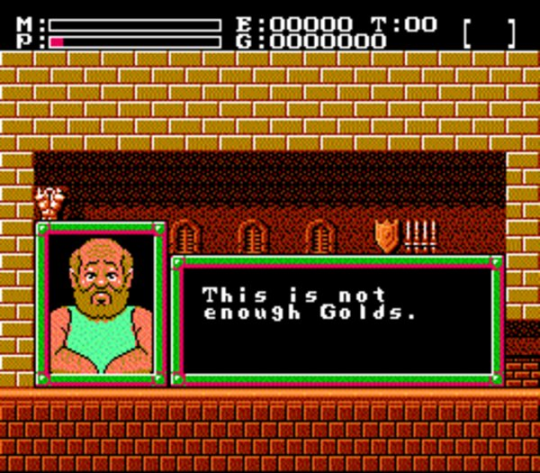
This is a classic “bad video game translation” screenshot (from Faxanadu for the NES), and that quote enjoyed a stint as a meme back in the era of “all your base are belong to us.” And it is funny, in that way that only uncanny-valley language can be.
But it got me thinking, what’s actually the problem here? The issue is that “gold” is a mass noun, not a count noun, right? And in real life that explanation suffices; but in video games and RPGs it’s not really true, is it? You might say an item “costs 10 gold” in that context, without appending a counting-word as would be required with a real currency. If you said “it costs 10 gold pieces” in the context of a game it would come off a little prissy, like the GM who narrates in cod Shakespeare or the guy who roleplays in the raid chat.
What seems to have happened here is that the ahistorical fantasy-game convention of universal “gold coins” (or gold/silver/copper) has been understood to refer to a notional currency denomination called the “gold”, which would be a count noun by the normal conventions. But because it inherits its name from a mass noun, it retains the syntactic conventions associated with mass nouns and thus is irregular. I think this convention probably applies with most notional things that behave like count nouns but use the name of a mass noun? “Tumblarity,” “mana”, and so on. And so, while we can’t know the translators’ intent, it may well be that this error is not a straightforward confusion about the mass/count distinction but instead is a result of them missing an irregularity which would (of course) have not been covered in any sort of teaching materials.
I usually think of irregular forms as relics, so it’s interesting to see how irregularity can crop up so abruptly and consistently just because of a context shift in a known word.