This is something I’ve been meaning to write up for a long time: a guide to reading the Bible for people who don’t want to commit to the full 2000+ pages. In theory you should read the whole thing, but realistically large parts of it are repetitive, dull, or just not very rewarding to the casual reader. So I came up with a list of what I consider to be the most essential books. If you read these you will “get” the Bible. I think it covers all of the main narrative portions, as well as enough theology for you to get the gist. It’s still probably half the Bible, so a formidable ~1000 pages, but with fewer of the boring bits, so it should go more than twice as quickly.
I read part of the Bible using the King James Version, but mostly I used this edition of the New Revised Standard Version. It has lots of annotations and good introductory material, plus it includes all the apocrypha. From the perspective of English literature, the KJV is definitely the one you should read. But my interest was in understanding what the Israelites themselves were thinking, so for me a modern translation, built on our better philological knowledge, was more appropriate than a highfalutin archaic translation, which puts up an extra barrier between you and the text. Which version you should pick depends on your goals. KJV can be read, but it is more difficult and you do have to work for it much more.
I list these books in the order of the Protestant Bible, just because
that’s what I know. Books which I do recommend are in bold, while books I
don’t recommend but still wanted to mention are in parentheses. And
there are too many genealogies and lists in the Bible to mention them
all, but whenever you see one you can skip it.
Obviously this is my opinion as a reader, not as a scholar.
Old Testament
Pentateuch/Historical Books
Firstly, you should start off by reading most of Genesis through 2 Kings. This is the main narrative chunk of the Old Testament, and it tells the story of Israel from the creation of the world through to the Babylonian Exile, and it contains most of the Biblical stories you’re likely familiar with. There are some large skippable sections within these books though. In particular, the genealogies and some random non-narrative bits like instructions on how to build a tent to protect the Ark of the Covenant. There’s no need to read any of that other than literary masochism. Also, large portions of the Pentateuch (the first five books of the Bible) are just laws and rules for how the Israelites should live. E.g. how should you properly sacrifice a sheep. I find that as interesting as the narrative parts, but if you don’t you can skip it.
(1 and 2 Chronicles are just a retelling of the previous few books from a slightly different perspective.)
Next you should read Ezra and Nehemiah, which conclude the story of Israel with the end of the Babylonian Exile. These books aren’t terribly interesting, but they are important, and again you can skip all the lists of names.
(Esther is a silly folk tale. Highly inessential.)
Wisdom Books
Job feels like an interesting story which got kind of messed up by later editors, but it’s important enough that you should probably read it anyway.
(Psalms and the Song of Solomon are important as literary history, but I can’t imagine the casual reader getting much out of them. You could try reading a few of the most famous psalms just to get the flavor of them, since each one is only about the length of a sonnet.)
Proverbs is just a list of Iron Age sayings and life advice. If that’s interesting to you, read part of it. If not you can skip. And even if you do read it, you don’t have to do the whole thing, since it’s repetitive.
Ecclesiastes is in my opinion the most interesting book of the Bible, and certainly the most sophisticated. A fascinating, almost Epicurean approach to theology, very different from anything else in the Bible, and probably very different from your expectations of the Bible. If you only read one book, make it this one.
Major and Minor Prophets
In general, the actual prophecies in these books are super tedious. It’s all “And God shall smite the city of so-and-so for their iniquities” or “And God shall smite the Israelites for their iniquities but then He shall forgive them”. No personality. So you can skip all of the books that are just prophecies, and focus on the ones with narrative elements.
Jeremiahis the best of these, the story of a prophet during the fall of Jerusalem. It’s a ground level retelling of events which were previously described from the perspective of a distant chronicler, which makes it a good counterpoint to other, less personal parts of the Bible. Read the whole thing, including the prophecies, so you can get the gist of what the prophecies in the other books are like.
Daniel has some well known folk stories at the beginning, but you can skip the dream interpretations of the second half.
Jonah is the only one of the Minor Prophets with a story. Him getting swallowed by a whale and all that.
(Probably the most important prophetic book without any narrative is Ezekiel, which has some interesting visions and was very influential later on. I can’t say I recommend it, but if you were to read another prophetic work this is the one I’d go with.)
(Lamentations is more poetry, but it’s also short.)
Apocrypha
The only apocryphal work I’d consider to be essential is 1 Maccabees, which fills in an important narrative gap in between the Old and New Testaments.
New Testament
Gospels
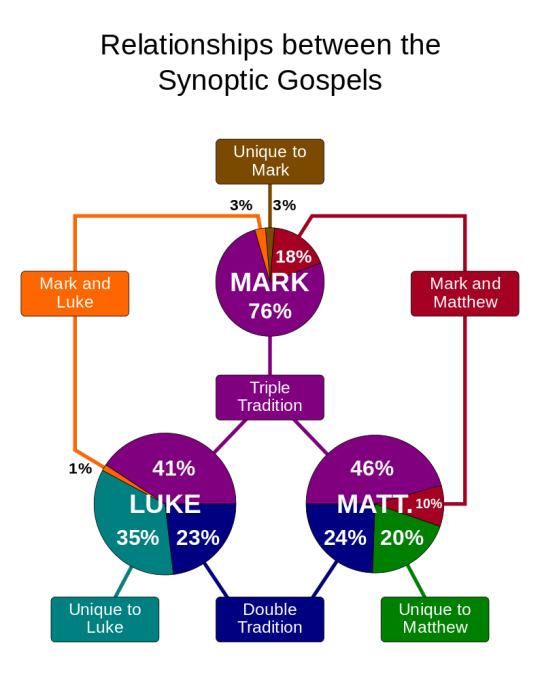
I guess the gospels are important enough that you should read all of them. Certainly you should read John, which is the most unique of the four. But the other three gospels, Matthew, Mark, and Luke, share a lot of material:
So if you wanted to, you could skip the parts which you’ve already read in the other Gospels. If you only had the energy to read two, I would go with Luke and John.
Also, I might recommend reading them in the order they were written (Mark, Matthew, Luke, John), instead of the order they were placed in the Bible. If you read the Gospels that way, you get a very clear sense of how Jesus became more and more revered over time. In Mark, Jesus is a cranky human, more or less. But by John he’s become primarily divine.
Acts of the Apostles tells the story of the early church just after the crucifixion. The stories aren’t as well known, but it’s still essential.
Epistles
The epistles are just a series of letters from various Church Fathers, mostly Paul, to churches around the Mediterranean. They deal with various doctrinal issues, how to run a church properly, and so on. Very important theologically, but not rewarding to the casual reader. I’d say read Hebrews to get a feel for what these books are like, but that’s it. Maybe Romans as well if you’re ambitious.
And finally, you should of course read Revelation. Not only is it the conclusion of the Bible, it’s also a fun read at points. The apocalyptic prophecies are gaudy and weird. They do get repetitive though, so you can skim parts if you want to.