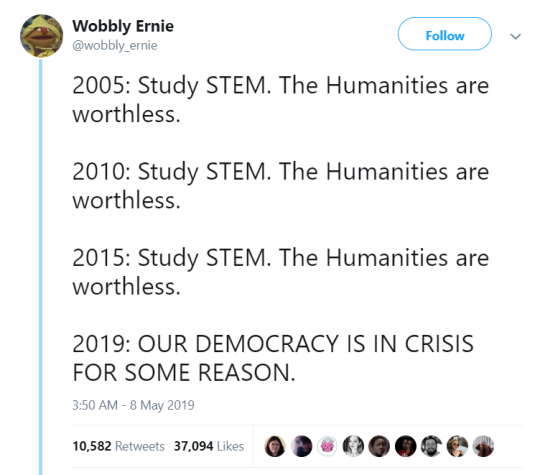
The current state of political crisis coincides with a historic high in engagement with the humanities, *including* from STEM people. If anything, political sophistication has drawn people away from a naive faith in democracy, on the right and left.
And yet humanist expertise feels devalued relative to quantitive STEM expertise, as part of the maturation of neoliberal technocracy
And you shouldn’t assume returning the humanities would move the culture leftward either. Look at all the shit Jesse Singal gets on Twitter, and a lot of it is he takes a humanist approach to the recent prominence of gender transition – he identifies it as a cultural phenomenon, with influences and origins and addressable as such by anyone who cares about human culture; he at least implicitly raises questions of what a human is or should be; critically he sees the apparatus of STEM-style sexuality experts as a cultural and not natural phenomenon
Because that apparatus is committed to no-gatekeeping yay-trans (and increasingly seeking to openly maintain itself as such in ways not explained by its own legitimating narrative) and they being the only “real”, legitimate experts helps translate that into policy and people want to defend that.
Like that’s what the debate over homosexuality in the 20th century was - quantitative sexologists would cite studies and surveys and then ministers and psychologists - postgrad-credentialed humanist experts - would push back with arguments from first principles over what humans Are and Are For and the whole thing was a wash.
(Even within gender-scholar quarters the humanist theorists asking if the rectum must be a grave have been eclipsed. I guess there’s Kate Manne doing feminism-as-philosophy, but the obsolete thing about Paglia isn’t her politics, it’s who would consider a Nietzschean exploration of the Western Canon a useful approach to anything these post-Theory days?)
You’re not wrong. I think these questions are reimposing themselves precisely because of the failure of the humanities being excessively quantified on one side and sociologized on the other.
I didn’t mean to say that the humanities were not devalued, but rather that the correlation is more or less the opposite of what the tweet suggests. The apparently stable hegemony of liberal democracy and disdain for the humanities probably reinforce each other–the big questions being apparently settled breeds complacency, like the philosophical naiveté exhibited by the New Atheists, but also a lot of unquestioning agreement that helps maintain the stability of the system. Likewise, instability and profound humanistic reflection feed each other–the big questions are called, and people arrive at (sometimes radically) different conclusions.
Which means we might be entering a period of profound humanistic reflection right now, of re-grappling with modernity and post-modernity, and early 20th Century thinkers and artists and movements seem to be gaining a renewed power and relevance. And I think a lot of regular people are revealing themselves to be profoundly interested in engaging with the humanities, voluntarily, on their own time, and a lot of very interesting work is being done outside of institutions. This may very well be the dawn of a golden age of the humanities.
Hopefully we’ll make do without the two world wars this time.