Also, why aren’t UPSses more common? They tickle my prepper senses–not that they’d be useful for long in any disaster, but they’re useful in a lot of situations. I just like having auxiliary power on hand and the units themselves are actually pretty fucking cheap.
Assuming the ISP’s network is still up, a small cheap UPS will run your modem and wireless router for hours, saving you the trouble of having to tether your laptop or whatever to your phone.
Also with the magic of LED lighting you can have backup lighting for a really long time with that same low-wattage UPS. The ~930 watt UPS my desktop is plugged into could keep some basic lighting on forever as well.
If I’m not around to supervise, the units will just discharge down to ~25 percent and shut the machines down. But If I am here (and really, when do I ever leave?) I’d likely shut them down early and save the power to charge cell phones or whatever.
Anyway I’ve always thought they were cool and I’m glad they’ve gotten so much cheaper over the years.
The typical issue is maintenance costs, especially in the areas that most benefit from them. Lead batteries aren’t that expensive, but almost any consumer grade UPS will only use a three-year rated battery, and even residential areas with good power will usually have outages enough that you’re getting a few deep discharge cycles and that generally keeps them on weak end of the bathtub graph. Not only do you have the normal risks of forgetting to keep equipment cycled and the costs of replacement, but even disposal of old batteries is surprisingly not-cheap.
((The Official Corporate Policy is wrong, and decent batteries will still have ~80% of their total amphour rating at the ‘end’ of their rated lifetime. You can actually get a pretty good deal by specifically looking for used business-scale UPS batteries, and sometimes they’ll near beg you to take them away. But it’s overcautious for a reason: end-of-lifed batteries only have slightly reduced total charge, but have much reduced reliability.
Meanwhile, less frustrating battery chemistry aren’t compatible with this use case. You really don’t want to be floating NiMH or especially LiIon.))
But they’re definitely underused.
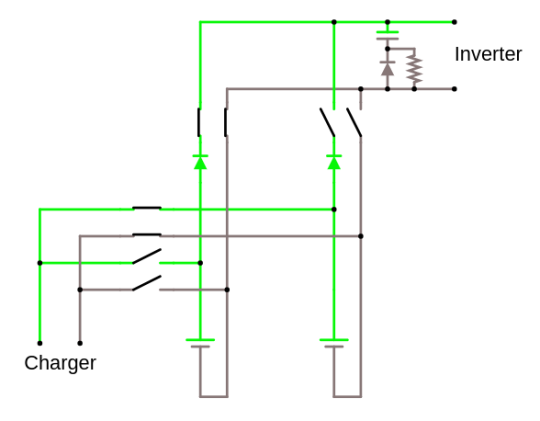
You don’t have to float your batteries if you just add additional battery banks to a double-conversion system:
Then you can cycle batteries as often as they need without losing the UPS while doing so.
Looking at how much a large enough capacitor to work as a transient load carrier in the above sketch costs these days led me to find that you can now get a 16V, 1.9kA rated 500 F capacitor for just $522.63 each these days, less if you buy more than one.
Still not suitable for mass power storage, tho, since that is still only enough power between 16V and 12V to carry a particularly power-hungry PC for about 30 seconds.
> why aren’t UPSses more common? They tickle my prepper senses
Do we have any reports from areas with equivalent technology levels during a period they experienced unreliable power supply/rolling blackouts (a more reasonable “civilizational collapse” scenario than full SHTF, anyway)
I’m thinking maybe cosmopolitans in the Arab Spring instabilities, Cairo in particular.
I guess the question is, for what scenario particularly is this superior to a backyard generator? (High-rise living, for one). A jerry can of gasoline is a pretty competitive rechargeable energy store.