JACOBIN MAGAZINE American leftists are stuck in a conundrum. On the one hand, our two major parties are dominated by corporate...
JACOBIN MAGAZINE
American leftists are stuck in a conundrum. On the one hand, our two major parties are dominated by corporate interests — including the Democrats, who are currently tasked with (and failing to) meet the challenge of opposing the openly reactionary and wealth-worshipping Republicans.
On the other, our country’s laws governing third parties are the most restrictive of any established democracy, making ballot-line challenges to the two major, corporate-dominated parties arduous, if not impossible. We seem doomed to either quixotic, ineffectual third-party challenges, or getting sucked into the conservatizing force field of the Democratic Party.
In a 2016 article, Jacobin executive editor Seth Ackerman proposed another way. He argued for creating an independent organization that functions in key ways like parties in other countries around the world, with an official membership, a binding platform, and clear mechanisms to ensure fealty to that platform from candidates and officeholders running under the organization’s banner — all things the Democratic Party currently lacks.
The issue of whether to run on the Democratic ballot line or something else, he argued, should be secondary: left candidates should run as independents when it makes sense to and Democrats when it doesn’t. But our principal concern should be creating that party-like organization — not what’s listed on a ballot line.
In the wake of successful challenges to the Democratic Party leadership by insurgent candidates like Sen. Bernie Sanders and Alexandria Ocasio-Cortez, and the explosion in membership of the Democratic Socialists of America (DSA), Daniel Denvir of Jacobin’s The Dig podcast spoke with Ackerman about the ideas in that article and the path forward. You can subscribe to Jacobin Radio here.
Daniel Denvir:
Your article “Blueprint for a New Party” argues that the institutional nature of American electoral politics is such that we have to think beyond this debate that we’ve had forever on the Left about whether we need a third party or should work to transform the Democratic Party.
The way we do that, you argue, is by building a militantly democratic and independent party-type organization, while opportunistically hijacking the Democratic Party ballot line when we need to. Explain what the problem is with the American electoral system and what your solution is.
Seth Ackerman:
The American electoral system is off the charts in its uniqueness, structure, and institutional setup — to the point that almost all of the basic concepts and terms used in democratic politics throughout the world tend to have a different meaning in the American context.
The most fundamental element here is the question of what it means to have a political party. What is a political party? People on the Left talk all the time about the Democratic Party: Is it good? Is it bad? Can you change it? Who’s in control? Often people talk about the Democratic Party as if it were a party in the normal sense that’s used in other countries. But it really isn’t.
In most places in the world, a political party is a private, voluntary organization that has a membership, and, in theory at least, the members are the sovereign body of the party who can decide what the party’s program is, what its ideology is, what its platform is, and who its leaders and candidates are. They can do all of that on the grounds of basic freedom of association, in the same way that the members of the NAACP or the American Legion have the right to do what they want with their organization.
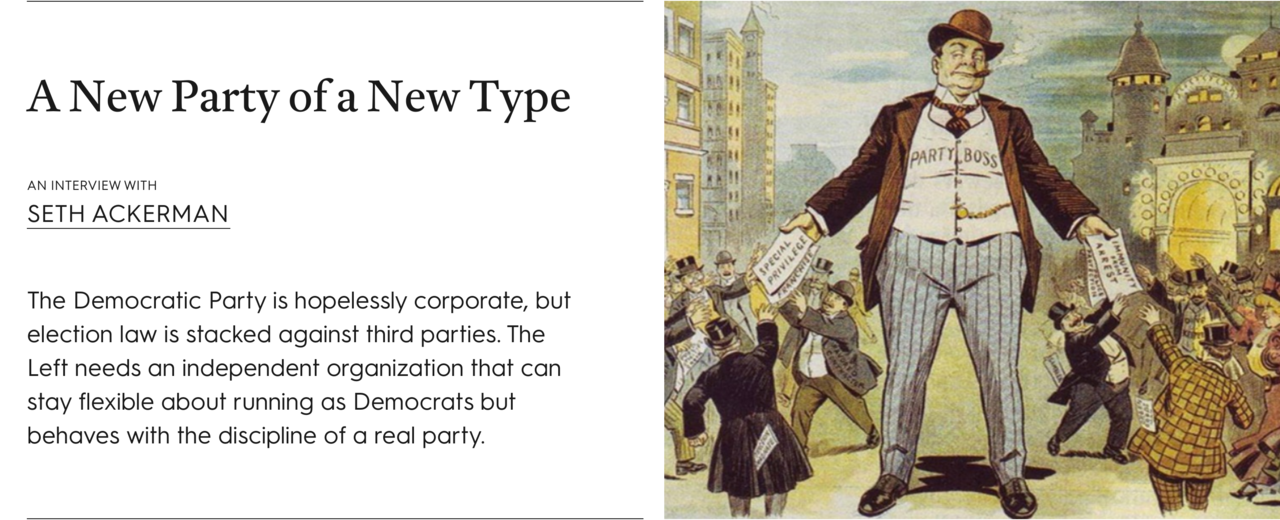
In the United States, that’s not the case at all with the Democratic Party or the Republican Party. We’ve had an unusual development of our political system where, in the late nineteenth and early twentieth centuries, the bosses of the two major parties undertook a wave of reforms to the electoral system that essentially turned the political parties into arms of the government, in a way that would be quite shocking — you could even say “norm-eroding” — in other countries.
If you took a comparative politics class in college during the Cold War, it would have discussed the nature of the Communist system, which was distinguished from a democratic system by the merger of the Party and the state, becoming a party-state. Well, the United States is also a party-state, except instead of being a single-party state, it’s a two-party state. That is just as much of a departure from the norm in the world as a one-party state.
In the United States, the law basically requires the Democrats and the Republicans to set up their internal structures the way that the government instructs them to. The government lays out the requirements of how they select their leaders and runs their internal nominee elections, and a host of other considerations. All this stuff is organized by state governments according to their own rules. And of course when we say state governments, who we’re talking about the Democrats and the Republicans.
So it’s a kind of a cartel arrangement in which the two parties have set up a situation that is intended to prevent the emergence of the kind of institution that in the rest of the world is considered a political party: a membership-run organization that has a presence outside of the political system, outside of the government, and can force its way into the government on the basis of some program that those citizens and members assemble around.
Daniel Denvir:
Even though your analysis parts ways with the orthodox third-party approach, that approach is entirely right about the fact that this is a two-party cartel system designed to exclude them.
Seth Ackerman:
That’s absolutely true. And you can see that in the way that the two parties have set up the rules regarding how other parties get on the ballot. The United States is the only democratic country in the world where two governing parties automatically get on the ballot, and every other party has to petition to get on the ballot with an enormous series of obstacles, such as signature requirements. And then the two parties send their lawyer goons to strike those petitions off and keep the other parties off the ballot.
We’re used to this kind of stuff in the United States; it’s considered the cost of doing business if you’re operating on the margins of the mainstream political system. But in other countries, again, that sort of thing doesn’t exist.
So the attitude of supporters of the purist third-party approach is absolutely correct. But then it’s a question of what do you do about it, and that’s where I part ways with a classic third-party approach.
Daniel Denvir:
You call for the “electoral equivalent of guerrilla insurgency.”
Seth Ackerman:
I want to see the Left organize to the point that it can strategically and consciously exploit the gaps in the coherence of the system in order to create the equivalent of a political party in in the key respects: a membership-run organization with its own name, its own logo, its own identity and therefore its own platform, and its own ideology.
The membership and leaders and candidates of that party would go out and present their message to the electorate. Just as the Democrats distinguish themselves from the Republicans, this organization would distinguish its political vision from the existing visions of the mainstream parties.
The question is how you fit that within the institutional setup that we have now regarding how the government regulates parties. We’re seeing initial steps being taken by people who, I think, have this ultimate vision in mind. Until we get to the point where we actually have the strength at the national level to frontally challenge the mainstream Democrats and Republicans with that kind of cohesive organization, how do we get to that point? It’s a chicken-and-egg problem.
If you don’t have candidates who are visibly contesting for power under a different political stripe, then it’s hard to convince rank-and-file voters and ordinary people that you you have a distinct vision and they should care about it. So, that’s where the Catch-22 comes in.
I think what we’re seeing now with Ocasio-Cortez and so many other candidates at the state and local level, are attempts, especially by members of Democratic Socialists of America, to take the first steps of having candidates operating under an alternative banner — somewhat tangentially, but still pretty palpably.
Every article about Ocasio-Cortez mentioned that she’s a member of the Democratic Socialists of America, that she’s a democratic socialist. That is a major step towards the goal of having an alternative political vision beamed into the consciousness of a larger electorate in a way that is very difficult to do when you don’t have candidates with a chance of winning running under that kind of banner.
What we haven’t seen yet is a membership organization with an organic relationship with these candidates, and a consistent ideological and programmatic coherence.
Daniel Denvir:
Something that would look more like an actual political party, like the Labour Party in the UK?
Seth Ackerman:
Exactly. The Labour Party is an actual membership organization. You can go to your local Constituency Labour Party and become a member, you have your party card, you have the right to vote on agenda items. Because of the nature of that party, the left wing of the party was able to project their candidate, Jeremy Corbyn, to the head of the party in 2015. And then he was able to impose and cultivate a new ideological and programmatic identity for the party. That’s because there are levers of power within that party that allow Corbyn and those who have won those fights within Labour to actually impose discipline.
We don’t have that yet. The Democratic Party itself doesn’t have that yet because it’s an institution that prevents any kind of a democratic membership from imposing discipline. And of course they’ve set up the whole institution to make it so that nobody else can either.
That’s the problem we need to overcome. So far, with DSA, we don’t have the wherewithal quite yet. But we are taking the initial steps of creating a distinct political identity and having candidates who can project that political identity to a larger audience.
(Continue Reading)
Okay, they can pursue whatever future vision they want (though I am skeptical of exporting the lessons from a Dem primary win in the Bronx to a nationwide political program), but their knowledge of the past is bizarrely ahistorical.
Seth frames it as if the rules for how the Democratic and Republican parties pick their candidates were implementing by corrupt party bosses, with the legislation of the government only being their tool for enforcing these rules.
When of course it was exactly the other way around: when the two parties were more like membership organizations, they were dominated by patronage networks. It was the ideological activists of the day, the counterparts of Seth here, who fought tooth and nail to make the parties accountable to a broader voting public - sometimes doing it within the party, but other times forcing through government initiatives on the matter.
This was one of the major aims of the progressive reform movement, and took place over decades, peaking with the presidential primary system that in 1972 gave the nomination to McGovern, a supposed extremist who didn’t have the support of insiders. And now like, they just want to undo all that.
History schmistory, does it really matter how wrong Seth got his fairy tale? Well the problem is he’s making the same mistake as past election reformers did - he’s pointing at this structural feature, and pretending as hard as he can that this is the reason America the country is so conservative, and the hard right is enjoying a rise in power. Even if he succeeds, well, we’ll just get another few decades of bad governance, before another left wing program decides the party structure needs to be messed with again.
Like, the comparison to the UK Labour Party glides over how that party was explicitly rigged to serve as a vehicle for trades unions
(And then that kind of decayed under Blairite New Labor, but then because it decayed leaving only paid membership, a radical subscription surge was able to keep Corbyn in power against the pressure of go-along-get-along pragmatists)
A thing is the 2016 primary shows how the Democrats are still indebted to their history as urban and labor machines - the fact that they have “superdelegates” to promote institutional continuity, yes (the defining attribute of the election was the GOP inability to maintain institutional continuity)
But also the way that Hillary Clinton was the apex product of a 40+ year project – as “Clean for Gene”, as “Atari Democrats”, as neoliberals, as the DLC, as “the Clinton machine” of Arkansas then DC/NYC/Davos , to mate the old Democratic transactional “interest group alliance” structure to post-‘68 politics
With the same result as the ‘70s candidates - she was an unstoppable juggernaut cause she’d captured the bold name leaders and institutional apparatus of internally disciplined Dem-aligned movements but in a top-down way such that the rank & file didn’t particularly want her