In April 1976 the Yankees came home to the South Bronx. It was, more or less, the same place that the team had left two years earlier, but it bore no resemblance to the South Bronx in which Martin had played twenty-three years before that. Back then the neighborhood’s main thoroughfare, the Grand Concourse, had been known as New York’s Champs-Elysees (with Yankee Stadium as its Arc de Triomphe). Now metaphorists referenced Dresden, not Paris, when describing the area. The old Concourse Plaza Hotel, a stately building of red brick, had been shuttered after a brief and ignominious run as a welfare hotel. The South Bronx itself was losing ten square blocks, or five thousand housing units, a year to arson fires. Rows of private houses, apartment buildings, and small businesses had been gutted, leaving only blackened hulks in their wake. In the area surrounding the stadium, more than twelve hundred buildings had been abandoned. Empty lots were covered with shoulder-high weeds. Ten blocks from the ballpark, an unfinished five-million-dollar low-rise housing development, abandoned for lack of funds in 1972, was a thriving heroin den. When Charlayne Hunter-Gault, the first Harlem bureau chief of The New York Times, visited the Samuel Gompers Vocational-Technical High School in the South Bronx, she was confronted by charred classrooms and broken blackboards. Students passed around a bottle of wine during class. “It’s very difficult to generate enthusiasm,” one teacher told her, “when you feel everything is terminal.”
Deborah Wallace and Rodrick Wallace, A Plague on Both Your Houses:
Testifying in 1976 before the New York State Senate Subcommittee on Police and
Fire Protection in New York City, newly retired Deputy Chief George Freidel
called the fires “a metastasing cancer on the City.” In 1970, Neil Hardy, the Assistant
Commissioner of Housing, had viewed housing abandonment as a spreading epidemic: “If it isn’t stopped, now sound neighborhoods will become ghost towns.” In the 1970s, the language of the civil servants charged with housing preservation
borrowed words and phrases from disease medicine and epidemiology. By 1980,
op-ed writers also cast their fears in disease and epidemiologic metaphors,
although germ and cancer cells were not the triggering mechanism. To these writers and civil servants, fires and abandonments had become contagious, facilitating
each other as HIV-infection facilitates tuberculosis.
Fires have always been contagious, but, before 1968, an“immunization program” kept epidemics at bay. Fires became virulently epidemic in 1968. Before
then, a large fire ushered in a period of lower-than-average fire incidence in that
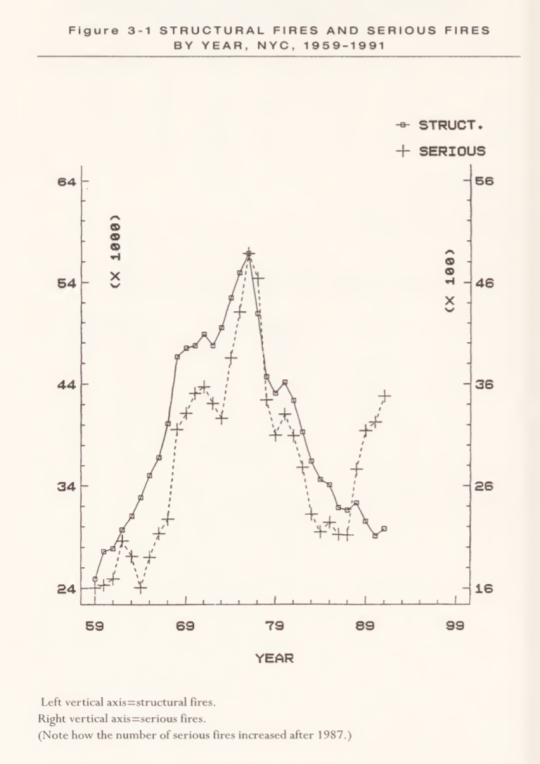
area because fire-prevention activities by municipal agencies focused there. Still, citywide, the number of structural fires per year grew consistently (figure3-1).
After 1968, fire damage failed to trigger targeted agency action. The damage instead marked the area as neglected and negligible, and fire disease infected the
area, eroding the housing stock.
The fire epidemic crested in the 1975—77 period and ebbed because the density of
susceptible housing in the path of the fire wave had fallen below critical threshold.
What could burn did burn, leaving behind vast stretches of charred hulks and abandoned shells. The estimates of housing loss in the 1970s range greatly, depending on
who makes the estimate and the assumptions on which it is based. The Bureau of the
Census developed a data base on housing units in 1970 and in 1980 and mapped the
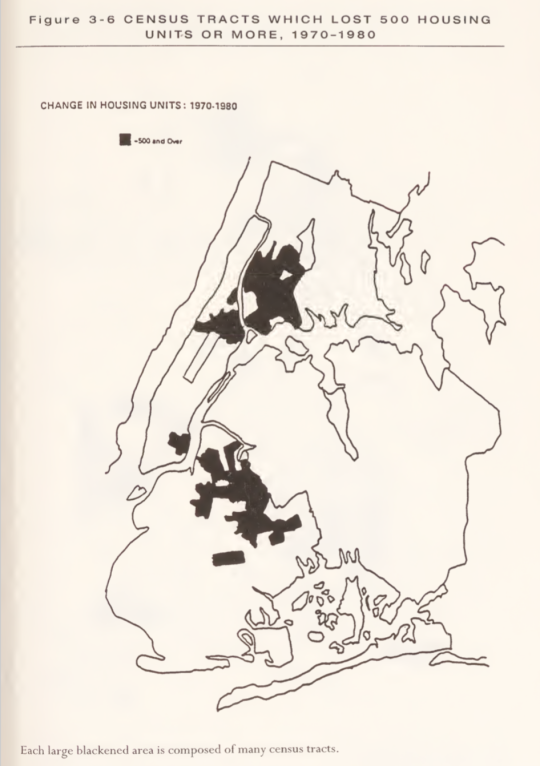
loss between the two decadal censuses. In figure 3-6, the blackened areas are those
census tracts losing at least 500 housing units during the 1970s. Each contiguous
black area contains many census tracts. According to this map, hundreds of thousands of housing units were lost in these areas of concentrated housing loss, housing
stock which had been stable and had served New Yorkers since before 1915.
Joe Flood, The Fires:
The urban planner Robert Moses, now retired to his Long Island beach house, but still an influential writer for The New York Times and a bevy of magazines, wanted to blacktop the whole South Bronx—with the buildings burned down and the land abandoned, most of the heavy lifting was already done. City planning commission studies from the late 1960s had recommended the same thing, taking advantage of the burnout to acquire abandoned lots on the cheap and redevelop them. Roger Starr, the head of the city’s housing department in the mid-1970s, had actually proposed a policy of “planned shrinkage,” closing hospitals and fire, police, and subway stations in places like the South Bronx and pushing out whoever was left living there. A few years later, a friend of Vizzini’s from the union recounted an interesting conversation he had with a high-ranking mayoral aide about the fires and how the city hadn’t done anything to stop them, had, in fact, encouraged the destruction with all the cuts. “Well, you can always look on the bright side,” the aide had said. “The city got rid of a million and a half undesirables.”
Kim Phillips-Fein, Fear City:
A few months earlier, in the spring of 1975, a woman named Lyn Smith wrote a letter to her senator, the liberal Republican Jacob Javits. Smith described the housing conditions in a South Bronx neighborhood near her home. The city, it seemed to her, had stopped making any effort to demolish burned-out buildings, despite their dangers. “When a house burns down they don’t destroy the frame, they leave it standing—you never know when it’s going to fall. A little boy I know or knew named Ralfy lives in the South Bronx he was playing in one of the broken down houses and he fell through the floor he’s dead now but if that building had been torn down he wouldn’t be dead.” Smith’s tone—flat, apathetic, resigned, quietly bearing witness but hardly even launching a protest—is perhaps the most haunting aspect of her missive. “I don’t know why I wrote this letter you’ll probably never read.”