I Wouldn’t Mind Dyin’: The Case for Blues as The First Goth Genre
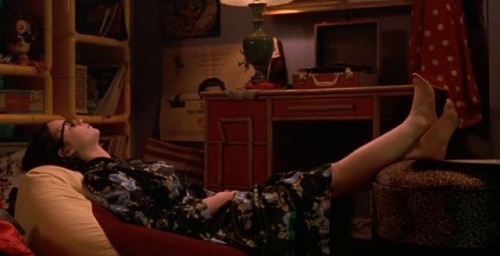
•Photo: Thora Birch in Ghost World, listening to Skip James’ “Devil Got My Woman” (2001)
After the positive response to my Screamin Jay article, I decided to explore the Goth tendencies of the Blues. This happened by accident and quite naturally, after I compiled a Spotify playlist of songs from the late 20s-30s for a party, and couldn’t stop listening to it.
•Wouldn’t mind dying / got to go by myself / Well, I wouldn’t mind dying if dying was all
Circa 1926
The Blues. It’s one of the first real genres of popular music, and the roots for all of today’s greatest musicians and singers. Nicki Minaj would not be, if Ma Rainey hadn’t warned us to “Trust No Man”. Beyoncé would not be, if Bessie Smith hadn’t begged for “a little sugar in (her) bowl”. Leadbelly was the original gangsta. with a murder and a couple attempted homicides on his record, he embodied just about everything the modern Hip Hop star stereotypes would have. The connections are there. But what about in our subgenres? Have EDM, Punk, or Goth music been influenced by the Blues bug? Well the case can be made for one of those.
It’s 1939, and Leadbelly is back in prison for a stabbing. with his long standing relationship with musicologists John and Alan Lomax, his legal expenses were covered, and Leadbelly found himself with a record deal. With no instrumentation, save for some hand clapping, Leadbelly recorded “Black Betty”. It was part of a medley of songs, all recorded together, including “Looky Looky Yonder” and “Yellow Woman’s Doorbells”. But 40+ years later, this medley would be covered by Post-Punk/Goth giants, Nick Cave and The Bad Seeds, with the lyrics to “Looky Looky Yonder” appearing in the single “Tupelo” (First Born is Dead, 1985), and their cover of the “Black Betty” medley (Kicking Against The Pricks, 1986).
Nick Cave already had a reputation by the mid-80s as this God-obsessed, murder-obsessed, drugged out genius. Reviews of his earlier band, The Birthday Party, are baffling to say the least, with one writer under the moniker “Mr. B”, declaring, “…the band creates a disturbing sexual voodoo music for urban society.” Even Cave himself weighed in on The Birthday Party’s press legacy.
•“…(H)e was shocked at how Australians were depicted in the press. ‘I remember a review of the Birthday Party which suggested, in a veiled slur, that we had obviously listened to a lot of Aboriginal music.’”
But this sort of “othering” of the influences from which bands like Cave’s drew from, dates back to the so-called “Blues Revival” of the 1960s. Jack Hamilton, who’s book Just Around Midnight: Rock and Roll and the Racial Imagination (Harvard University Press, 2016) touches the surface of this othering, explains, “With the Stones, that is a real disruption they represent. Not just that headline” (“Would you let your sister [or daughter] date a Rolling Stone?”), “but throughout the early-to-mid-’60s, the amount of weird racial whistles being used in description of the Stones in both the mainstream British press and the mainstream American press is pretty stunning. They really are being othered in this way that conflates their physical appearance with social danger. Their proximity to black music is really harped on by the fear-mongering pieces about the Stones.”
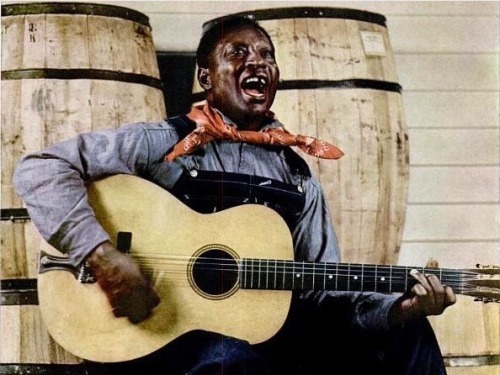
•Photo: Lead Belly for LIFE Magazine (1937)
And that’s just in mainstream Rock alone. But the early post-Punk and Goth bands–some of who may have been influenced by the Stones, The Doors, or The Kinks–get away unscathed from the connection of them to the more “primitive” Blues. It’s that same othering, and creating distance, but take much further. Goth has made great strides in reminding us of its supposed whiteness, and aims to keep its proximity to it very close. Goth is thought of as Victorian, it’s also Bauhaus; it’s art school music. But can it be Blues? Like the Stones before them, The Cramps wore their influences on their sleeves, but took it further into a kind of parody. “I Was Teenage Werewolf” is like a page ripped right out of the “How to do White Blues” book. The chapter? Link Wray. And when a young Nick Cave saw The Cramps live for the first time in 1980, he tore off a sample of that chapter for himself.
Goth and Blues share a common, dismal energy. But while The Blues was created by African Americans, many the children or grandchildren of slavery time, and some of whom faced extreme hardship during The Depression, coupled with lynchings and segregation, those who grew up post-Vietnam in the U.K. and Europe as Gen-Xers, were generally more privileged. Why so moody? Well for one, mental illness sees no privilege. The great strength of Joy Division was Ian Curtis’s honest written portrayals of depression and anxiety, while dealing with epilepsy. They are some of the same sentiments driven home in A.C. & Mamie Forehand’s 1927 recording of “Wouldn’t Mind Dying If Dying Was All”. Initially a religious song under the title “Bye and Bye I’m Goin’ to See the King”, this early cover version encapsulates the fear in dying, and not making it to heaven. PJ Harvey’s popular portrayal of a woman in the throes of postpartum committing filicide, is an echo of Victoria Spivey, whose haunting and almost grotesque “Blood Thirsty Blues”, about killings her no good man, is some of the most unique work of the 1920s.
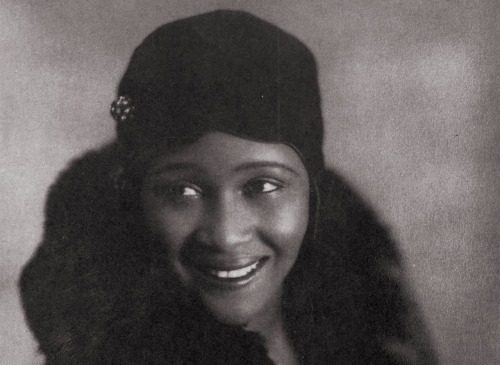
•Photo: Victoria Spivey, circa 1920s
But the Blues often tackled issues like domestic violence, racism, colorism, death, and despair. The ruthless murder-for-murder’s-sake vibe of a song like “Stagger Lee” hardly holds a candle to the unflinching visuals in the lyrics to “Strange Fruit”, or the solemn pleas in Josh White’s rendition of “House of The Rising Sun”. Black trauma has always been rooted in the music made by Black People, and Black trauma is what informs the aesthetic of Southern Gothic, from Blues to plantation ghost tours.
•I’m goth as fuck / Even when I’m not in black / Gothic is the pain you feel / and not the clothes that’s on your back
Princess Nokia, “Goth Kid” (2017)
In the era of Trump, and the newer, watering down and almost superficial take on “Goth” music today, it is important to look back on our country’s long trend of revisionist history, and take back the missing aspects of our culture. Most of history is in fact, Black.
I leave you with a list of selected songs to inspire, listed in order by year released.
1927 – Blind Mamie Forehand, “Wouldn’t Mind Dying If Dying Was All”
1927 - Victoria Spivey, “Blood Thirsty Blues”
1928 - Blind Lemon Jefferson, “See That My Grave Is Kept Clean”
1931 - Skip James, “Devil Got My Woman”
1931 - Cab Calloway, “Minnie The Moocher”
1938 - Billie Holiday, “My Man”
•1939 - “Strange Fruit”
•1941 - “Gloomy Sunday”
1944 - Lead Belly, “Where Did You Sleep Last Night?”
1947 - Josh White, “House of The Rising Sun”
1956 - Screamin’ Jay Hawkins, “I Put A Spell On You”