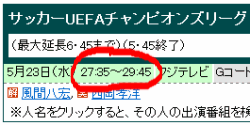
In Japan (and less commonly in China), there’s a concept of a 30-hour day.
Not in the sense that two days would be 60 hours, but more that the days overlap between midnight and 6 AM. So, for instance, it something happened 2 AM on Sunday, you could say “2 o’clock on Sunday”, but you could also say “26 o’clock on Saturday”.
Which MAKES SO MUCH SENSE. When you talk about things happening “last night”, it doesn’t suddenly stop being “last night” the instant the clock strikes midnight because I’m not Cinderella.
In conclusion, I wish America had this so I could throw it in the face of every smug friend who says “DON’T YOU MEAN LATER TODAY????” when I tell them “see you tomorrow” at two minutes past midnight.
Anime aired from around 11 p.m. until the wee hours of the morning, occasionally indicated by the odd-looking “22:00-27:00” notation. […]
The trope name refers to the odd way of noting when the shows start airing; it’s common to see a show aired at 1:00 am listed at “25:00”. This is largely done to align the schedule with that of the previous day; many Japanese TV networks still sign off in the middle of the night, and those who don’t will only switch to “the next day”’s programming at 4 am or so.
Times past midnight can also be counted past the 24 hour mark, usually when the associated activity spans across midnight. For example, bars or clubs may advertise as being open until “26時” (i.e. 2 am). This is partly to avoid any ambiguity (2 am versus 2 pm), partly because the closing time is considered part of the previous business day, and perhaps also due to cultural perceptions that the hours of darkness are counted as part of the previous day, rather than dividing the night between one day and the next. Television stations will also frequently use this notation in their late-night scheduling. This form is rarely used in conversation.
cultural perceptions that the hours of darkness are counted as part of the previous day
idk about you, but I have the same cultural perceptions. Let’s get this popularized in the US!