Cable television was perfect and we ruined it
Cable television was perfect and we ruined it
This frames itself as “there’s so much good stuff I should waaatch! I miss vegging out on crap because it was what’s on!”
And that’s not wrong per se, but I’m thinking beyond that to the effect on the whole-culture that we shared this pre-internet experience in common, of taking in media that was not very optimized for us because it was around, and consequently having a lot of cultural background we were very lightly invested in, in common with the rest of the country, and that enabled us to build increasing elaborations on the culture while maintaining coherence
Like, there might have been a lot of webcomics, but honestly, there were a lot of newspaper comics. Like, on any given day I might read 18 of them cause they were just there. And we’d have that in common, like, not just the good stuff like Calvin and Hobbes and The Far Side, we’d all recognize the Family Circle dotted-line meandering travel paths. And so someone could reference that and we’d all be like “ahh”. Or Dennis the Menace’s slingshot. That Liz Lemon “chocolate, chocolate, chocolate! ACK” cutaway works because everyone, including people who didn’t or still don’t care about the experience of unmarried single women approaching middle age, would have read enough Cathy to instantly place the reference and further, to process the twist, that yeah, it was awfully mannered and ritualized for a “relatable” comic. Garfield without Garfield works because we’ve all seen it with Garfield.
Part of your contemporary social/identity/representation/ownership fights is just rehashing the 80s “Canon Wars”. What is authentic American culture, these works long held up for praise but dismissible as product of an old order and old demographics? These new works by and about the non-dominant that don’t even try and engage with the first tradition?
And that never resolved so much in either direction as all High Culture was deprecated in favor of a new American Canon of Pop Culture. One that could skip normative questions of merit entirely by being a descriptive canon of what the masscult Broadcast Era left us.
Like, The Brady Bunch wasn’t in the canon because it was smart, or well-acted, or well-shot, or had something interesting to say about society in the period where blended families and domestic servants were each at the edges of “normal”. (If it was that, lesser Norman Lear like Maude would be). No, the Brady Bunch was in the canon because it was ubiquitous. Everyone had seen it at some point, if you were Generation X there was a good chance you had seen any given episode at some point.
And this still represented a diversification. This new canon had a lot more “white ethnic” and particularly Jewish pillars, and blacks certainly had more pride of place in 20th century “pop” than “high” culture.
(This leaves Jazz and Blues in the interesting position of having been significantly intellectualized to “fit” the old High Culture paradigm before the new one came in, leaving them somewhat overlooked)
And with this stuff established as the New Authentic America you could appeal to it. With Rock as the National Genre, not just kids’ stuff, you could say that thru Blues and Motown the culture owed black artists more respect. (Where no one really thinks of contemporary American pop as Swedish-indebted).
Feminist and queer scholars pored over Hollywood camp, subtext, old “Pre-Code” work aiming to prove that gender variance and homosexual desire had always been an authentic part of American culture.
(I def. remember on multiple occasions apropos of I forget what the tale of “Fatty” Arbuckle trotted out as a moral condemnation and warning of the unscrupulous young women and tabloid press that for money and attention would peddle baseless rape accusations to a public of vulgar moralists, which today hm)
And past those knock-on effects on social health, the cultural output itself was great. I think that’s the defining factor of Long 90s culture, not only that it built off a shared canon but its creators and audiences recognized it as working from a shared background with traits and forms that could be played with, the meta-awareness of it all.
Xena: Warrior Princess, a syndicated swords-and-sandals actioneer spin-off attracting an ecology of academic conferences and journals by mashing up all of ancient mythology, Mediterranean history, and knowing Hollywood encoded/subtextual queerness.
Kevin Williamson deconstructing and rebuiding the slasher genre with the Scream series. And then, honestly, doing the same with the teen relationship drama with Dawson’s Creek, where the principals were always talking through what their character developments meant, seeing them through a cinematic lens in heavily referential dialogue
Joss Whedon and Rob Thomas (of Veronica Mars) wielding their audience’s genre-savviness against them, setting up scenarios that would “have” to end some predictable way that resolved everything by the conventions of five-act episodic TV with recurring stars and plotlines, and then just not.
In comics hitting earlier in the 80s, Crisis on Infinite Earths as a recognition at the core of the capes-and-powers mainstream that these disposable entertainments had congealed into mythology, proceeding by in-metaverse acknowledgement of extranarrative structure.
In more far-out stuff Morrison, Moore, Gaiman, and Miller going meta as hell, all “what if comics were myths, what if comics were real, what if reality was comics, what if reality was myth.” DKR as “if Batman was real, he’d be pretty fucked up”. Watchmen as “if Golden/Silver/Bronze ages were real, superheroes would be just as fucked up and unmoored by the 80s as we all are”. Sandman was “what if every human story and mythology was part of the same meta shared universe”
Even Star Trek:TNG was an attempt to realize the coherent universe that the fandom had mostly projected onto an original series that were really a stock cast and setting adaptable to filming any SF short story of the week. (Lurking in the background is the 70s-80s realization from Star Wars that coherent universes increase audience stickiness, and are a well you can go back to)
Then Ron Moore took his project of trying to give Star Trek coherence and weight to an even less respectable space opera reboot, and made the fact of an IP-driven rehash (“all of this has happened before, and all of this will happen again”) a load-bearing religious theme of eternal recurrence.
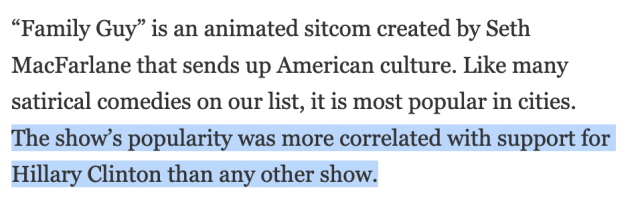
Family Guy, the conceit of half the jokes was they invoked 70s-80s pop culture just the right amount of obscure so you constantly surprised yourself that you even knew enough to get them.
SeaLab 2021 repurposing a piece of establishment futurism to underscore how absurd the concept seemed by then was despite how nostalgic the aesthetic was, Venture Brothers pastiching postwar boys’ adventure fantasies to highlight their complete disconnect from any actual process of becoming a man.
I miss that, you know. That overlapped/kept going with the Early Internet, so I thought it would continue through and we’d just keep building on it.
I guess that’s what really sticks in the craw re: “cancel culture”, millennial insouciance, wevs. The blithe dismissal of a rich, elaborated, mutually supportive canon with nothing to replace it.
Also realizing you’re now the kind of person to levy that critique at The Youngs, I guess that sticks too.
I dunno, maybe that was because the Early Internet was full of people who got acculturated pre-Internet and carried that with.
Maybe it’s cause I’m not getting particularly acculturated anymore - I accept Pokémon and Spongebob memes and reaction images in their own right, maybe if I saw the underlying properties - or whatever comes after - I’d appreciate them more.
Maybe that shared culture was an artifact of suburban retrenchment and then the Early Internet narrowing the cultural/economic/political American subject to a narrow white UMC and adjacent band and allowing a generation of us to mistake ourselves for America entire
Maybe it was product of a bottlenecking that was still negative on net. Like, basic cable had more channels than the plain 3 network broadcast era, but in 1950 they were competing with like, the bowling league, the pool hall, the Elks club, the Masons, the ladies’ charity, the socialist meeting, the dinner show club, the Mafia nightclub, the gay Mafia nightclub, any of the 4 bars between your work and home, the “whatever’s playing this week” double-feature movie theater…
(And even then, more diversity between examples. If you started going to shows in like “the Washington punk scene” in 1989, that was probably a lot of hardcore if you meant “comma, D.C.” and twee and proto-grunge if you meant “Olympia, comma”)
I dunno. Still, I miss it.
An aspect I think of a lot is how network tv used to follow the seasons. You get 22 to 26 episodes spread over the year, and for the most part, shows followed that in real time. Halloween episodes at Halloween, Christmas episodes at Christmas, my tv school friends are starting and ending their semesters the same time I do, etc. And this was regardless of show; no matter what you watched, everyone did a Christmas episode. TV was connected to our own flow of time, it made us feel more connected. I think that’s part of why the last ten years have simultaneously felt like a few months and a century, our cultural output is no longer tied to the passing of time - it’s all ten-episode season this and limited series that, posted any time of the year, you can go back and watch it any time that works for you, etc. Not that there aren’t benefits to this model, but it has strange effects. Community might he the last show I remember watching thay really stuck to this model.