Favourite vegetable?? Pls vote. trying to prove smth!!
1105 votes • Poll ends in 5 days 9 hours
🥕 carrotjesus Follow
OP clearly yuor followers are biased. Carrots are objectively better than broccoli of all things and i think it’s problematic that you called carrots stinky it’s really manipulative. also tomatos aren’t technically a vegetable. maybe try thinking before posting passive agressive polls next time
🤡 jizzardtower Follow
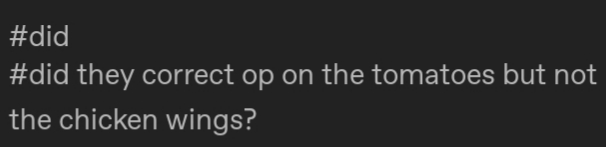
shgdfdsg these tags. yes. chicken wings my favourite vegetable
✴ cadylady2002 Follow
Haha. I just realized the #eggplant looks a little like a d***. That is so #funny !!
👁 shreksbellybutton Follow
🦷 pigeonsarecool Follow
CHICKEM WIMGS
🍵 souperdouper Follow
shoutout to soup. won’t stop making shoutouts for soup until one hears me and comes walkig over. i want soup.
i feel like a man lost in the desert having oasis hallucinations
this website’s fake posting game is fucking unparalleled
BTS is serving active duty in Cookie Run: Kingdom!
Join Frosted Oatmeal Raisin Cookie and send your favorite K-pop boys to die in battle for the Cookie Kingdom! 💜
brba/bcs characters react to you having a tapeworm💔
Read more
You know who else feels like a man lost in the desert having oasis hallucinations?
THAT’S RIGHT YOU’RE STILL IN THE FAKE POST. GET WILE E COYOTED IDIOT
This site is such a preschool simulator you’ll meet someone and be like ‘wow we played toys together for 5 minutes and now we’re making friendship bracelets’ and then you’ll meet someone else and be like ‘hm i’ve never hit someone with a plastic dump truck before. i think i might like to try it.’
why is it called shoegaze? is it because you have to keep looking at your ridiculously massive pedalboard to tippy tap on all your silly little guitar pedal switches?
guy next to him wearing wraparound shades talking into his Bluetooth: Yeah i’m peeing at a urinal right now. Yeah. The noise is the guy next to me. Yeah, he’s peeing too. Yeah. Peeing so hard he’s screaming
Lots of interesting commentary in there! Right now, I want to talk about this part:
“In the months after Pearl Harbor the driving aim of Japanese strategy was to capture a string of islands running the length of the western Pacific and fortify them against an American counterattack. This defensive perimeter would set the boundaries of their new empire – or, as they called it, the "Greater Asia Coprosperity Sphere.” Midway Island, the westernmost of the Hawaiian Islands, was one of the last links they needed to complete the chain. They sent an enormous fleet, the heart of the Japanese navy, to do the job: four enormous aircraft carriers, together with a whole galaxy of escort ships. On June 4 the attack force arrived at Midway, where they found a smaller American fleet waiting for them.
Or so the history-book version normally runs. But the sailors on board the Japanese fleet saw things differently. They didn’t meet any American ships on June 4. That day, as on all the other days of their voyage, they saw nothing from horizon to horizon but the immensity of the Pacific. Somewhere beyond the horizon line, shortly after dawn, Japanese pilots from the carriers had discovered the presence of the American fleet, but for the Japanese sailors, the only indications of anything unusual that morning were two brief flyovers by American fighter squadrons. Both had made ineffectual attacks and flown off again. Coming on toward 10:30 AM, with no further sign of enemy activity anywhere near, the commanders ordered the crews on the aircraft carriers to prepare for the final assault on the island, which wasn’t yet visible on the horizon.
That was when a squadron of American dive-bombers came out of the clouds overhead. They’d got lost earlier that morning and were trying to make their way back to base. In the empty ocean below they spotted a fading wake – one of the Japanese escort ships had been diverted from the convoy to drop a depth charge on a suspected American submarine. The squadron followed it just to see where it might lead. A few minutes later they cleared a cloud deck and discovered themselves directly above the single largest “target of opportunity,” as the military saying goes, that any American bomber had ever been offered.
When we try to imagine what happened next we’re likely to get an image out of Star Wars – daring attack planes, as graceful as swallows, darting among the ponderously churning cannons of some behemoth of a Death Star. But the sci-fi trappings of Star Wars disguise an archaic and sluggish idea of battle. What happened instead was this: the American squadron commander gave the order to attack, the planes came hurtling down from around 12,000 feet and released their bombs, and then they pulled out of their dives and were gone. That was all. Most of the Japanese sailors didn’t even see them.
The aircraft carriers were in a frenzy just then. Dozens of planes were being refueled and rearmed on the hangar decks, and elevators were raising them to the flight decks, where other planes were already revving up for takeoff. The noise was deafening, and the warning sirens were inaudible. Only the sudden, shattering bass thunder of the big guns going off underneath the bedlam alerted the sailors that anything was wrong. That was when they looked up. By then the planes were already soaring out of sight, and the black blobs of the bombs were already descending from the brilliant sky in a languorous glide.
One bomb fell on the flight deck of the Akagi, the flagship of the fleet, and exploded amidships near the elevator. The concussion wave of the blast roared through the open shaft to the hangar deck below, where it detonated a stack of torpedoes. The explosion that followed was so powerful it ruptured the flight deck; a fireball flashed like a volcano through the blast crater and swallowed up the midsection of the ship. Sailors were killed instantly by the fierce heat, by hydrostatic shock from the concussion wave, by flying shards of steel; they were hurled overboard unconscious and drowned. The sailors in the engine room were killed by flames drawn through the ventilating system. Two hundred died in all. Then came more explosions rumbling up from below decks as the fuel reserves ignited. That was when the captain, still frozen in shock and disbelief, collected his wits sufficiently to recognize that the ship had to be abandoned.
Meanwhile another carrier, the Kaga, was hit by a bomb that exploded directly on the hangar deck. The deck was strewn with live artillery shells, and open fuel lines snaked everywhere. Within seconds, explosions were going off in cascading chain reactions, and uncontrollable fuel fires were breaking out all along the length of the ship. Eight hundred sailors died. On the flight deck a fuel truck exploded and began shooting wide fans of ignited fuel in all directions; the captain and the rest of the senior officers, watching in horror from the bridge, were caught in the spray, and they all burned to death.
Less than five minutes had passed since the American planes had first appeared overhead. The Akagi and the Kaga were breaking up. Billowing columns of smoke towered above the horizon line. These attracted another American bomber squadron, which immediately launched an attack on a third aircraft carrier, the Soryu. These bombs were less effective – they set off fuel fires all over the ship, but the desperate crew managed to get them under control. Still, the Soryu was so badly damaged it was helpless. Shortly afterward it was targeted by an American submarine (the same one the escort ship had earlier tried to drop a depth charge on). American subs in those days were a byword for military ineffectiveness; they were notorious for their faulty and unpredictable torpedoes. But the crew of this particular sub had a large stationary target to fire at point-blank. The Soryu was blasted apart by repeated direct hits. Seven hundred sailors died.
The last of the carriers, the Hiryu, managed to escape untouched, but later that afternoon it was located and attacked by another flight of American bombers. One bomb set off an explosion so strong it blew the elevator assembly into the bridge. More than 400 died, and the crippled ship had to be scuttled a few hours later to keep it from being captured.
Now there was nothing left of the Japanese attack force except a scattering of escort ships and the planes still in the air. The pilots were the final casualties of the battle; with the aircraft carriers gone, and with Midway still in American hands, they had nowhere to land. They were doomed to circle helplessly above the sinking debris, the floating bodies, and the burning oil slicks until their fuel ran out.
This was the Battle of Midway. As John Keegan writes, it was “the most stunning and decisive blow in the history of naval warfare.” Its consequences were instant, permanent and devastating. It gutted Japan’s navy and broke its strategy for the Pacific war. The Japanese would never complete their perimeter around their new empire; instead they were thrown back on the defensive, against an increasingly large and better-organized American force, which grew surgingly confident after its spectacular victory. After Midway, as the Japanese scrambled to rebuild their shattered fleet, the Americans went on the attack. In August 1942 they began landing a marine force on the small island of Guadalcanal (it’s in the Solomons, near New Guinea) and inexorably forced a breach in the perimeter in the southern Pacific. From there American forces began fanning out into the outer reaches of the empire, cutting supply lines and isolating the strongest garrisons. From Midway till the end of the war the Japanese didn’t win a single substantial engagement against the Americans. They had “lost the initiative,” as the bland military saying goes, and they never got it back.
But it seems somehow paltry and wrong to call what happened at Midway a “battle.” It had nothing to do with battles the way they were pictured in the popular imagination. There were no last-gasp gestures of transcendent heroism, no brilliant counterstrategies that saved the day. It was more like an industrial accident. It was a clash not between armies, but between TNT and ignited petroleum and drop-forged steel. The thousands who died there weren’t warriors but bystanders – the workers at the factory who happened to draw the shift when the boiler exploded.“
———–
”“Shigata na gai,” Mrs. Nakamura says about what happened to her city that day; Hersey glosses: “A Japanese expression as common as, and corresponding to, the Russian word nichevo: It can’t be helped. Oh well. Too bad.”
Hersey doesn’t say so directly, but he appears on the surface to agree. He presents the bombing neutrally, without commentary, as though it’s a new species of natural disaster, motiveless and agentless. As far as any reader of Hiroshima can tell, the bomb came out of nowhere, was dropped by nobody, and had no purpose.
…
Hersey was describing for the first time the war’s true legacy: a permanent condition of helpless anger and universal dread.“
"It’s also the culmination of a modern trend of increasingly destructive weapons reducing the individual soldier’s scope for personal agency (one might say, for heroism). The explosion of an atomic bomb doesn’t look like anything an ancient warrior would have recognized as a battle, it looks like a natural disaster, like a storm or an earthquake; its typical victim experiences it as something that cannot be fought or hurt or meaningfully defied, only endured.
For most of the time war has existed, war consisted mostly of personal combat (broadly defined). I suspect there’s a relatively common sort of person (often male) who finds personal combat kind of fun, in the way some some people find playing football and rugby fun. I suspect the historically common cultural romanticization of war partially reflects this; for much of history a non-trivial number of the combatants really did kind of enjoy it.
Being in a WWI trench charge or being on the receiving end of a nuclear strike isn’t anybody’s idea of fun… Broadly speaking, it has the horrible parts of combat, but not the parts that I suspect some people find kind of fun; the opportunity to exercise personal agency in a heroic way, the opportunity to feel strong and powerful, the opportunity to feel like you’re playing a heroic role in some grand and important narrative, etc.. The experience of having an artillery barrage or a nuke dropped on you is closer to the experience of the Midianite women in Numbers 31; you feel impotent and afraid and you suffer and if you die it’ll probably be in a squalid and humiliating and painful way and you probably won’t even get to hurt the people who are doing this to you.
…
WWI trench warfare and fire-bombing with napalm and nuclear MAD are hard to romanticize. And I suspect that’s part of the reason we romanticize war a lot less than we used to.”
Tempted to call this the feminization of war (see the point where I reference the Numbers 31 for why).
I think there’s something to what you say, but worth remembering that there wasn’t ever an era when most combatants died in personal combat. My understanding is the biggest killer pretty much went straight from disease to artillery. Cholera probably qualifies as squalid, humiliating, and painful.
I think romanticizing war has always required distance from the worst parts of it, though sometimes just being on the winning side provides enough distance (certainly, the US doesn’t seem to have a problem with romanticizing World War II).
Here in Britain we have a chain of supermarkets known as Tesco. However some people refer to these stores as Tescos, indicating a plural, or as Tesco's which denotes ownership of the stores by "Tesco", whoever that is. I would like your opinion on which is correct.
I tend to say “Tesco” as that is the word I’m more used to, and it’s the one that will fit into whatever context I’m using it in.
Fantastic to hear that you have the correct answer. Although if it was possessive Tesco’s I would be fascinated to know who Tesco is.
If it’s possessive Tesco’s, they own some amount of Tesco’s, and they own it through some entity called Tesco. That’s the case with many companies in that situation – Google owns Alphabet, Amazon owns LogisticsLogic, so forth. But Google and Amazon don’t just have “Google” and “Amazon,” they have “Google inc” and “Amazon inc.” The corporate structure is part of the legal identity, like your name, although people would usually also use another name for day-to-day use (if you want to refer to your company, say, on legal forms or whatever, you’ll use inc or something like it).
The situation with Google and Amazon, while somewhat more complex than the scenario described by the OP, is not actually that convoluted. In the simplest case, say you want to create a website where you can order a product, then you’ll make a new company, Inc.., and buy the domain name “www.amazon.com” so that it will “belong” to Inc..’s brand (and of course, that’s what you’ll link people to – I mean, you aren’t going to link people to Inc..’s site, because that’d be bad). Inc..’s corporate parent is Amazon, Inc. At this point, you aren’t actually “Amazon,” you’re just “Inc..” – but you’re Amazon, Inc., in the sense of “the group of entities legally distinct from one another and also legally distinct from your previous incarnation,” whereas the group of people who do “the thing” for you (as Amazon) are the “Inc..” corporation.
It’s kind of like your name – no one has to use your name unless they want to refer to you, and when they do so they have to say “James Inc.”., not just “James.” But they’d be stupid to do that for legal or organizational reasons; saying “James” on paperwork would be confusing or misleading or something.
And as for the “who is Tesco”? Here’s a story. There was once a company called “Jameson’s Limited,” owned by the Jameson family. And one day the company changed its name to “Jameson Limited & Partners,” because the business had grown and now they had more than one partner (there were several Jamesons in the ownership group).
Later, some other companies wanted to buy Jameson Ltd. & Partners, so they created another company with the same name. But people weren’t confused because they referred to this other company as “Jameson Ltd.” and to the other Jameson Ltd. (which wasn’t a partnership at all, now) as “Jameson & Partners.”
In some cases, companies will want to “brand” themselves in a particular way. The Coca-Cola company, for instance, will probably not want to have any other beverage company start advertising Coca-Cola. So the Coca-Cola company will create a subsidiary, Coca-Cola (UK) Ltd., which owns the “Coca-Cola” brand name and also owns the “Coca-Cola” trade name. The Coca-Cola company will then own the company Coca-Cola (UK) Ltd. (There can be more than one Coca-Cola company, I guess.)
The parent company in this case will be Coca-Cola Ltd., which is different from Coca-Cola Inc. (that one just owns “Coca-Cola” the brand) because the parent company will not own the company Coca-Cola (UK) Ltd., which would be confusing. (I think it’s a bit clearer than in the case of Google & Co. and Inc.. where you don’t actually own or have any right to any of the individual companies.)
(I haven’t used “inc.”., by the way. My habit is to refer to the parent company as that one and the subsidiary as “the one that owns this,” rather than referring to the subsidiary with anything other than the name of its parent company.)
That was more in depth than I was expecting. Here is a picture of Tesco (or Tescos or Tesco’s) to give you a flavour of what it is like to shop here.
In general, when I think of it in those terms, I would say “the one that’s not the one that owns that” (where that “that” refers to the store in the picture, which is one of the ones that’s owned by Tesco), but I would also say “the one that doesn’t own the one that owns this” (I’m guessing the store has many owners because it’s actually quite big), and I can’t help but wonder whether there are possible situations where there’s no such thing.
I guess technically speaking, all of the companies listed above are distinct companies as opposed to part of the same company, and thus the “ownership” of, e.g. Google is not in question here. But still I guess when people talk about the same person in different ways they are usually saying “we’re talking about the same entity rather than about the same person.” E.g. if Google and Microsoft were to split up tomorrow, and someone said “James is still Google’s CEO,” I would still think they meant “James is still the head of Google (and its other subsidiary companies)” rather than “James is the same as that other James” (but I imagine they would probably still say “I still do the thing”).
I’ve not encountered such a stereotype, but maybe it exists. I don’t think I’ve met any Armenians, so I can’t say if it’s true. Armenian followers: are you hotter than average?
In LA the stereotype was basically as West Coast Italians. Like, in the California version of Aqua Teen Hunger Force, Carl would be Armenian.
Had a moment last night when I was too hot under the covers and I realized it was cause I lost the silk sheets and was directly against the down comforter and when I retrieved them it was perfect again, it’s like there’s just enough ventilation in the weave to shed heat from the outer layer of my skin while staying warm, it’s really remarkable. Also means I don’t at all sweat in bed, which is nice cause silk is kind of a production to wash.
Okay, so from what I can tell, you invented the idea of Lucifer’s actual surname literally being Morningstar for ‘The Sandman’ and ‘Lucifer’, but now other non DC-affiliated projects have had their own Lucifer Morningstars — most of whom have daughters, much like how the FOX/Netflix Lucifer portrayed by Tom Ellis had Rory — the Lucifer Morningstar of ‘Chilling Adventures of Sabrina’, portrayed by Luke Cook and depicted as the father of Sabrina Morningstar, and the Lucifer Morningstar of the upcoming ‘Hazbin Hotel’, voice actor yet to be announced, but the father of the protagonist Charlie Morningstar. Plus Luci Morningstar in the old Andy Weir webcomic ‘Casey and Andy’. Also, was Michael’s surname in ‘Lucifer’ also meant to be Morningstar? As there is a ‘Ben 10’ villain named Michael Morningstar, sort of modelled after your Lucifer as well. What do you think of this extra addition of yours to depictions of the devil in pop culture?
I blinked, and then went and googled, and it looks like, yes, that one appears to be me. How odd. Nice, too, I think. (I just liked the one-two-three-four-five-six beats of the name.)
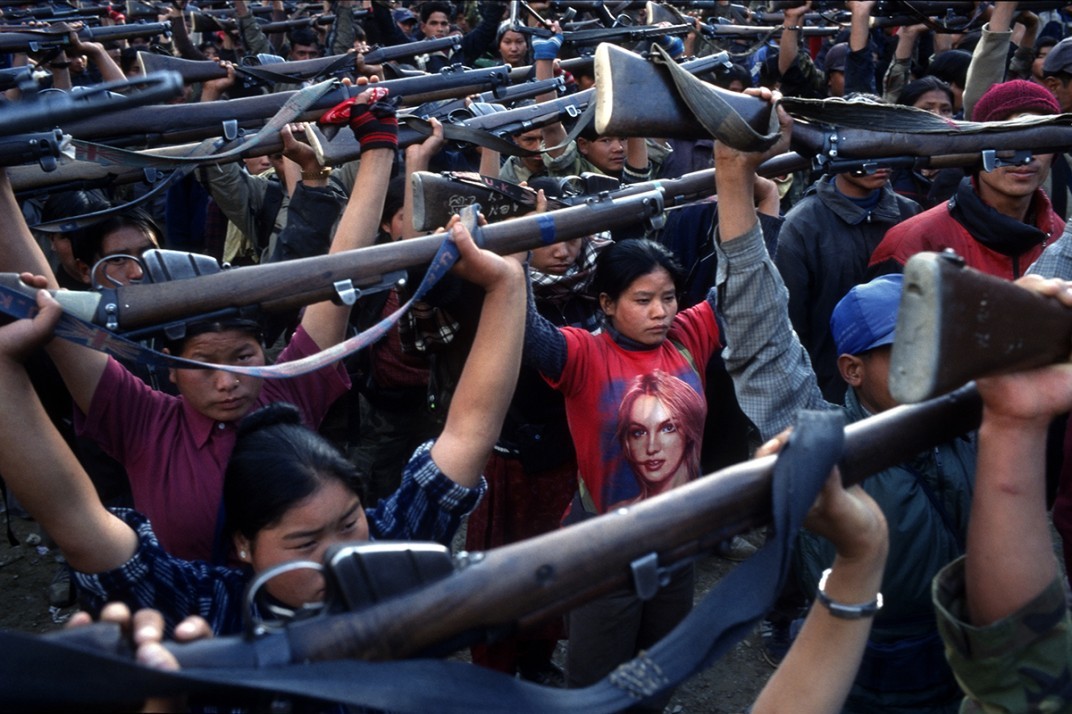
A Maoist rebel soldier wearing a Britney Spears t-shirt stands among a battalion of other soldiers of the People’s Liberation Army, First Brigade, Mid Division during a drill in a schoolyard in the village of Gairigaon. Tomas Van Houtryve.
Was kind of expecting a mania this month, and while I’m powerfully horny lately, I’m not getting the reduced need for sleep or other intensity I do when one’s on the horizon
Ah, okay, on both going to bed and waking my mind wasn’t racing yet but it was trotting. Should be within the week.
Like, in the 20th century the mainline Protestant churches tried to
deal with the romantic drift of “spouse as soulmate” from “spouse as
partner in household as institution” by introducing mandatory classes in
their colleges to teach the students how to fuck each other better.
Oh and you know what I just remembered? Marriage manuals.
Which I think even still existed in the 1980s as a degenerate genre of erotica, but early in the 20th century, that was a serious earnest concern of mainstream bourgeois WASP culture in say the 1920s-30s, that young people get on birth control and be good at sex.
There was a concern that marriage was under threat from Romantic ideals, and people were neglecting spouses in favor of lovers, and that this had to do with Christians being sexually repressed and unpracticed and being totally incompetent at getting each other off
(especially with America’s rural homestead culture leaving people so isolated without partners to practice on. Except relatives and barnyard animals, which is absolutely a thing in isolated rural cultures!)
Like in the immediate postwar when the whole “going steady” teenage culture came up, journals of upper-middlebrow tradition were seriously fretting that teenagers were getting too sexually exclusive too soon, and that this boded poorly for the formation of their mature character. And when you think of the divorce wave of the 60s-70s, well…?
(really, a lot of postwar teenage culture was about how the car changed rural life by giving kids the range and mobility to find each other to fuck)
Mind you this was going on while the churches were still in their great missionary boom. In fact, it was kind of related. Margaret Mead, Coming of Age in Samoa, 1928. A lot of period linguistics, anthropology, archaeology was handmaiden to Protestant missionary evangelism, and the churches invested heavily in them. (The rest was a handmaiden to European nationalisms.)
And half a century before Club Med, before the hippie ‘60s, the mainline Protestant churches sent the cream of their young elite off to spend a few years living with tropical islanders and other brown people and one of the bigger things they brought back was “Oh yeah, they’re a lot less uptight about sex, premarital, extramarital, teenage casual, it’s all good. We should try that.”
![[Description] a graph with two lines. The first line is blue, and the second is black. The first line is the line for female-dominated companies. [Text] Female- dominated Companies [newline] 0.10% [newline] 0.5% [newline] Female-dominated [newline] Companies [newline] 0.05% [newline] 2% [newline] 3% [newline] 5% [newline] 0 [newline] 1 [newline] 4 [newline] 7 [newline] 9 [newline] 10](/media/4ca9a354c896a44bcb38776502e4e7a4b4744c9e_b39810400dc3.png)