shrine to the prophet of americana
All posts (oldest first)
The whole General Store thing is because one of the biggest influences on D&D that’s not in Appendix N is the American Western....
The whole General Store thing is because one of the biggest influences on D&D that’s not in Appendix N is the American Western. The classic D&D village with the church, blacksmith, saloon/hotel, and general store? The elected mayor? Being convienently located to a large underground source of gold so they can make money selling picks, shovels, rope, weapons, pleasurable company, and alcohol to outsiders who come in search of gold? Local pastimes include listening to music in the saloon, drinking, whoring, and getting into bar-fights? The law’s enforced by a sheriff who has an actual jail to put offenders in? All you need to make a classic Wild West town is adding a train stop and a telegraph- which are, incidentally, the necessary technologies to make general stores make sense.this makes a surprising amount of sense (via brotherentropy)
the plural of anecdote is not “data”
the plural of anecdote is not “data”
the plural of anecdote is “lore”
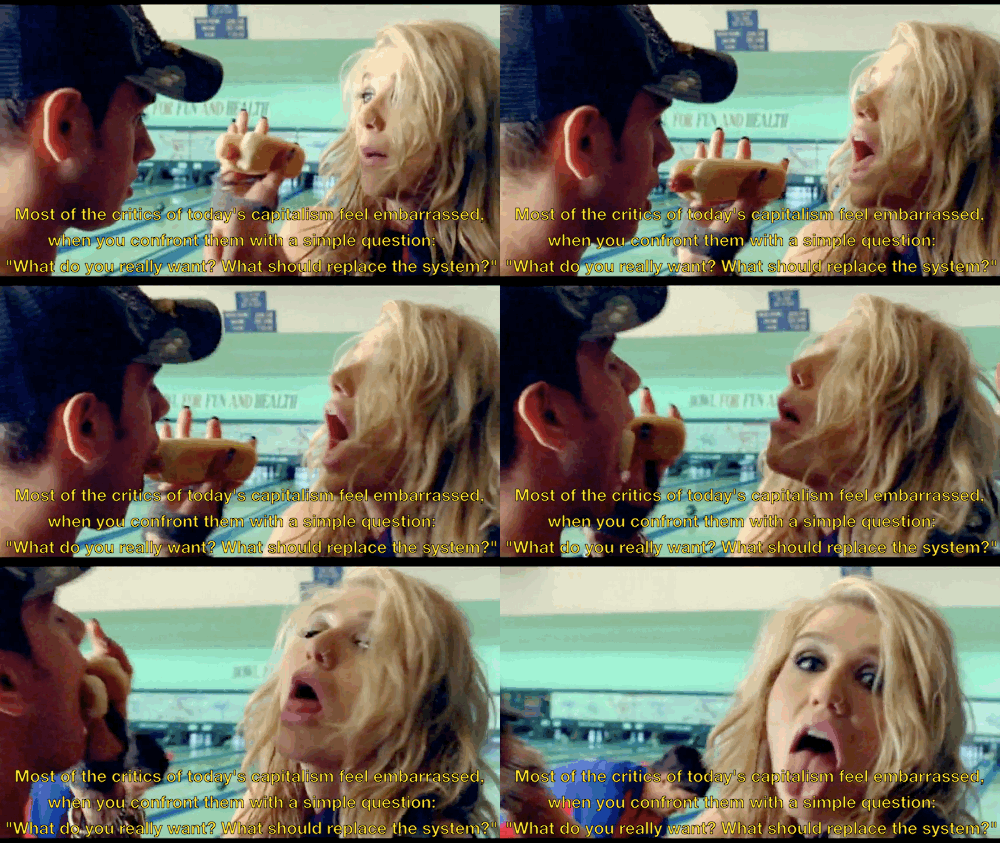
Most of the critics of today’s capitalism feel embarrassed, when you confront them with a simple question: “What do you really...
Most of the critics of today’s capitalism feel embarrassed, when you confront them with a simple question: “What do you really want? What should replace the system?”







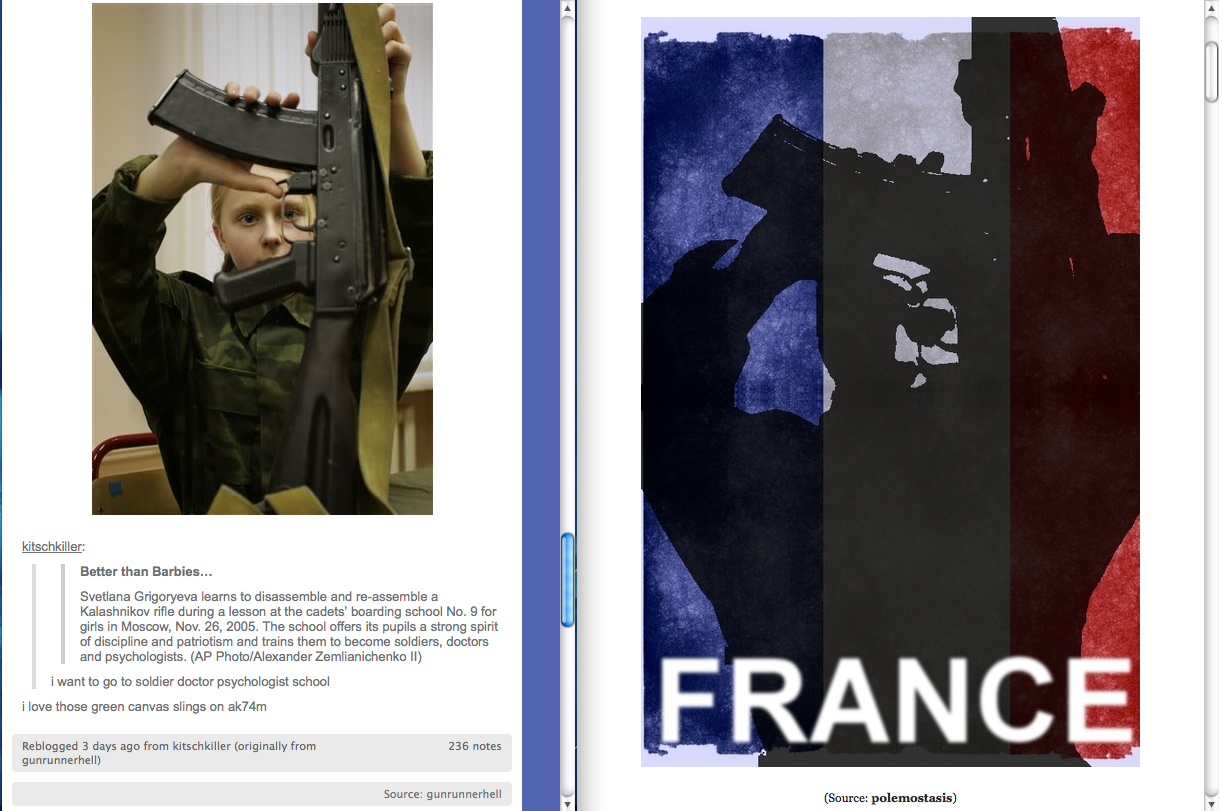
On the left, today in paraleninist tumblr. On the right, today in parafascist tumblr. Full modernity indeed.
On the left, today in paraleninist tumblr.
On the right, today in parafascist tumblr.
Full modernity indeed.


Remember 2004, and blogging? Remember political blogging? I remember Matthew Yglesias' blog, the one 1 or 2 before...
Remember 2004, and blogging? Remember political blogging? I remember Matthew Yglesias’ blog, the one 1 or 2 before ThinkProgress. I remember the comments, that’s where I first ran across Steve Sailer. Yglesias made a show of not acknowledging the comments, good for him, but I remember in the 2008 primaries this guy went by Petey, always good for a riposte and counter, dropped that and just went all in on this absurd message discipline. As time wore on the main posts eventually referenced his line “trust-fund scumbag Matthew Yglesias”, eventually wrote a few posts about it.
I learned something there. Used to think that “capitalist running dog” thing was a joke, but now I realize hey, I remember the phrase “capitalist running dog” off the top of my head so.
If you had told me that Steve Sailer would turn out to have a much greater influence than Matthew Yglesias, Twisty Faster than Jessica Valenti…
…well actually I don’t think I would have laughed at you. I wouldn’t have predicted it then, but I’d like to think I would’ve been “Huh. Yeah, okay, I could see that.”
Also: Reddit is a recapitulation of Usenet. I only just realized that two weeks ago. You live, you learn.
AMERICAN ASSASSINATIONS FOR DUMMIES
AMERICAN ASSASSINATIONS FOR DUMMIES
t’s hard to have a serious conversation about America’s drone assassination policy when no one seems to have a basic grasp of recent history. This cultural amnesia epidemic is starting to get me down— which is partly my fault for paying more than two minutes’ attention to Twitter at a single go.
The problem starts with Reagan, as problems so often do. Most people on the left take for granted that Reagan’s executive order 12333 “banned assassinations” — which is not just a false interpretation, but really awful mangling of one of the dark turning points in modern American history.
It’s been nice to see the exiled folks rally and regroup as nsfwcorp, they were starting to get stale and I had to resort to Moe Tkacik’s twitter feed for quality Ames.
My father was a paratrooper lieutenant in the early ‘60s between Korea and Vietnam. He got into it by way of a skydiving club at college (Cornell, same as me, I was actually 3rd generation) that existed for that exact purpose. Did his time in the guard, I think the only fieldwork he ever did was to suppress a black riot that from what I can tell was probably Newark '67. They were ordered to go in with unloaded rifles but everyone said fuck that, his platoon heard gunfire and shot out every streetlight for better cover. Turns out the gunfire was the platoon next street over doing the same thing for the same reasons, which I guess is why they gave that order in the first place.
Anyway, he tells me he knew this guy at jump school down at Benning, real smart all-American type that just vanished one day, no one knew what happened to him. Few years later ran into him again, dude said he’d been in the Peace Corps, which was suspicious, I think they and the military are supposed to be mutually exclusive, membership-wise, to keep it pure. Few years later, meet up again, guy’s an executive for Coca-Cola, working on foreign markets in the developing world.
Then at some point in the '70s or '80s there’s a coup down in South America somewhere, and watching on TV my dad sees, behind the new president reading his proclamation, this guy is one of the dudes in shades holding a SMG. Met him again years later, still claiming Coke, dad didn’t bring it up.
The CIA’s cool, real cool. I’ve said before that it shoulda been the natural home of the more ambitious counterculturalists of the '60s - like, you like LSD, overthrowing governments through guerrilla warfare, nihil a me alienum puto cosmopolitan liberalism, personal glory? Come on down, we will pay you, back you, and immunize you to play Che. From the sound of what they’re saying here about the WU, some of them did and good for them.
Maybe I should’ve thought to go CIA. Maybe better I didn’t, I hear SOCOM stole their thunder in the decade after I graduated. Which is true to form, the Green Berets were originally formed to give DoD a wedge to claim Vietnam back from CIA jurisdiction. Maybe I should’ve gone Green Beret. (They’re not woo Rambo badasses, that’s the Rangers - the Berets’ special abilities are multilingualism and in-depth cultural understanding. Their job is more to start brush wars than fight them.)
I was thinking about that, when I was thinking of going Army two or three years back, but from what I understood officers spend more time on training rotations than fieldwork, and as for enlisted, well on the SF enlistment option if you wash out of training even because of like, injury you get sent back to be standard infantry and it would really suck to, break a leg and then get stuck as a grunt for 5 years.
Now that I know more I realize that’s probably bait-and-switch for gung-ho 18 year olds who Want To Be Heroes, and a politically clever genius who’s already been through part of a Category IV language program might be able to find his own way.
Hilarious true fact: as part of their training, the Green Berets are constantly infiltrating North Carolina.
My dad had another story about a training exercise where he played the infiltrating side. He had his men just walk right up to the defending HQ pretending to be defenders, entered the command tent, and pulled guns on the enemy commander. He got bitched at for that - fair enough a team that could mimic Americans perfectly wouldn’t be wasted on a nowhere outpost, but dudes shoulda used a passphrase. He also got chewed out for smashing store windows to resupply - too much verisimilitude. But officers only avoid getting chewed out by being unworthily boring, which is why Picard never made it past ensign with an intact heart.
Other dad Army stories:
Training paratroopers for the South Vietnamese Army. Says the men were impressive, doing full runs in full gear even though they topped out at 5'2", but the officers were fat fucks who rode alongside in jeeps.
Stealing the company commander’s jeep from the motor pool, going off for drunken joyriding, getting it stuck in a ditch in the woods, stealing the next company’s jeep and restencilling it as a coverup.
Testing a prototype of the Scorpion airdroppable tank with a frame but no armor - his managed to land with the frame around a tree, and they had to march 8 miles back through the forest at sunset.
Sitting on a reviewing stand as said tanks were demonstrated being dropped for the brass, one tank’s parachute tangling, said tank very nearly landing on the reviewing stand, instead merely smashing just in front and spraying rivets everywhere.
Oh, there was one other military thing my dad did, he was called to alert around the Cuban Missile Crisis. Luckily the unit he...
Oh, there was one other military thing my dad did, he was called to alert around the Cuban Missile Crisis. Luckily the unit he was assigned to was attached to the armory in his hometown (later mine) in the county outside Philly, where he was at the law school at Penn. So he commuted between studenting and unit leading, scheduling drills so everyone in the unit could kind of maintain their previous lives a bit.
Also, he made sure to do the training and file the paperwork to get his men as many pay-boosting qualifications and promotions as physically possible, which I’m sure was good for morale. When he was called out on having an absurdly over-ranked platoon he said that in the case of a war the whole unit could be broken up and used as NCO cadres for fresh draftees.
Oh: here’s another story - his unit was called on to present some sort of maneuver demonstration for visiting bird officers with mortars and grenades, they impressed the hell out of the brass with their accuracy by sneaking out to the grounds overnight and wiring it with explosives to be set off remotely.
When I was thinking of going Army OCS – well, let me back up, obviously it was OCS and not ROTC because I was fine on tuition and beyond that the pitch seemed to be “hey kids, do you wish your college experience was more like boot camp?” and no, no I did not. And obviously OCS and not enlistment even at E-4 because bitch please.
When I was thinking of going Army OCS he shared a bunch of these stories and gave me two tips for running an infantry platoon.
First off, for coming in as a fresh wet thing, “Act like you know what you’re doing, and let your sergeant make all the decisions.” While I’ve never applied that, just knowing it led to this situation here, where the first time I met a bunch of Iraq war veterans in a bar, they bought me drinks.
Second off, that you should cross-train as many men as practical as machine gunners and medics, at least one in each squad.
I didn’t join, and by now I think it’s too late for me to go in as officer anyway. I asked a bunch of people I knew who had signed on my idea, and the answers were “no”, “no”, “fuck no”, and “if you don’t give this idea up immediately I am going to personally drive up from Pendleton and kick your ass”. They’re probably right, and I think a big part of it’s that with the New Professional Army even in peacetime the Army doesn’t have that fun, F-Troop/Beetle Bailey “college experience for people in the wrong class to go to college” thing going anymore.
It comes back to Vietnam, of course. With the epidemics of fragging and order refusal, the brass realized that if you take a random sample of the lower classes circa 1970, trained and armed them, assigned fresh college graduates to rule over them and sent them out into the bush, they would persecute war, yes, but specifically race war.
And that while losing Vietnam might augur poorly for the free world, losing the goddamned U.S. Army was a hell of a lot worse. Which is why non-elite units weren’t deployed again (beyond vacation tours in the military colonies of Germany/Japan/South Korea) until they’d been professionalized in the ‘80s. Which is why that dismissive “pff, the Reagan actions were just morale-building exercises” attitude – well yeah, morale needed to be built. Not much of that was regular Army anyway. Air Force and Navy maybe but they didn’t have the same problems - on a base or boat, people could keep eyes on you.
The first Gulf War was the coming-out party, and then with the Cold War over and no need to take what they could get and find a place for it – there’s always that danger of going full Prussian, too much like a civil service bureaucracy with guns. Promotions in accordance with time served and graduate degrees acquired from institutions that exist to grant degrees to enable promotion. I hear SOCOM and Petraeus were shaking that up, which is I’m sure why the iron trianglists putsched him and McChrystal out.
Maybe making combat units mixed-gender and gay as they wanna be *will* result in collars being loosened, god I hope so. Barring that maybe we should bring back a peacetime draft. I say that, starting to be too old for this shit, but anything truly worth raising levies for I’d probably join up anyway. Used to be down with the whole “down with deadly government enslavement” thing, but more and more I identify with my hero d'Annunzio, barnstorming for Italian entry into WWI, telling the crowds “yes, a lot more likely than finding heroic glory you’ll die in a meaningless battle, and no, despite what we say we won’t actually remember or value your sacrifice at all, but COME ON, peasants! It’s not like you’d be doing anything worthwhile with your life otherwise!”
Yes with age comes an enthusiasm for gathering up young men and sending them to their deaths for a cause in which they have no stake, but the ideal from which that degenerates isn’t peace but young men enthusiastically rushing to their deaths.
I woulda loved to go Blackwater, if only they hired fresh and did their own training. I mean hell, they have their own training camps, they can, but they go along with the whole “no raising your own private armies with no loyalty or affiliation to the state” thing, which is No Fun.
That's two dad posts that found so much material they never got to where I wanted to end up. So let's continue. After he...
That’s two dad posts that found so much material they never got to where I wanted to end up. So let’s continue.
After he graduated law school he returned to our hometown, a county seat, and joined a law firm that probably had about 5 or 6 partners at that point. Been there since, never lived more than a 3 minute commute away.
Wasn’t actually his birth town, that was Ithaca. His dad moved down when mine was young to um, own a feedstock business, I think? Or maybe manage one his unmarried aunt or sister owned? As long as I knew him he was just old on a full-time basis. Anyway, ever since, I guess going to Cornell has been swimming back upstream to the spawning grounds for us.
(I don’t know if my grandfather was ever in the military. I should ask. I don’t think he was in WWII, it didn’t come up in the stories my dad told of going over to the houses of professors who’d give kids cookies only to find them gone off to what he later realized was the Manhattan Project.
The male line on my other side is Navy engineers. That grandfather signed up in WWII and got sent to Hawaii to build golf courses. [They were staffing up and there were formulas for building 9 holes for every so many officers Colonel and above, the idea was the brass should always have an open tee time.] Ended up being a state legislator for a bit despite the fact that he’s not that great with ideas, grammar, or even spelling. I guess that’s what secretaries were for. That and class miscegenation.)
I was born into that town just after shopping centers and malls devastated downtown shopping. In my teens the farmland of the region got developed as exurbs both for Philly white flight and South Jersey bio/chem/telecom tax refugees. By the 2000s I think it was getting Manhattan commuters, which is INSANE.
They got a “resort town” designation from the state, lifted the per capita cap on liquor licenses, redeveloped the downtown as the nightlife destination for all this. In my life it went from dingy to decent to ridiculous, boutiquey stuff for people who own exactly one horse. It’s impressive how some fake gaslights and wooden signs can make the same architecture that used to look hella ‘70s look hella quaint, “historic” in quotes, referencing “history” more than any actual period.
I am very much my father’s son. My dad was 45 when I was born, as far as I know his first and only child. So he’s of a generation or at least a half older than a lot of my peers’, carries around cultural assumptions according that I’ve inherited. All this is to account for a lot of who I am - growing up the squire of country gentry and finding out that not only did I not inherit the role by default but it barely existed to even claim anymore. And that’s part of why I like Oregon so much, that it’s sorta an open frontier where that dream – all previous American dreams, really, it’s kinda weird – still exists.
(Now that Portland’s having its moment it’s funny that it’s this icon of progressivism. Yes, but Progressive as in Era - a permissive-technocratic system that relies heavily on the fact that Germanic masculine primacy is not only upheld, it’s never seriously been threatened.)
Don’t be fooled though, for whatever identity I’m professing at the time I can work up a compelling story about how My History Obviously Led To This. After all, it did, didn’t it?
I am really looking forward to my hair going grey.
I am really looking forward to my hair going grey.
From pirates to pilgrims to the Royal Navy, I don't think we today appreciate the debt our political idioms owe to people stuck...
From pirates to pilgrims to the Royal Navy, I don’t think we today appreciate the debt our political idioms owe to people stuck together on a boat for months.
I've become more fond of American support of Israel as I learn more European history and start to appreciate that Establish...
I’ve become more fond of American support of Israel as I learn more European history and start to appreciate that Establish State In Jerusalem has for millennia been the capstone achievement of a Western empire, worth at least 150 points.
The convenient thing about that part of the planet is that being so close to the cradle of civilization it has so much history,...
The convenient thing about that part of the planet is that being so close to the cradle of civilization it has so much history, so there’s always a pretext and always a faction with a claim to patronize, yet never so large or powerful that they can swallow their patron.
This has greatly improved my life.
This has greatly improved my life.
Dougal & Gammer feat. Stefan B — Fall From the Stars Essential Platinum [EPP09], 2004
Dougal & Gammer feat. Stefan B — Fall From the Stars
Essential Platinum [EPP09], 2004
if im interpreting things correctly it looks like there used to be a phonetic Japanese writing system where Chinese characters...
if im interpreting things correctly it looks like there used to be a phonetic Japanese writing system where Chinese characters would represent the first syllable of the pronounced word that seems like it’d take a lot of strokes to write a single word
It kind of still does… okay. Let’s do this.
Waaay back when, literate Japanese (courtiers and monks, pretty much) did their writing directly in contemporary Chinese, which was the courtly language. Eventually there came about a system where Japanese would be written phonetically using Chinese characters, alongside Chinese loanwords (which are a big chunk of Japanese, like Latin with English) written directly.
There were some problems with this though. Chinese is tonal and Japanese isn’t, so there wasn’t one-to-one matching to begin with. And also, in that example above, Chinese was to Japanese more like Latin AND French were to English - a word would be borrowed in, and then centuries later after meaning and pronunciation and orthography had mutated so completely that it wasn’t really the same language, words with the same root would be borrowed in *again* for entirely different purposes. So it became really tough to figure out what any specific characters were supposed to mean.
Now a difficult language can be useful, especially to a nobility that wants to keep knowledge from the rabble, but things had gotten so bad that few of even the highest classes could be trained to understand texts, which made provincial administration tough. So from this emerged a phonetic alphabet, hiragana, which was first used to gloss kanji.
Eventually this progressed to the system, more or less used to this day, which uses kanji for word roots, and hiragana for grammatical particles and prefixes and suffixes that indicate structure and conjugation. Things are also fully “spelled out” in hiragana for obscure words, neologisms, or words in texts aimed at language-learning kids. This is done either in line with the text or as glosses on kanji called furigana, which can also be used to introduce a reading completely against the kanji, such as to explicate or undermine euphemism and reference.
There’s also ANOTHER phonetic alphabet called katakana. It has the same number of “letters”, one for each mora (which is a whole other planet of wax, but they’re kind of syllables, and they’re all either consonant+vowel pairs, vowels, or n). It was used to write purely phonetically, which was even easier to learn, of particular appeal to noblewomen who were in a sufficiently leisured position to read but weren’t educated in kanji literacy. These days it’s used kind of like italics, either denoting emphasis or for transliterating loanwords from foreign languages.
Both alphabets were developed by adapting prominent features of common kanji. This is also true of Hangul, modern Korean orthography, which was also the result of an attempt to broaden literacy.
Basically the lesson is there’s a ton of semantic overloading in Japanese, which is part of why Japanese humor and poetry relies so heavily on homonym and puns that translate poorly. (I remember one extended sequence in FLCL where the translators kind of gave up and tried to explain things in a bonus feature.) A lot of famous Japanese poems when written in English look pretty spare because in the original Japanese, lines carried multiple interpretations, of which only one at a time can be translated. Haiku developed by way of renku which developed by way of freestyle battles where someone gave a line and you had to give the next one while following metrical constraints, and the highest accomplishment was to give a line that would retroactively force a reinterpretation of the previous one.
I suppose the obvious English analogue is Shakespeare, where a lot of things that seem like baroque or archaic constructions are actually phrased to accept multiple readings, often one polite and one rude. Off the top of my head in the first scene of Romeo & Juliet where some Montagues & Capulets meet in the street and one group challenges the other, the response is some rococo banter that can be taken both as
“we are of course peacefully intentioned and follow all proper social protocols”
and
“we are going to kill you all and rape your sisters in the street”.
Classical Japanese poetry: it’s kind of like Shakespeare, in that there are a ton of nasty sex puns.
Page 54 of 1712