The Hollywood Reporter? Off-brand Variety? That’s the last place I’d expect the first interview with a triumphant political macher to run.
That’s exactly where I’d expect an old Hollywood dealmaker to call in debts for a friendly outlet though. And that’s the last place I’d expect the writing staff to get uppity in the name of wounded journalist pride.
Steve Bannon has done some thinking about how to end-run the MSM, I assure you.
It’s not entirely dissimilar to Reagan, journalists started out trying not to normalize him, bird-dogging and fact-checking and after a few months their editors pointed out they’d gone out on crusade without an army following, and things calmed.
And so after a while you’d have press conferences where Teflon Don would deflect a hostile question through two completely unrelated talking points before concluding with a joke on liberals, and even the asker would laugh and laugh.
Which critics of the time felt horrifying, along there with “talking heads” and the chirpy frivolity of local TV Action/Eyewitness News formats and MTV-influenced stylized editing. What Max Headroom was getting at. Part of the backsliding from the Great Introspection of the 70s.
One difference there, I see journalists saying their Reagan-era bosses were saying “we can’t destroy ANOTHER president”. Because Nixon. Driving him from office had looked like the ideal realization of the noblest journalistic impulses but instead of yielding some bicentennial national renewal it gave us the muddy, paranoid, demoralizing ‘70s, when the center could not hold.
(Like what was what was significant about Reagan getting shot but pulling through joking, after which he was politically invincible - we not only had a President who wasn’t a lemon but we actually got to KEEP him this time like we hadn’t since Eisenhower)
And without that cautionary tale gonna be people going into this one gunning for Nixon, we’ll see.
trump is probably trying to neutralize him/force ‘the party’ closer together under his overall aegis, and what’s even more hilarious is that for all intents and purposes this a mirror version of what obama did with hillary in 2008
romney creeps the hell out of me and i dislike him intensely, but he’ll literally be forced to play nice and kindly, and in any event trump will be dealing with really bigname leaders himself, so
*shrugs*
He’s pretty much the only Republican figure I can think of to pull “statesman” that well and still have a high enough profile to hold his own in bureaucratic turf fights, unless maybe they could call Condi Rice back from the 29-foot cabin cruiser where I like to imagine she’s been living a Jimmy Buffett lifestyle since 2008
(one-off ruptures, as distinct from bottom-turtle “power flows from the barrel of a gun” stuff or norm changes like the regularization of the filibuster, the end of earmarks or the decline of deference in Supreme Court confirmations from Bork on.)
Hinckley Shooting (1981)
69 days into his presidency, Ronald Reagan is shot in the lung. The shooting is seen in the lineage of “national hero” assassinations from Kennedy (1963) to King (1968) to Lennon (1980) which contributed to the sense of no “successful” presidency since Eisenhower
Taken to a public ER, prompt medical attention saves the jocular Reagan, breaking the streak in a visceral display of his “Morning in America” pledge to remoralize the country through sunny optimism.
Iran-Contra Affair (1985-1987)
Following Watergate, the publication of the Pentagon Papers, and the “Watergate babies” wave election of 1974, Congress moved to limit the power and autonomy of the executive, particularly over military and security services.
High-profile actions included the Church Committee and passage of the War Powers Act as legitimating rituals, but much leverage was made of Congress’ “power of the purse”, with a legitimating tradition back to the Magna Carta. The Impoundment Control Act removed Presidential volition in spending appropriated funds, which allowed the President to tack into the wind of Congressional opinion and was a major source of leverage over individual legislators.
(there were unsuccessful attempts to restore an equivalent in the 90s as the “line-item veto”)
More specific acts like the Boland and Clark Amendments, which prohibited aid to resistance groups in Angola and Nicaragua, moved to undercut executive desires to pursue Cold War proxy wars. During this period the Democrats were considered to have a lock on Congress while Republican strength was in the presidency and right-aligned theorists considered these Congressional acts improper trespasses on the President’s sovereign power over foreign policy.
The administration of Jimmy Carter (1977-1981) is remembered for a foreign policy that upheld not only the letter but the spirit of this new constraint and was considered a failure by anti-communists and large branches of the deep state for it.
In this climate, elements of the Reagan administration with at least the noninterference of POTUS himself end-ran the laws, supporting a forceful anti-communist posture. Figures up to the SecDef were indicted (and later pardoned by George H W Bush), but Congress could not generate the political will for impeachment and lacked any further enforcement mechanism. Congressional checks on the President became increasingly vestigial, retained as the pro forma AUMF.
Base Realignment and Closure (1988-)
Victorious in the Cold War, the United States was left with an unnecessarily large military footprint.
Military units, installations and the programs that supplied them had long been the subject of Congressional pork and logrolling at the margins, in a power politics system ill-suited to executing major shifts in a coherent way.
Accordingly, the regular process of appropriation-by-negotiation was circumvented in favor of appointing a commission of experts to make en bloc recommendations for the drawdown then ratified by legislators.
Ross Perot (1992)
A third-party Presidential candidate takes almost 19% of votes, the strongest ever third-party showing not by an ex-President.
Federal government shutdown (1995-6)
A power struggle between Democratic President Bill Clinton and a Congress under unified Republican control for the first time since the 1950s, the two sides could not agree to a budget and the federal government suspended “non-essential” operations for 4 total weeks. With the executive more united than a Congress still developing “responsible party government” parliamentary discipline, the Republicans yielded, though similar actions were attempted under the Obama administration with greater party coherence.
Tobacco Master Settlement Agreement (1998)
a nationwide parategulatory regime over tobacco is established through settlement between leading companies and 46 state attorneys general.
The regime, which in ways resembled irregular-but-precedented systems like utility franchising and workman’s comp, was constructed this way rather than through Congress, the formally legitimate venue for interstate compacts, to circumvent friendly legislators from tobacco-growing constituencies or elected in open elections with industry support who might be expected to defend industry interests.
Bill Clinton impeachment (1999)
After recapturing both chambers of Congress in the Republican Revolution of 1994, the GOP was eager to assert its power against the Democratic executive (see shutdown, above).
A series of investigations were launched into President Bill Clinton, originally focusing on ethics in the operation of his political machine as Arkansas governor, expanding into any area thought to be a political vulnerability.
Eventually the second-ever impeachment of a US President was launched over the proximate issue of perjury under law regarding a sexual affair with a petty staffer, a matter that had come collateral to prior investigations.
The impeachment ended, like that of Andrew Johnson, in acquittal. (Nixon resigned in anticipation of a successful impeachment).
The act of Republicans to issue impeachment over matters tangential to government and of Democrats to vote for acquittal in the face of evidence were reciprocally considered norm-breaking in pursuit of power.
Bush v. Gore (2000)
coming down to a close and ambiguous result in Florida, the victor of the Presidential election of 2000 remained unclear for weeks after the vote and it became apparent that contested interpretations of election law would decide the winner.
In an unprecedented and non-precedent decision, the Supreme Court usurped the issue from lower courts and election boards to effectively decide the election in favor of Republican George W Bush, on a 5-4 court split that closely tracked the parties responsible for Justices’ appointments.
On an intellectual level I’ve thought for years that something like this could happen so the first week was a warm bath of vindication and victory laps, it’s actually now seeing it settle in to the patterns that’s uncanny.
Of course, you know me, it’s the little civic rituals that really throw me. Saw a tweet that was just like
Donald Trump is going to pardon a turkey
And I was like FUCK, that’s true.
Donald Trump is going to host an Easter egg roll for children
Donald Trump will throw out the opening pitch of Major League Baseball
On an intellectual level I’ve thought for years that something like this could happen so the first week was a warm bath of vindication and victory laps, it’s actually now seeing it settle in to the patterns that’s uncanny.
Of course, you know me, it’s the little civic rituals that really throw me. Saw a tweet that was just like
Donald Trump is going to pardon a turkey
And I was like FUCK, that’s true.
Donald Trump is going to host an Easter egg roll for children
Donald Trump will throw out the opening pitch of Major League Baseball
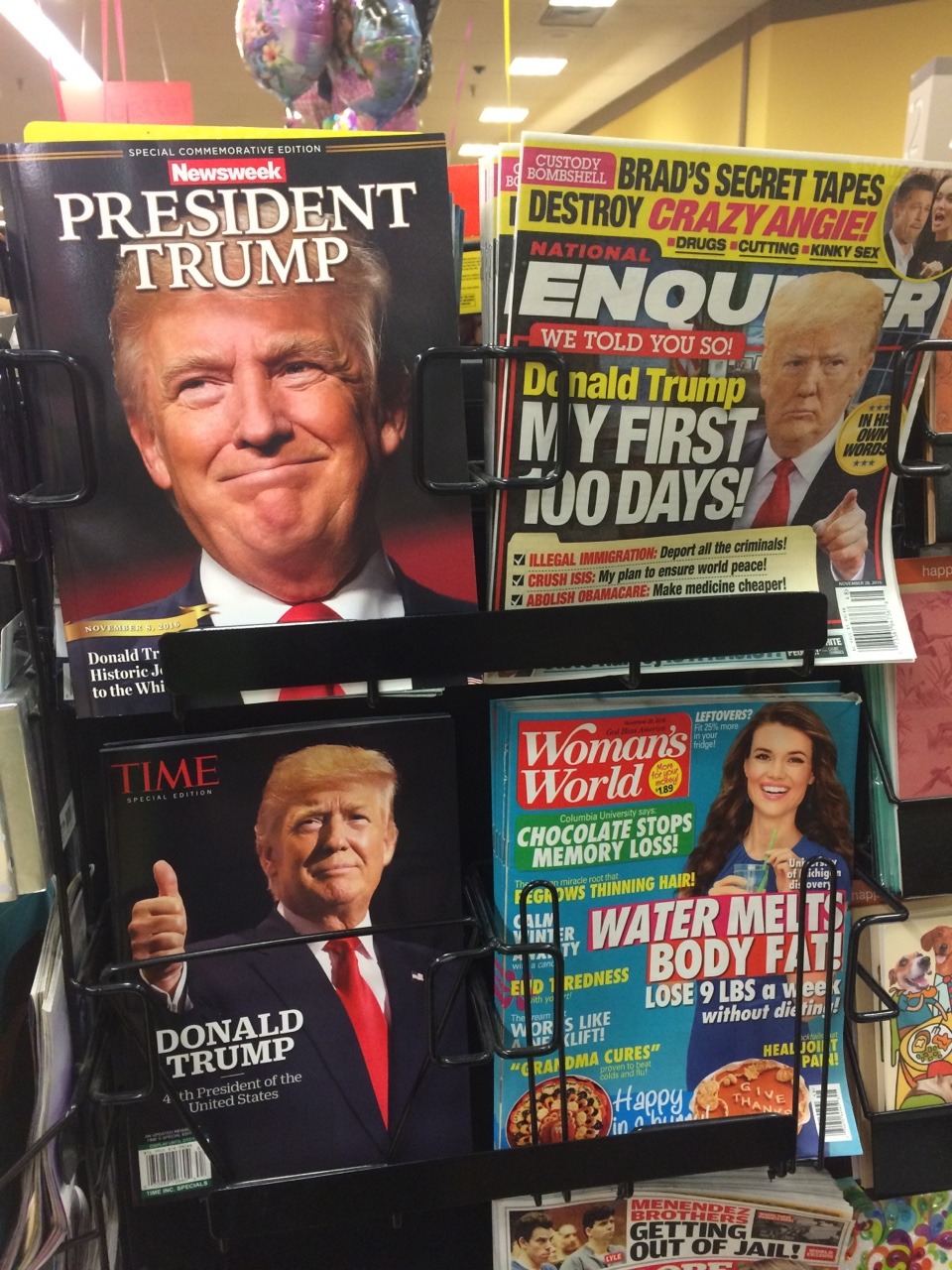
I looked for that National Enquirer article cause I thought it would be funny if their take was less wild-eyed than Vox. But “My First 100 Days” “In His Own Words” just refers to that bullet-pointed subhed lifted from his official plan
We Told You So was an article though, 2 pages under the cover, a timeline piece on how his candidacy progressed and all the times the Enquirer had gotten something right the consensus got wrong
I shoulda got a copy now I think of it. It was clearly written to equate Trump’s superiority over the elites with the Enquirer’s, with the audience invited to parallel their own - I’ve wondered what primary sources might be unridiculous enough to do this election in AP US history and that’d be a good one.
I spend all goddamn day on the internet and when I hear all about this “fake news” going around on social media like it’s something everyone’s noticed I have no idea what they’re talking about
I attribute this to my longstanding policy of not following idiots
(one-off ruptures, as distinct from bottom-turtle “power flows from the barrel of a gun” stuff or norm changes like the regularization of the filibuster, the end of earmarks or the decline of deference in Supreme Court confirmations from Bork on.)
Hinckley Shooting (1981)
69 days into his presidency, Ronald Reagan is shot in the lung. The shooting is seen in the lineage of “national hero” assassinations from Kennedy (1963) to King (1968) to Lennon (1980) which contributed to the sense of no “successful” presidency since Eisenhower
Taken to a public ER, prompt medical attention saves the jocular Reagan, breaking the streak in a visceral display of his “Morning in America” pledge to remoralize the country through sunny optimism.
Iran-Contra Affair (1985-1987)
Following Watergate, the publication of the Pentagon Papers, and the “Watergate babies” wave election of 1974, Congress moved to limit the power and autonomy of the executive, particularly over military and security services.
High-profile actions included the Church Committee and passage of the War Powers Act as legitimating rituals, but much leverage was made of Congress’ “power of the purse”, with a legitimating tradition back to the Magna Carta. The Impoundment Control Act removed Presidential volition in spending appropriated funds, which allowed the President to tack into the wind of Congressional opinion and was a major source of leverage over individual legislators.
(there were unsuccessful attempts to restore an equivalent in the 90s as the “line-item veto”)
More specific acts like the Boland and Clark Amendments, which prohibited aid to resistance groups in Angola and Nicaragua, moved to undercut executive desires to pursue Cold War proxy wars. During this period the Democrats were considered to have a lock on Congress while Republican strength was in the presidency and right-aligned theorists considered these Congressional acts improper trespasses on the President’s sovereign power over foreign policy.
The administration of Jimmy Carter (1977-1981) is remembered for a foreign policy that upheld not only the letter but the spirit of this new constraint and was considered a failure by anti-communists and large branches of the deep state for it.
In this climate, elements of the Reagan administration with at least the noninterference of POTUS himself end-ran the laws, supporting a forceful anti-communist posture. Figures up to the SecDef were indicted (and later pardoned by George H W Bush), but Congress could not generate the political will for impeachment and lacked any further enforcement mechanism. Congressional checks on the President became increasingly vestigial, retained as the pro forma AUMF.
Base Realignment and Closure (1988-)
Victorious in the Cold War, the United States was left with an unnecessarily large military footprint.
Military units, installations and the programs that supplied them had long been the subject of Congressional pork and logrolling at the margins, in a power politics system ill-suited to executing major shifts in a coherent way.
Accordingly, the regular process of appropriation-by-negotiation was circumvented in favor of appointing a commission of experts to make en bloc recommendations for the drawdown then ratified by legislators.
Ross Perot (1992)
A third-party Presidential candidate takes almost 19% of votes, the strongest ever third-party showing not by an ex-President.
Federal government shutdown (1995-6)
A power struggle between Democratic President Bill Clinton and a Congress under unified Republican control for the first time since the 1950s, the two sides could not agree to a budget and the federal government suspended “non-essential” operations for 4 total weeks. With the executive more united than a Congress still developing “responsible party government” parliamentary discipline, the Republicans yielded, though similar actions were attempted under the Obama administration with greater party coherence.
Tobacco Master Settlement Agreement (1998)
a nationwide parategulatory regime over tobacco is established through settlement between leading companies and 46 state attorneys general.
The regime, which in ways resembled irregular-but-precedented systems like utility franchising and workman’s comp, was constructed this way rather than through Congress, the formally legitimate venue for interstate compacts, to circumvent friendly legislators from tobacco-growing constituencies or elected in open elections with industry support who might be expected to defend industry interests.
Bill Clinton impeachment (1999)
After recapturing both chambers of Congress in the Republican Revolution of 1996, the GOP was eager to assert its power against the Democratic executive (see shutdown, above).
A series of investigations were launched into President Bill Clinton, originally focusing on ethics in the operation of his political machine as Arkansas governor, expanding into any area thought to be a political vulnerability.
Eventually the second-ever impeachment of a US President was launched over the proximate issue of perjury under law regarding a sexual affair with a petty staffer, a matter that had come collateral to prior investigations.
The impeachment ended, like that of Andrew Johnson, in acquittal. (Nixon resigned in anticipation of a successful impeachment).
The act of Republicans to issue impeachment over matters tangential to government and of Democrats to vote for acquittal in the face of evidence were reciprocally considered norm-breaking in pursuit of power.
Bush v. Gore (2000)
coming down to a close and ambiguous result in Florida, the victor of the Presidential election of 2000 remained unclear for weeks after the vote and it became apparent that contested interpretations of election law would decide the winner.
In an unprecedented and non-precedent decision, the Supreme Court usurped the issue from lower courts and election boards to effectively decide the election in favor of Republican George W Bush, on a 5-4 court split that closely tracked the parties responsible for Justices’ appointments.
Used to think he was an intellect, all cocking his head and looking when I was opening a door, trying to figure it out.
Now starting to suspect he just has some golden retriever in him, homeboy will stand outside a door cracked enough to nose through and meow and pull at it from underneath.