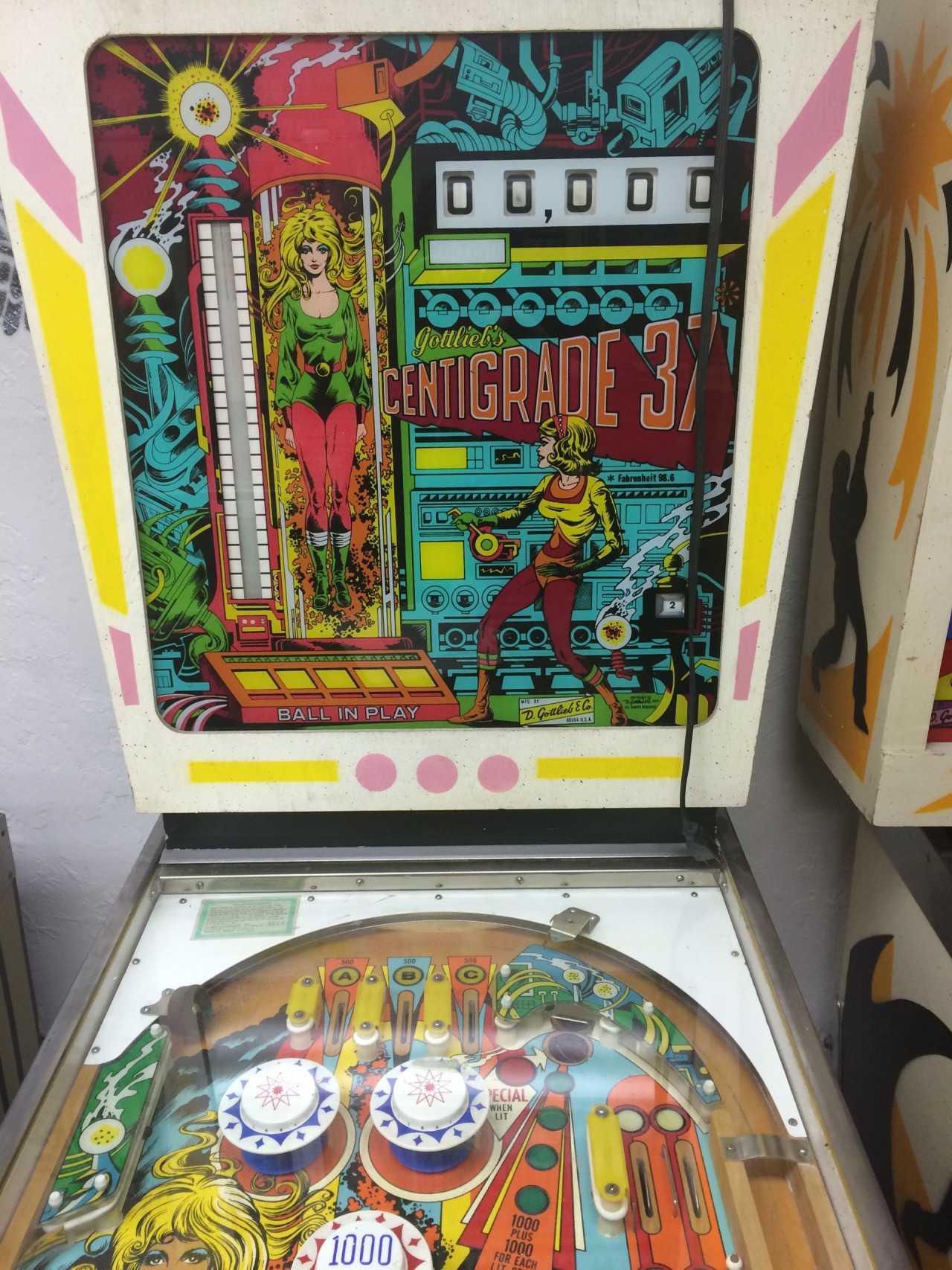
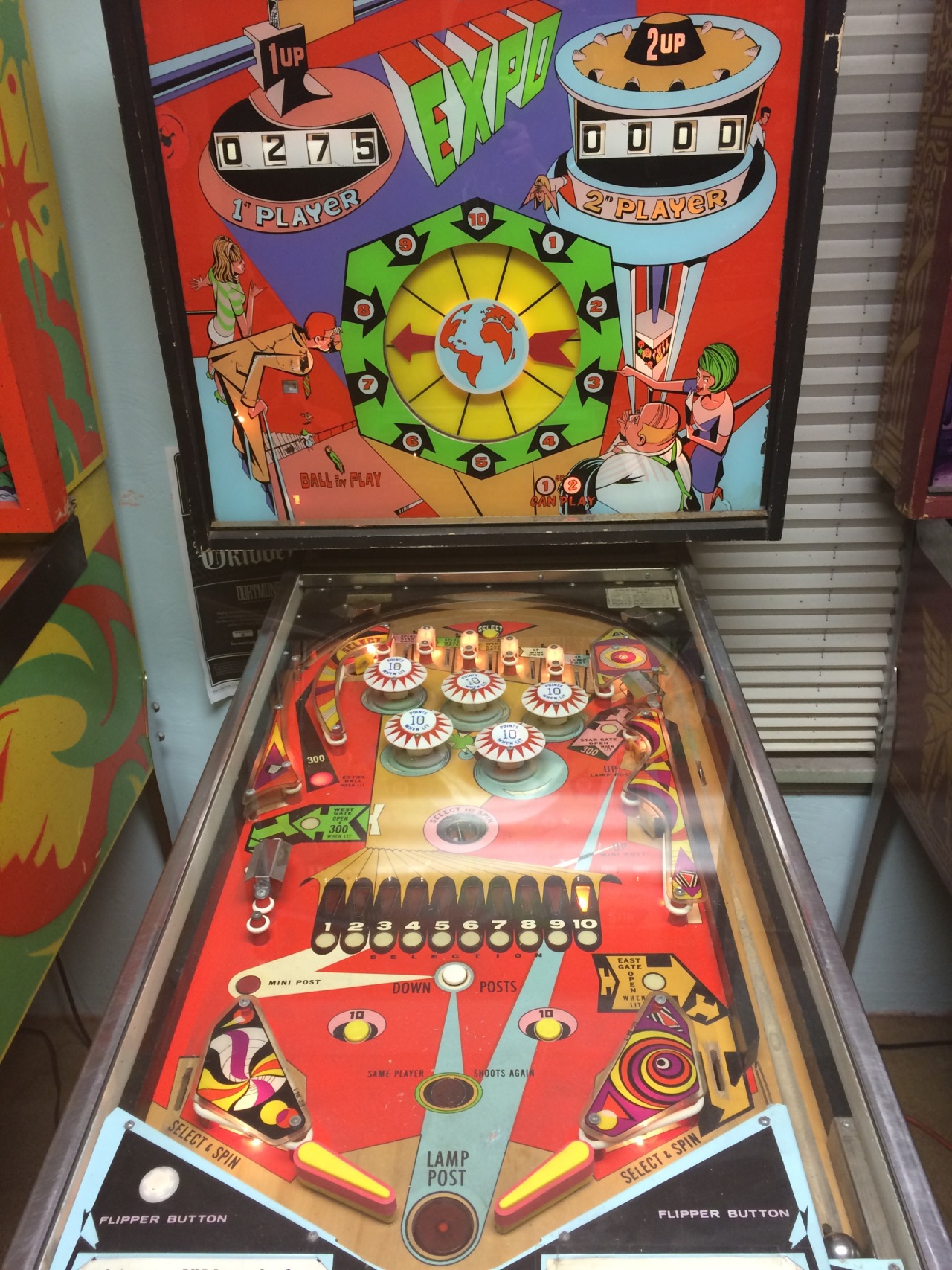
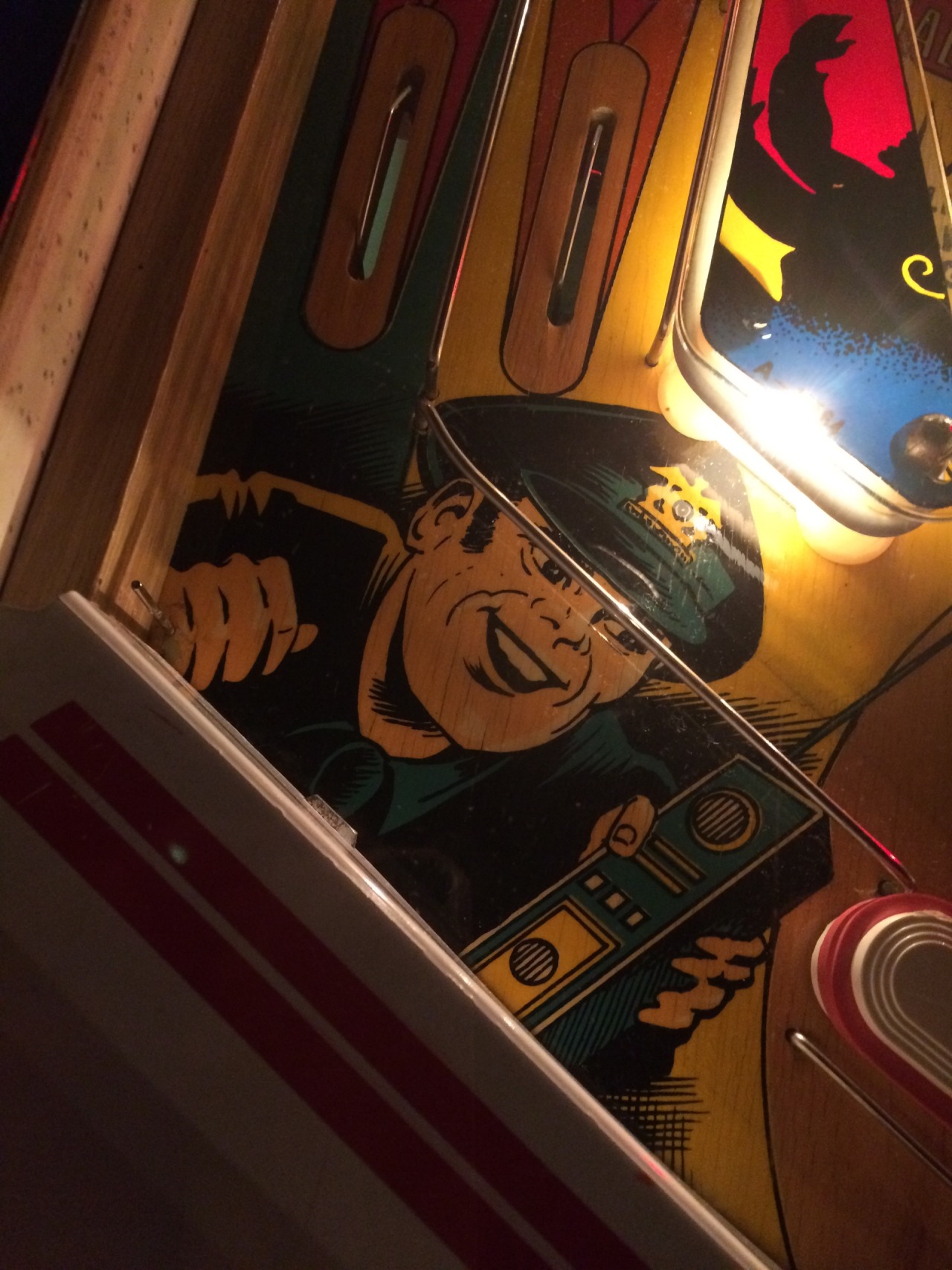
Twinky, a color TV/mod fashion-themed pinball table from 1967.
The “typical” playfield bottom – an outlane then one or more inlanes separated by wireforms, slingshot, flipper, center drain and then mirrored on the other side, an arrangement known as an “Italian bottom” - didn’t become standard until the 1970s; older games feature some pretty funky alternatives.
The Thirties had seen the first generation of American industrial designers; until the Thirties, all pencil sharpeners had looked like pencil sharpeners - your basic Victorian mechanism, perhaps with a curlicue of decorative trim. After the advent of the designers, some pencil sharpeners looked as though they’d been put together in wind tunnels. For the most part, the change was only skin-deep; under the streamlined chrome shell, you’d find the same Victorian mechanism. Which made a certain kind of sense, because the most successful American designers had been recruited from the ranks of Broadway theater designers. It was all a stage set, a series of elaborate props for playing at living in the future.
William Gibson, ‘ The Gernsback Continuum’ in Burning Chrome. (via bustakay)
See the real issue is that the pragmatic salt-of-the earthiness that looks at outfits and says “that emperor’s naked!” is the exact same one that says “that girl’s asking for it!”
The Thirties had seen the first generation of American industrial designers; until the Thirties, all pencil sharpeners had looked like pencil sharpeners - your basic Victorian mechanism, perhaps with a curlicue of decorative trim. After the advent of the designers, some pencil sharpeners looked as though they’d been put together in wind tunnels. For the most part, the change was only skin-deep; under the streamlined chrome shell, you’d find the same Victorian mechanism. Which made a certain kind of sense, because the most successful American designers had been recruited from the ranks of Broadway theater designers. It was all a stage set, a series of elaborate props for playing at living in the future.
William Gibson, ‘ The Gernsback Continuum’ in Burning Chrome. (via bustakay)
Oh hey remember the David Brooks era when Michael Graves and Martha Stewart’s lines for Target were supposed to be the Cold War’s peace dividend?
relationship outcome prediction markets, a real blinder of an idea!
encourages skilled matchmakers by giving them a financial incentive to create lasting relationships, among other things.
(other things including but not limited to a bizarrely indirect form of sex work, shorting your own relationship providing valuable advance warning of divorce, plausibly deniable ways of splitting up couples you have crushes on, etc.)
Oh man, friggin’ dream. All thru high school and college I’d tell my friends when and why their relationships would end and furthest off I was was two weeks at a distance of 6 months.
The word “intellectual,” used as a noun referring to the “intellectual laborer” who assumes a political stance, did not exist until Georges Clemenceau used it in 1898 during the Dreyfus case, congratulating those “intellectuals,” such as Marcel Proust and Anatole France, who had joined Dreyfus’s great champion, Emile Zola. Zola was an entirely new form of political eminence, a popular novelist. His famous J'accuse was published on the front page of a daily newspaper, L'Aurore (“The Dawn”), which printed 300,000 copies and hired hundreds of extra newsboys who sold virtually every last one by midafternoon.
Zola and Clemenceau provided a wholly unexpected leg up in life for the ordinary worker ants of “pure intellectual labor” (Clemenceau’s term): your fiction writers, playwrights, poets, history and lit profs, that whole cottage industry of poor souls who scribble, scribble, scribble. Zola was an extraordinary reporter (or “documenter,” as he called himself) who had devoured the details of the Dreyfus case to the point where he knew as much about it as any judge, prosecutor, or law clerk. But that inconvenient detail of Zola’s biography was soon forgotten. The new hero, the intellectual, didn’t need to burden himself with the irksome toil of reporting or research. For that matter, he needed no particular education, no scholarly training, no philosophical grounding, no conceptual frameworks, no knowledge of academic or scientific developments other than the sort of stuff you might pick up in Section 9 of the Sunday newspaper. Indignation about the powers that be and the bourgeois fools who did their bidding-that was all you needed. Bango! You were an intellectual.
From the very outset the eminence of this new creature, the intellectual, who was to play such a tremendous role in the history of the twentieth century, was inseparable from his necessary indignation. It was his indignation that elevated him to a plateau of moral superiority. Once up there, he was in a position to look down at the rest of humanity. And it hadn’t cost him any effort, intellectual or otherwise. As Marshall McLuhan would put it years later: “Moral indignation is a technique used to endow the idiot with dignity.” Precisely which intellectuals of the twentieth century were or were not idiots is a debatable point, but it is hard to argue with the definition I once heard a French diplomat offer at a dinner party: “An intellectual is a person knowledgable in one field who speaks out only in others.”