shrine to the prophet of americana

All posts (oldest first)

You realize, “gender is socially constructed” doesn’t mean your ~real~ pronouns are whatever you say they are, it means they’re...

cinefeminism:

thededekindadafunction:

kontextmaschine:

You realize, “gender is socially constructed” doesn’t mean your ~real~ pronouns are whatever you say they are, it means they’re whatever everyone else says they are.

Seriously, if you guys still bothered to actually read your fucking Foucault instead of goddamn sad teen bloggers… the fuck did you think “repressive power is a creative force that gives rise to meaning” was about?

I have no idea what that means, but fortunately one doesn’t need to read Foucault (or Butler) to Think About Gender Well.

And since gender is *not* entirely socially constructed….

According to Foucault, one’s “real” pronouns are “whatever everyone else says they are“? No.

I disagree with such an interpretation of Foucault. He’s not interested in what is real, authentic, or true at all, and doesn’t suggest that meaning is exclusively imposed from the outside. (He also actually argues that power is NOT repressive, so kontextmaschine’s interpretation is off there as well.) 

What I believe Foucault allows us to do is step away from negotiations over what is real/authentic/true and understand ourselves to be operating within systems of language and power that give specific meanings to (in this case) biology. Right now, we have competing social constructs of how pronouns are used to produce meaning about bodies and people. 

Personally, given the two generally available options for using pronouns to produce meaning, I’m going to follow the social construct that  kontextmaschine dismisses as being created by “sad teen bloggers”: use the pronouns that the person you’re talking about says produces the appropriate meaning. While this may be the more real, true, or accurate approach, the argument about its objective validity is far less compelling to me than its ethics.

Foucault has many problems. However, here it is the misrepresentation of his argument, rather than the argument itself, that is problematic.

That’s a popular reading in the academy, but that’s mostly ‘cause they so want to reach that result they’re willing to do pretzel twists to get there. Mine’s better.

And the conceit that the best models of peoples’ natures are the constructs that they consciously promote to others, like holy shit, have you ever MET people?

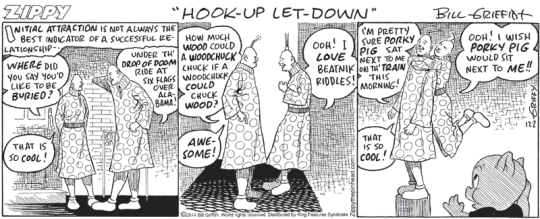
zippy the pinhead: vaguely reactionary anti-mass-culture mass-culture comic that occasionally drops its authorial voice to yell...

severnayazemlya:

severnayazemlya:

zippy the pinhead: vaguely reactionary anti-mass-culture mass-culture comic that occasionally drops its authorial voice to yell about kulaks

edit:

image

i am reading british meme-communists and it occurs to me that this is probably normal. the ‘cupcake fascism’ guy has a very angry post about some sort of cartoon character, a yellow pill-looking thing with a variable number of eyes, which is apparently in two movies and innumerable advertisements. i have never heard of this before. there is also a very angry post about a marketing gimmick for a brand of candy which i think might have risen to my conscious attention once when i was eight.

particularly illustrative is the one about the cereal bar. as part of the broader agenda of infantile cupcakeism, somebody somewhere in britain opened a thing called a ‘cereal bar’, which is a place that sells servings of cereal for three and a half of the local unit of currency, which one presumes translates to somewhere slightly upwards of three and a half dollars.

there are a lot of paragraphs about the relation of the cereal bar to the vile cupcake agenda. after them, there are more paragraphs, these describing the meme-communist’s visit to the cupcake bar, and the expensive bowl or two of cereal he consumed there.

upon reading this, two words came to mind:

‘jersey shore’.

i have met many people who watched jersey shore. (‘watched’? ‘watch’? does it still exist? i don’t know.) i have never met anyone who was motivated to watch jersey shore by the artistry it exhibits; i would assume it does not exhibit any. the motivation for watching jersey shore that is shared by every single person i have met who does so is that it is bad. they watch it because it is bad. the cupcake fascism guy went to the cereal bar because it is bad.

there are pop-cultural artifacts that use this vector much more overtly, like pickle surprise. pickle surprise is not high-quality. it is intentionally awful. that is why it has upwards of two million views.

here is a selection from the comments on the video:

wtf… just…. no. no. no. no. no. no. no. nooooooooooooooooooooooooo.

Okay. Now my eyes have gonorrhea.

What kind of sick fuck would come up with something like this?

I once saw a video on here of a poor boy jumping off a bridge into some water and he accidentally face plants on some concrete below, The after math shows him on his death bed struggling to survive while his face is literally split in half. This video bothers me just as much as that poor split face boy : /

Can I ask a serious question? Am I homophobic? because this makes me really uncomfortable.

Please, no.

Is this hell or what

Sweet merciful god.. What is this.

Shared on Google+

Now I’m scarred for life…

all of these people watched the video.

a larger-scale example of the same phenomenon is the celebrity status of tommy wiseau. the room is an awful movie. it is watched precisely because it is awful.

it makes no difference to the cereal bar whether their customers are giving them money because they genuinely like paying three and a half of the currency units of their country to eat a bowl of sugar in an infantile cupcake nostalgia ukulele shrine or because they think it is awful. three and a half currency units from an unironic neoteny-lover and three and a half currency units from the guy who coined the term 'cupcake fascism’ are both three and a half currency units. i r o n i c c o n s u m p t i o n i s c o n s u m p t i o n

i have, for some reason, a bag of candy. i do not particularly like it, and would prefer a bag of carrots. but it requires an active expenditure of effort not to keep eating the fucking candy, even though it is not particularly good and my tongue feels like a plague of locusts shat on it. this does not happen with a bag of carrots. when i have a bag of carrots, i eat some carrots and then i close the bag. zippy the pinhead guy and cupcake fascism guy keep sticking their hands into the bag of candy again and again and again and again and again

“please, brer fox, please don’t throw me into the briar patch!!!!!”

To derail this, the way my mealsquares experience ended was I never got to eating them. I ate everything in the cabinet. I ate butter or jam on the all the discount post-Passover matzoh megapack. Everything except my several packs of nutritionally complete, satisfying foodstuffs. Because the thing about so completely optimizing them as a nutrition vector with no interest towards mouth appeal is that EVEN WHEN I was hungry, EVEN WHEN there was no other food in the house, EVEN WHEN I knew they would satisfy me, I was never actively moved to eat them. I ate out instead.

Tagged: mealsquares

(x)

tswiftdaily:

(x)

same

Tagged: taylor swift

Cassetteboy remix the news: Taylor Swift forces government u-turn on welfare spending Mashup artists Cassetteboy edit the...

Cassetteboy remix the news: Taylor Swift forces government u-turn on welfare spending


Mashup artists Cassetteboy edit the last month’s TV news coverage, including the first Conservative budget in 20 years and its impact on the NHS; the financial crisis in the eurozone and how Greece is coping with record debt; the Confederate flag and its implications for the race debate in the US; Taylor Swift’s influence on the prime minister; and Iain Duncan Smith’s music career

Tagged: taylor swift taylour swift it's media

“what do you do when you stay up all night on your computer?”

seriousjones:

image

zippy the pinhead: vaguely reactionary anti-mass-culture mass-culture comic that occasionally drops its authorial voice to yell...

severnayazemlya:

nostalgebraist:

ogingat:

severnayazemlya:

severnayazemlya:

zippy the pinhead: vaguely reactionary anti-mass-culture mass-culture comic that occasionally drops its authorial voice to yell about kulaks

[snip]

i have met many people who watched jersey shore. (‘watched’? ‘watch’? does it still exist? i don’t know.) i have never met anyone who was motivated to watch jersey shore by the artistry it exhibits; i would assume it does not exhibit any. the motivation for watching jersey shore that is shared by every single person i have met who does so is that it is bad. they watch it because it is bad. the cupcake fascism guy went to the cereal bar because it is bad.

there are pop-cultural artifacts that use this vector much more overtly, like pickle surprise. pickle surprise is not high-quality. it is intentionally awful. that is why it has upwards of two million views.

here is a selection from the comments on the video: [snip]

a larger-scale example of the same phenomenon is the celebrity status of tommy wiseau. the room is an awful movie. it is watched precisely because it is awful.

it makes no difference to the cereal bar whether their customers are giving them money because they genuinely like paying three and a half of the currency units of their country to eat a bowl of sugar in an infantile cupcake nostalgia ukulele shrine or because they think it is awful. three and a half currency units from an unironic neoteny-lover and three and a half currency units from the guy who coined the term ‘cupcake fascism’ are both three and a half currency units. i r o n i c c o n s u m p t i o n i s c o n s u m p t i o n

i have, for some reason, a bag of candy. i do not particularly like it, and would prefer a bag of carrots. but it requires an active expenditure of effort not to keep eating the fucking candy, even though it is not particularly good and my tongue feels like a plague of locusts shat on it. this does not happen with a bag of carrots. when i have a bag of carrots, i eat some carrots and then i close the bag. zippy the pinhead guy and cupcake fascism guy keep sticking their hands into the bag of candy again and again and again and again and again

“please, brer fox, please don’t throw me into the briar patch!!!!!”

nostalgebraist somehow this post is responsive both to your recent post about neoteny and to your recent post about doing things ironically.

This was the post the post on neoteny was inspired by.

Tom Whyman, AKA “cupcake fascism guy,” has this weird tendency to associate cute aesthetics (e.g. a sign next to some napkins reading “Please Only Take One Of Me”) and people becoming “infantalized” in the behavioral sense that they are more dependent on others, more self-absorbed, more inclined to complain about relatively trivial pains, etc.  He doesn’t seem to have a causal theory of how these two things are just connected, or which causes the other – they are just “obviously” part of the same thing, apparently.  (This perspective makes the logical gaps in something like this post glaringly obvious – note the remarkable slip from “cute aesthetics” to “dependence” at the end of the first paragraph, for instance.)

I guess I think that Whyman isn’t only missing how much of the appeal of this stuff might be “ironic,” he’s also missing a theory of how cute aesthetics and behavioral childishness are related, which is pretty ridiculous for someone who purports to be riffing intellectually about this stuff.  (Without such a theory, what does he have?  “I saw something cute in a public space, and also I think lots of people are childish.”  Cool story, bro.)

(Q: The Victorians probably had “cuter” aesthetics than we do – the polite reserve, the idealization of children, etc. – but were they also more childish?)

Re: irony, yes, Homestuck has a theme of “all interpersonal interaction is mediated by a byzantine tangle of status horseshit that isn’t even immediately obvious as a set of rules for systematically distorting communication to avoid being ‘awkward’ or losing face”. So does LW.

Before Adam Kotsko turned himself completely into a vector for the culture war, he wrote a book about awkwardness:

To find the origin of so many awkward tv shows and movies, Kotsko traces the flowering of contemporary awkwardness to the breakdown of pre-1960s Fordist social norms:

The African-American civil rights movement and feminist movement both achieved considerable gains, but more radical changes proved elusive as the forces of cultural conservatism turned out to retain considerable power. It is here, I claim, that we find the ultimate origin of contemporary awkwardness: the events of the 1960s threw the normative social model significantly off-kilter, making it impossible to embrace that model wholeheartedly — and yet they did not produce any viable positive alternative.

Stuck with the proliferation of identities, the (false) universals torn asunder, Americans struggle to find something solid to cling to. Modern American conservatism offers one attempt to fill this values vacuum, but Kotsko, rather than seek universality in a reactionary attempt to reinstall pre-60’s grand narratives, looks to what we currently share, regardless of our various affiliations: awkwardness. This naming of the void is one of his most deft theoretical moves. What we all have in common, he asserts, is our inability to deal with the absence of assured social scripts; we are all left bumbling diagonally toward our lives. …

Kotsko’s chapter on marriage and gender roles takes up the work of screenwriter and director Judd Apatow, who, in another deft theoretical move, he treats as a genre rather than an auteur. In Apatow-related movies, which include The 40-Year-Old Virgin, Knocked Up, and The Hangover, awkwardness results from the scarcity of acceptable social scripts for adult men, Kotsko argues. To prepare for or shore up marriages with women they don’t understand, men in Apatow films maintain overgrown adolescent friendships based on porn, pot, and video games. In such “bromance” movies, a close homosocial friendship becomes part of the traditional romance narrative, a childish, sentimental release valve that persists into adulthood and rivals marriage itself.

His conclusion, according to that review (I haven’t read the book and there’s no way in hell I’d ever give him money), is that ‘radical awkwardness’ is a positive force, allowing people to “simply meet each other, without the mediation of a defined cultural order, and figure out how to live together on a case-by-case basis”, which is similar to LW’s ‘tell culture’, but worse in a different direction. Where ‘tell culture’ assumes that communication can be strictly denotational, 'radical awkwardness’ posits a True Self that exists prior to and unaffected by cultural order, which it sees as a terrible imposition from outside, rather than admitting that a defined cultural order (a commonality of language, culture, scripts, norms of etiquette, signs and their meanings, etc.) is the structure that allows communication. l i b e r a l i s m

On the one hand, we have the destruction of a shared social order; on the other hand, we have a social order so complex as to make communication almost require violating it and risking loss of face. What gives?

There are two separate things going on here.

First, you have jeysiec​‘s line about the replacement of ‘close friend’ with ‘disposable acquaintance of convenience’ – the small-scale interpersonal equivalent of the general loss of trust? If you can’t trust anyone to stand by you unless you send the optimal signals, if you face the risk of losing your entire social life for being perceived as ‘uncool’…

Second, you have Nature’s well-known abhorrence of vacuums. The fall of the common cultural order created a vacuum; what replaced it?

Well, what is irony about? You don’t take up folk music ironically; you do drink PBR ironically. You don’t exercise ironically; you do listen to Ke$ha ironically. Irony is about navigating acceptable patterns of consumption – cf. 'guilty pleasures’ in music, things that one likes but that one knows one should not admit to liking, because it’s against the rules of the social order, because a good person is a person who consumes the right things, because the rules of the social order were put there by capitalism to fill the void left by the '60s 'radicals’, because progressivism and neoliberalism are two sides of the same fucking coin.

Now, children, at least ideally, experience the ~unconditional love of the parents – they won’t be disowned for listening to Garth Brooks or not listening to Kanye – and are not expected to already know how to perfectly navigate the rules of the current social disorder. (Whyman: “the desire to feel comfortable and secure in a very troubling and uncertain world”. Atomization, absence of a shared social order for everyday interaction, presence of a shared social insane totalitarian dystopia for consumption patterns.) Given that, a resurgence in childhood nostalgia is no surprise – but children imply parents, patient stoic adults who love how cute their kids are and put on a cute/nurturing aesthetic for them – the same aesthetic that Whyman says the napkins at the House of Commons put on.

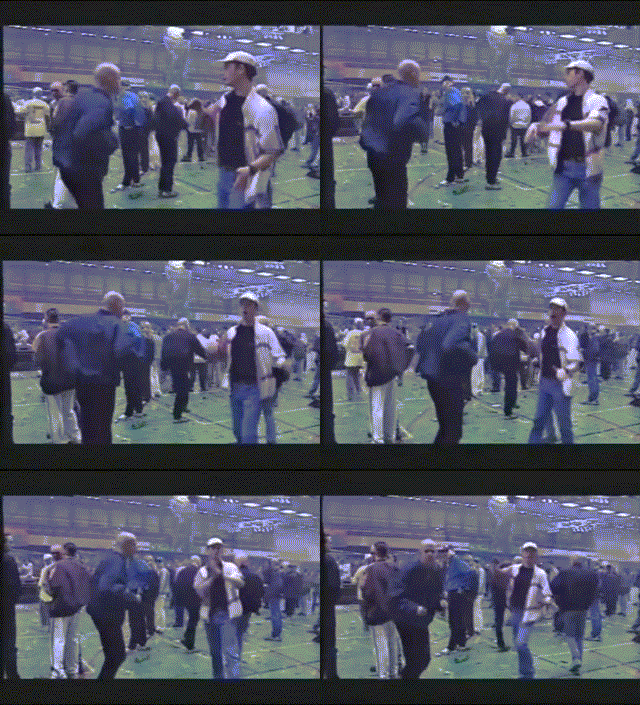
Megarave new year party @ Energiehal - Rotterdam - 31/12/1996

handinhandgabbers:

Megarave new year party @ Energiehal - Rotterdam - 31/12/1996

The Quick Brown Fox Jumps Over the Lazy Dog.

theamericankid:

The Quick Brown Fox Jumps Over the Lazy Dog.

What did you like most about Utena? What struck me most were the aesthetics, Anthy's arc, Anthy and Utena's relationship, and...

Anonymous asked: What did you like most about Utena? What struck me most were the aesthetics, Anthy's arc, Anthy and Utena's relationship, and the Kashira girls. But I feel like you probably have interesting analysis of aspects I haven't thought about much. (like those jerk Duelists)

Yeah, the aesthetics, or rather #the aesthetic - kinda German expressionism crossed with French rococo. If you haven’t seen the movie, the architecture’s even more ridiculous in that. JA Seazer’s music of course was a huge thing, I think it helped create the sunny feel where everything’s absurd and weighty but not ominous.

Also just all the ritualized, formalist, symbolist stuff - the “ascending to the duelling grounds” and sword-drawing bits which were literally the same in each episode, and came in at roughly the same point, but also the stuff that would happen each time but in a different way as a sort of commentary on the story - the shadow girls’ play, the preliminary conversations in the student council room/Akio’s car/the seminar’s elevator-confessional, the moment when the duellists’ flower is cut, the absurd lyrics in the duel songs, the accessories on the desks and the way they all slam together at the end in the Black Rose Arc, stuff like that.

The Anthy bits were nice and well-used to modulate the pacing, of course when I’m talking about “sunny feel” the bits in the sunlit garden while The Sunlit Garden plays help. Coulda done without Chu-Chu, I don’t know who decided that every ‘90s anime has to have a weird, humanized animal mascot.

Tagged: revolutionary girl utena shoujo kakumei utena

Jacob Kassay - HIJK, 2015

enskog:

Jacob Kassay - HIJK, 2015

Hatchet Jobs #3: Ta-Nehisi Coates

(So I realize I’ve been shit-talking other writers a bit recently. And hey, that’s actually a pretty traditional way to break yourself as a writer, by tearing others apart. So let’s make that an occasional series. Here’s entries 1 and 1.5 on Fredrik de Boer, 2 on Ozy Frantz. Might as well keep doing it until sempai notices me.)

Ta-Nehisi Coates will never say in 100 words what he could in 300, and will never say in those 300 words anything new or interesting enough to justify 100.

He’s endlessly fascinated with himself, convinced the most banal observations and experiences are transmuted to gold by his involvement. I can’t count how many times he’s invoked “in college I realized my juvenile ideas had been immature and self-flattering” as some mark of distinction rather than the baseline minimum, a foundation on which actual insight can be built.

Or presenting himself as some clear-sighted visionary for reading books on the Civil War and dragging his kids out to battlefields and historic sites - which I’m pretty sure History Dads have been doing since Lee surrendered at Appomattox - and then turning it into who knows how many articles, blog posts, book proposals in which he sucks his own thumb - among other parts - over the brilliant insight that The Civil War Was About Slavery.

The thing is I’ve seen this before. Another thing he keeps coming back to is his childhood, being raised by a black nationalist father - the kind of guy big on discipline, effort, and racial pride who would be easily recognized as a conservative in an environment where his ethnic identity was THE nationality. And I really respect those guys, and a lot of it is for their ability to instill a sense of confidence and drive in their kids that propels them into a solid middle- to upper-middle class life coming from an environment where a lot of people don’t even come close.

But when those kids get there… I’ve run into a few of them. And boy are they convinced they have wisdom to bestow, and boy does it get a little ridiculous sometimes. “Son, I grew up on the streets, so I’mma tell you how to be a creative-class yuppie, son.”

Honestly a lot of time it seems like they’ve absorbed wisdom as an aesthetic, a style, and confused that with actually being wise. Now that’s a trap anyone can fall into - I spent a while mistaking people for smart when they were really just fans of spaceships and Science!, myself - but a big part of the path to actual wisdom is dragging yourself back out again.

Now I suppose the obvious counter would be I’m just repeating an old racist trope, of Black intellectuals as just simian imitators puffing themselves up above themselves. So, then, when you look at, say Spike Lee movies or ‘90s Fox sitcoms or contemporary black feminist blogs where “the ~enlightened brother~” is a stock comic trope, that’s just… internalized racism, right? Pf, nah. What it is is your low expectations, seeing someone go through the motions and taking that as good enough. ☯✟ Follow for more soft bigotry ✟☯

Now that’s his subject matter, when it comes to style - as a person, I’d put him in the 99th or 98th percentile of writers; as a professional writer he’s still above average, but making him the flagship brand of a magazine that’s constantly selling itself on its history publishing the greats of American letters? I think he needed another good five or ten years of polish before he could even contend for that level, but he’s sure not going to get it getting published in front-cover packages for what he’s turning in now, and then praised to the heavens as some kind of Second Coming. When in an earlier one of these I said Freddie de Boer was finding his voice in venom, I’m talking about things like the line about Coates’ “creepshow commenters asking him to forgive their sins”.

You see from the pulpit to the sidewalk to the, uh, movie theater, black America has kept up a tradition and practice of public rhetoric that’s really fallen out of white life. And Coates draws on that. He’s clearly angling to speak with “prophetic voice”, basically in a cadence and idiom derived from the black church, that preeminent organizing institution of African-American life, with preaching as an accessible path to esteem and power for the clever and the loquacious, preachers as a leadership corps in social activism and public life.

The thing is, again Coates is familiar with the preacherly cadence but doesn’t seem to have internalized how and why it works. It’s like when you ask a kid to draw a future airplane and they put wings everywhere, wings where they won’t generate lift, wings that would foul the air of other wings. Honestly, I think it might have to do with picking it up from a father who had in him a captive audience rather than from the actual church from preachers with an eye towards keeping souls in the pews.

You see, the preacherly cadence, like all good cadences, is about rising and falling action, building your audience up and then bringing them back down, concentrating your energy and then releasing it in a focused beam. But Coates knows how to build intensity, but not how to bring it back down again. Instead of escalating from a baseline escalation becomes the baseline, devaluing his starting point by comparison, offering no local maxima and thus no climactic moments. He knows how to build a theme through repetition - his recent work littered with the increasingly stale buzzphrase du jour, “black bodies” - but not how to break or twist the repetition and pour all that energy you’ve built up into an original, novel thought.

The end result is a plodding drone of a tone, piling words on words on words unto infinity, it’s writing as prog rock. The preacherly cadence is at root an oral form, but you can tell his first medium is text, if he ever tried to speak this stuff in front of an audience he’d at least notice them tuning out halfway through, notice that he was just making himself hoarse without eliciting more of a response.

And really, that’s the telling bit. That’s the part that gives away the game, that the promotion of Ta-Nehisi Coates, all the self-congratulatory media attempts these past few years to put black figures up front in the public eye, it’s not about putting power in black hands but as a maneuver in a status games among whites, that these guys aren’t being looked to as thinkers but as mascots.

(There’s an old joke from when the Republicans were the “black party”, but even then more in thematics than in actual power - “What do you call a black man at the [annual fundraising] Lincoln Day dinner? The keynote speaker.” [related])

Because really, what is whiter - what could possibly be whiter - than trying to distance yourself from your whiteness, trying to show how with-it you are, by latching on to some black celebrity, praising him to the heavens, wielding your fandom as a talisman, and not even noticing that you’ve managed to pick a guy with no goddamn sense of rhythm?

Tagged: hatchet job ta-nehisi coates race the atlantic it's media

I’m pretty sure Peanuts is the apex product of the midcentury American canon, and more specifically the Charlie Brown holiday TV...

I’m pretty sure Peanuts is the apex product of the midcentury American canon, and more specifically the Charlie Brown holiday TV specials.

Like, A Charlie Brown Christmas, 1965, the first one.

Coca-Cola commissioned a 30-minute animated film with a jazz soundtrack based off the breakthrough comic strip repackaging depressive cynicism for kids. The plot is that the protagonist is depressed and so his psychiatrist tells him to conduct religious rituals to gain a sense of purpose but no one’s even taking the rituals seriously so they don’t work and the climax is literally straight-up King James Bible verses about our savior Jesus Christ reminding them to take the Christmas rituals seriously, at which point everyone is happy.

And America was like “yes, correct, this is so correct that we want to incorporate it itself into our national-popular Christmas rituals every year”, like the Swedes and their Donald Duck thing.

In fact, how about more like that, let’s reenchant every holiday in the civic canon with this vision of Protestant reserve in the face of failure. Let’s do Halloween, let’s do Thanksgiving, let’s do Election Day, Valentine’s Day, let’s… GAINAX made a Charlie Brown holiday special in 2002? What the fuck.

Let’s do Easter, come the ‘70s let’s do Arbor Day (that one didn’t catch on)…

Tagged: holidays christmas peanuts kontextmaschine does the bible amhist

young man, get yourself off the floor, I said young man, man door hand hook car door

frog-and-toad-are-friends:

young man, get yourself off the floor, I said young man, man door hand hook car door

Stained glass wall (1976) by artist Jochem Poensgen. Located in the St Georg church in Bleibach, Germany, by Josef Laule

germanpostwarmodern:

Stained glass wall (1976) by artist Jochem Poensgen. Located in the St Georg church in Bleibach, Germany, by Josef Laule

One of the distinctive features of Old Norse poetry is the use of kenning: a circumlocutory device in which a straightforward...

collaterlysisters:

prokopetz:

One of the distinctive features of Old Norse poetry is the use of kenning: a circumlocutory device in which a straightforward noun is replaced with an allusive phrase.

For example, a ship might be referred to as a “wave’s horse”; a sword, a “wound-serpent”; a shield, “the shame of swords”, and so forth. Sometimes, kennings could be embedded in other kennings - thus, one might have “feeder of war-gulls” = “feeder of ravens” = “warrior”; this is known as a doubled or extended kenning.

Though many conventions of English literature can be traced back to Old Norse roots, kenning isn’t much encountered these days - at least, not in most genres. There’s one particular genre where the art of kenning is alive and well, though.

I’m speaking, of course, of erotic fanfic.

Whether you’re referring to a penis as a “porn-truncheon” or a vagina as “squish-pocket” (both examples I’ve seen employed in all apparent seriousness, incidentally), that perfectly fits the form and function of a kenning. Indeed, these examples even adhere to the idiosyncratic grammatical structure of many Old Norse kennings, with the base word being modified by an uninfected noun determinant inserted as a compound prefix.

Euphemisms for sex acts, meanwhile, can be even more baroque, forming multi-level allusions in the manner of doubled/extended kennings. “To ride the baloney pony”, for example, employs the act of riding a horse as an allusion to penetrative sexual intercourse - but the contained phrase “baloney pony” is, itself, a kenning of the simple type, with “pony” as the base word and “baloney” as the determinant, making the whole phrase a doubled kenning.

There are practical reasons for this sort of practice, of course; e.g., complex euphemisms can help sexually explicit works sneak through content filters. Still, it’s kind of fascinating that smutty fanfic has managed to preserve - in virtually unaltered state - a poetic form that’s otherwise been largely extinct in English literature for the better part of a thousand years.

amazing

the thing about keeping secrets is you never get a reputation for it

Water tower, La Duchère, Lyon

architectureofdoom:

Water tower, La Duchère, Lyon

Well good morning to you too.

Well good morning to you too.

Tagged: it's media

Path Into Foggy Field (Marin, California - 6/2015)

steepravine:

Path Into Foggy Field

(Marin, California - 6/2015)