Holy jesus motherfucker AEP just dropped the mother of all bombshells (and I think his source is Varoufakis, more explained below).
They rejected Greek plans to work with the OECD on market reforms,
and with the International Labour Organisation on collective bargaining
laws. They stuck rigidly to their script, refusing to recognise in any
way that their own Dickensian prescriptions have been discredited by
economists from across the world.
“They just didn’t want us to
sign. They had already decided to push us out,” said the now-departed
finance minister Yanis Varoufakis.
So Syriza called the
referendum. To their consternation, they won, igniting the great Greek
revolt of 2015, the moment when the people finally issued a primal
scream, daubed their war paint, and formed the hoplite phalanx.
Mr Tsipras is now trapped by his success. “The referendum has its own
dynamic. People will revolt if he comes back from Brussels with a shoddy
compromise,” said Costas Lapavitsas, a Syriza MP.
“Tsipras
doesn’t want to take the path of Grexit, but I think he realizes that
this is now what lies straight ahead of him,” he said.
What should have been a celebration on Sunday night turned into a
wake. Mr Tsipras was depressed, dissecting all the errors that Syriza
has made since taking power in January, talking into the early hours.
The prime minister was reportedly told that the time had come to
choose, either he should seize on the momentum of the 61pc landslide
vote, and take the fight to the Eurogroup, or yield to the creditor
demands - and give up the volatile Mr Varoufakis in the process as a token of good faith.
Everybody knew what a fight would mean. The inner cabinet had
discussed the details a week earlier at a tense meeting after the
European Central Bank refused to increase liquidity (ELA) to the Greek
banking system, forcing Syriza to impose capital controls.
It
was a triple plan. They would “requisition” the Bank of Greece and sack
the governor under emergency national laws. The estimated €17bn of
reserves still stashed away in various branches of the central bank
would be seized.
They would issue parallel liquidity and California-style IOUs denominated in euros
to keep the banking system afloat, backed by an appeal to the European
Court of Justice to throw the other side off balance, all the while
asserting Greece’s full legal rights as a member of the eurozone. If the
creditors forced Grexit, they - not Greece - would be acting illegally,
with implications for tort contracts in London, New York and even
Frankfurt.
They would impose a haircut on €27bn of Greek bonds
held by the ECB, and deemed “odious debt” by some since the original
purchases were undertaken by the ECB to save French and German banks,
forestalling a market debt restructuring that would otherwise have
happened.
“They were trying to strangle us into submission, and this is how we
would retaliate,” said one cabinet minister. Mr Tsipras rejected the
plan. It was too dangerous. But a week later, that is exactly what he
may have to do, unless he prefers to accept a forced return to the
drachma.
Syriza has been in utter disarray for 36 hours. On Tuesday, the Greek side turned up for a make-or-break summit in Brussels
with no plans at all, even though Germany and its allies warned them at
the outset that this is their last chance to avert ejection.
The new finance minister, Euclid Tsakalotos,
vaguely offered to come up with something by Wednesday, almost
certainly a rejigged version of plans that the creditors have already
rejected.
Events are now spinning out of control. The banks
remain shut. The ECB has maintained its liquidity freeze, and through
its inaction is asphyxiating the banking system.
Factories are
shutting down across the country as stocks of raw materials run out and
containers full of vitally-needed imports clog up Greek ports. Companies
cannot pay their suppliers because external transfers are blocked.
Private scrip currencies are starting to appear as firms retreat to
semi-barter outside the banking system.
Yet if Greece is in turmoil, so is Europe. The entire leadership of
the eurozone warned before the referendum that a “No” vote would lead to
ejection from the euro, never supposing that they might have to face
exactly this.
Jean-Claude Juncker, the European Commission’s
chief, had the wit to make light of his retreat. “We have to put our
little egos, in my case a very large ego, away, and deal with situation
we face,” he said.
France’s prime minister, Manuel Valls said
Grexit and the rupture of monetary union must be prevented as the
highest strategic imperative. “We cannot let Greece leave the eurozone.
Nobody can say today what the political consequences would be, what
would be the reaction of the Greek people,” he said.
French
leaders are working in concert with the White House. Washington is
bringing its immense diplomatic power to bear, calling openly on the EU
to put “Greece on a path toward debt sustainability” and sort out the
festering problem once and for all.
The Franco-American push is
backed by Italy’s Matteo Renzi, who said the eurozone has to go back to
the drawing board and rethink its whole austerity doctrine after the
democratic revolt in Greece. He too now backs debt relief.
Yet 15 of the 18 governments now sitting in judgment on Greece
either back Germany’s uncompromising stand, or are leaning towards
Grexit in one form or another. The Germans are already thinking beyond
Grexit, discussing plans for humanitarian aide and balance of payments
support for the drachma.
Mark Rutte, the Dutch premier, spoke
for many in insisting that the eurozone must uphold discipline, whatever
the financial consequences. “I am at the table here today to ensure
that the integrity, the cohesion, the underlying principles of the
single currency are protected. It is up to the Greek government to come
up with far-reaching proposals. If they don’t do that, then I think it
will be over quickly,” he said.
The two sides are talking past
each other, clinging to long-entrenched narratives, no longer willing to
question their own assumptions. The result could be costly. RBS puts
the direct financial losses for the eurozone from a Greek default at
€227bn, compared with €140bn if they bite the bullet on an IMF-style
debt restructuring.
But that is a detail compared with the damage to the European
political project and the Nato alliance if Greece is thrown to wolves
against the strenuous objections of France, Italy and the US.
It
is hard to imagine what would remain of Franco-German condominium.
Washington might start to turn its back on Nato in disgust, leaving
Germany and the Baltic states to fend for themselves against Vladimir
Putin’s Russia, a condign punishment for such loss of strategic vision
in Greece.
Mr Lapavitsas said Europe’s own survival as
civilisational force in the world is what is really at stake. “Europe
has not show much wisdom over the last century. It launched two world
wars and had to be saved by the Americans,” he said
“Now with
the creation of monetary union it has acted with such foolishness, and
created such a disaster, that it is putting the very union in doubt, and
this time there will be no saviour. It is the last throw of the dice
for Europe,” he said.
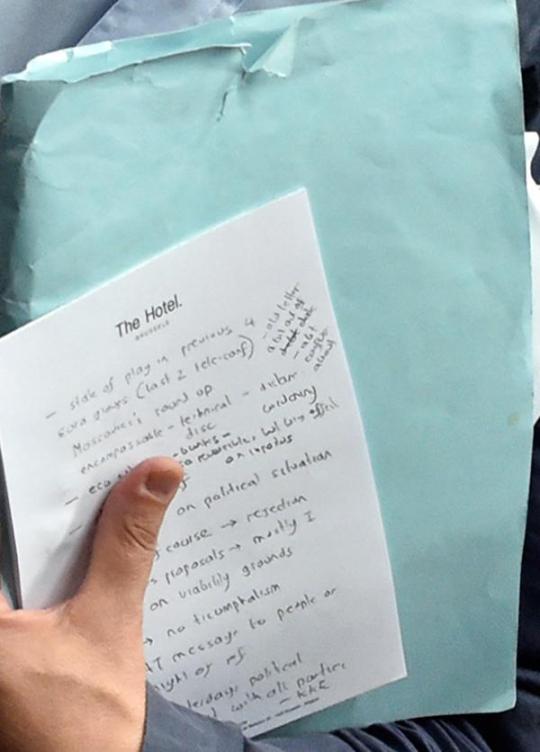
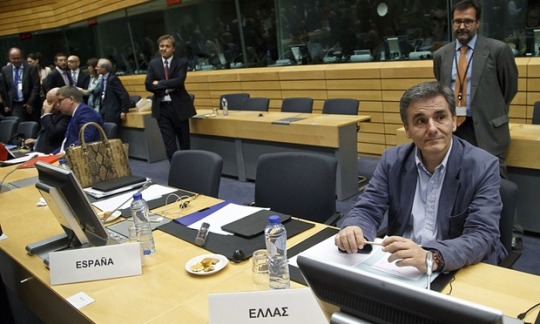
Today, the new Greek Finance Minister walked into a Eurogroup meeting with absolutely no new proposals, shocking everybody. He was photographed on the way out with a piece of paper on which he had written English notes, including “no triumphalism”.
Now maybe this is all one big scheme to smooth the path to SYRIZA forfeiting, just making sure that everybody believes they had no choice, but I trust that chaos is the law of the land far more than order. Tsakalatos’ face doesn’t look like a “>TFW”, it’s a “Oh god, we fucked up, what do we do”.
Now, this is not nearly the time to start planning a Grexit, which should have begun in January. It’s also not good that the battle plan was leaked, which means the ECB can take precautions (not that they probably haven’t already thought of it. They need to make sure Greece is dependent on humanitarian aid and has as few Euros in the country as possible to make it as pliant to Germany when the exit comes). But holy shit, it makes for exciting reading.
Now, why do I think Varoufakis is the source? AEP has implied over and over that he has intimate dealings with high level Syriza figures who were privy to the negotiation process, yet in this case, nothing about Tsakalatos’ dealings leaked. Instead, we heard about things that happened before Varoufakis resigned. In AEP’s last article, he mentions outright that he had spoken to Varoufakis, and his tone seemed to have been similar to the sort of things AEP’s articles have been saying:
AEP’s been awfully kind to Syriza for somebody who calls himself a “Burkean conservative”, implying maybe there was a personal friendship. I think Varoufakis stayed around to give his last interview to AEP so he could drop this bombshell scoop.
Hopefully, Greece can fly in those experts very quickly. There seems to be almost no chance that an exit can be averted. Eurocrats have outright stated that if they don’t get a detailed proposal on a third bailout on Thursday to hash out through the weekend, then Sunday’s Eurogroup meeting will be all about the exit.
In no way is this legal, but neither were the first two bailouts, and that never stopped them. This is gonna be a wild week. Will our heroes ride off into the sunset?