rock-a-la-carte-deactivated2017 asked: Oh, we always gave to the one that *was* a transparent front for the IRA. But I've never been to NI nor has anyone in my family. I know that it's pretty religious though - it's a pretty fundamentalist form of Protestantism in many cases; Ian Paisley had a "doctorate" from Bob Jones U. The abortion laws more closely resemble ROI than Britain (therapeutic only), & it's the only jurisdiction in either island without gay marriage.
For two decades or more, instructively in line with the retreat of
possibilities for concerted left political action outside the academy,
the popular culture side of that debate has been dominant, along with
its view that the products of this precinct of mass consumption
capitalism are somehow capable of transcending or subverting their
material identity as commodities, if not avoiding that identity
altogether. Despite the dogged commitment of several generations of
American Studies and cultural studies graduate students who want to
valorize watching television and immersion in hip-hop or other specialty
market niches centered on youth recreation and the most ephemeral fads
as both intellectually avant-garde and politically “resistive,” it
should be time to admit that that earnest disposition is intellectually
shallow and an ersatz politics. The idea of “popular” culture posits a
spurious autonomy and organicism that actually affirm mass industrial
processes by effacing them, especially in the putatively rebel, fringe,
or underground market niches that depend on the fiction of the authentic
to announce the birth of new product cycles.
“Let a crown be placed thereon, by which the world may know, that so far as we approve of monarcy, that in America the law is King. For as in absolute governments the King is law, so in free countries the law ought to be King; and there ought to be no other.” -Thomas Paine
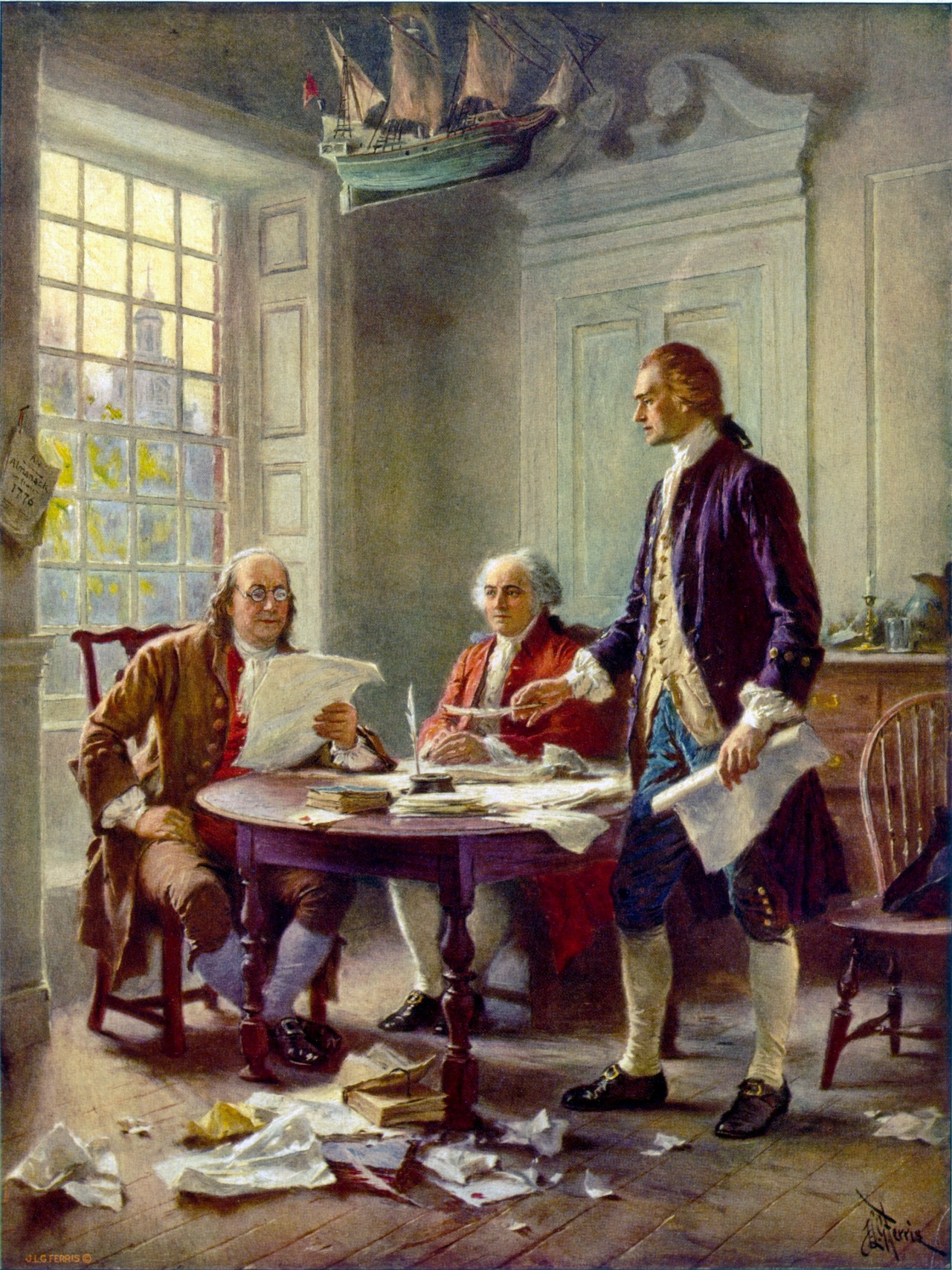
“We must all hang together, or assuredly we shall all hang separately.” — Benjamin Franklin (at the signing of the Declaration of Independence)
“There! His Majesty can now read my name without glasses. And he can double the reward on my head!” - John Hancock (upon singing the Declaration of Independence)
We began a contest for liberty and independence ill provided with the means for war, relying on our patriotism to supply the deficiency. We expected to encounter many wants and distresses, and we should not shrink from them when they happen- George Washington
“[T]he flames kindled on the Fourth of July 1776, have spread over too much of the globe to be extinguished by the feeble engines of despotism; on the contrary, they will consume these engines and all who work them.” – Thomas Jefferson
“They tell us, sir, that we are weak; unable to cope with so formidable an adversary. But when shall we be stronger? Will it be the next week, or the next year? Will it be when we are totally disarmed, and when a British guard shall be stationed in every house? Shall we gather strength by irresolution and inaction? Shall we acquire the means of effectual resistance by lying supinely on our backs and hugging the delusive phantom of hope, until our enemies shall have bound us hand and foot? Sir, we are not weak if we make a proper use of those means which the God of nature hath placed in our power. The millions of people, armed in the holy cause of liberty, and in such a country as that which we possess, are invincible by any force which our enemy can send against us. Besides, sir, we shall not fight our battles alone. There is a just God who presides over the destinies of nations, and who will raise up friends to fight our battles for us. The battle, sir, is not to the strong alone; it is to the vigilant, the active, the brave….. Our brethren are already in the field! Why stand we here idle? What is it that gentlemen wish? What would they have? Is life so dear, or peace so sweet, as to be purchased at the price of chains and slavery? Forbid it, Almighty God! I know not what course others may take; but as for me, give me liberty or give me death!” - Patrick Henry
“I wish to have no connection with any ship that does not sail fast; for I intend to go in harm’s way.” ― John Paul Jones
“The liberties of our country, the freedom of our civil Constitution, are worth defending at all hazards; and it is our duty to defend them against all attacks. We have received them as a fair inheritance from our worthy ancestors: they purchased them for us with toil and danger and expense of treasure and blood, and transmitted them to us with care and diligence. It will bring an everlasting mark of infamy on the present generation, enlightened as it is, if we should suffer them to be wrested from us…” - Samuel Adams
But the Day is past. The Second Day of July 1776, will be the most memorable Epocha, in the History of America. I am apt to believe that it will be celebrated, by succeeding Generations, as the great anniversary Festival. It ought to be commemorated, as the Day of Deliverance by solemn Acts of Devotion to God Almighty. It ought to be solemnized with Pomp and Parade, with Shews, Games, Sports, Guns, Bells, Bonfires and Illuminations from one End of this Continent to the other from this Time forward forever more. You will think me transported with Enthusiasm but I am not. I am well aware of the Toil and Blood and Treasure, that it will cost Us to maintain this Declaration, and support and defend these States. Yet through all the Gloom I can see the Rays of ravishing Light and Glory. -John Adams.
you hear this a lot, but what does it mean, specifically?
the pre-1776 americans who came from a sex, race, and class background that enabled them to participate in the conventional history of america sought to buy into aristocracy as a system of production. they were the youngest sons of minor aristocrats, the children of men with rank and no land, successful but socially limited military officers. there were people other than white men in america, but our history is not defined by them, they were not in power, they struggled to survive and their voices are faint and hard to hear. even the reality of working-class life in america among white men is largely silent; children read thomas paine’s agitation for the bourgeois revolution in america but nothing about his labor agitation in the us and england, nothing about his work as a corsetmaker or his parallel struggles to break into the bourgeoisie personally and defend workers as a class. we learn about the composition of washington’s teeth.
more people know washington had teeth extracted from slaves than know he was rich, and had an obvious and immediate material interest in the revolution as a wealthy planter.
george washington was arguably the richest man in america. not in money, although there is that. he was rich in land; he was a successful surveyor, planter, and politician. “politician” makes sense to us, and while it meant different things in the 18th century (and certainly he would have rejected any attempt to identify him that way) it’s something we can comprehend pretty well.
the planter class were slaveowners. this was a universal fact of revolutionary america; there was nowhere near enough ‘free’ labor in america to maintain their massive, highly inefficient cash crop farms. expanding the population of slaves in america was a major priority to intensify production.
before the cotton gin made cultivars of cotton that grew outside of fertile bottomland economically viable under even plantation slavery by reducing the titanic amount of labor necessary to make their bolls usable for fiber, the major cash crop of america was tobacco.
in america, because of peculiarly american mythology, we tend to believe that in the late 1700s and most of the 1800s people didn’t understand crop rotation or soil nitrogen. even in the context of european agriculture this is incorrect. soil nutrition was an incomplete science, and the primary fertilizer in the west was not an efficient nitrogen source but bone meal, yet american planters understood the basics of crop rotation and fertilization. they simply refused to use them because they would have driven up costs.
the rudiments of the agricultural revolution were things that wealthy american planters chose to forget. this is why america is larger than europe and has only been a food exporter in living memory - not because it is infertile, but because its economy was one of indifference to fertility, and this set down powerful cultural roots and industrial norms. the dust bowl was a product of this history as much as anything.
in slavery times, wealthy american planters planted a crop of tobacco on every surface available to them on good land - and they could tell if land was good for tobacco by means of both common knowledge about agriculture and surveyors’ trade secrets. a good way to tell in virginia was to count the pines.
they continued to plant tobacco season after season, crop after crop. the land was never given rest, never allowed to lay fallow. no land capable of raising tobacco was used for anything else; food and feed crops that would have partially restored soil were grown on bad, rocky, marginal soil.
in a few years, the best land used this way would become utterly infertile, and would be allowed to revert to barrens. the semi-indigent white smallholders of the antebellum south filled this vacuum, and in struggling to make do with an agricultural technology adapted for intensive, land-destructive agriculture, degraded soil still further.
the planters who had used up land then acquired more. land was cheap; formally it was necessary under english law to acquire title from natives, the english system of transfer of title was not a native institution and was easy to use to steal land. the american mythology includes a story about settlers buying manhattan for $50, and a riposte that this represented an easement and not a permanent purchase to the native lenape. there are also stories about natives selling land they did not own. these are both applicable in some cases, inapplicable in others; the interface between white settlers and natives was unstable and heterogeneous. in most cases, white title to land under english law was only ever ambiguous at best, and the land bought in this way rapidly became incapable of supporting people outside of the deformed european style of agricultural production prevalent in america. even if the system were not rigged against natives, economic pressure would still have created a comprador class which sold out and moved north and west, and this would still have intensified political struggles among natives and between natives and white settlers.
these conflicts, and legal hassles for the british government, lead to the proclamation of 1763. we hear mostly about it forbidding squatting - white settlers moving over the mountains and claiming land without title. in the american popular imagination this is what the revolution changed.
the reality is that the main thrust of the proclamation of 1763 was that the purchase of native land in america by private agents was forbidden, and all such purchases had to be formal purchases by agents of the crown itself. to a planter class whose bloated, vampiric way of life depended on shady and frequently illicit private land deals between themselves and natives, this was a deadly threat. from the word go, it was challenged by planters - who, being sustained by the legal system in a basically predatory life, in general took pains to be literate in the formal law of england and keep copies of significant precedents in common law courts - using a forged version of the pratt-york opinion.
the pratt-york opinion held that the british east india company was within its rights to purchase land from princely states in india. it held, unambiguously, that its decision did not apply to america, and american skeptics always expressed scorn and ridicule about the idea it suggested of dealing with indian “princes” and “governments”. (after the war, john marshall made it clear that there was no homology in the eyes of anglo-american law between the formal, legitimate governments of the raj and american indian nations.) but when you think about it, the same logic was really at work: the british east india company was an agent of the crown in its own right so its expropriating land from natives was in the crown’s interest even without its formal say-so. and so in a sense were american planters agents of the crown in this capacity. if george washington, the richest man in america, was not an agent of the crown in north america, who even was?
forged versions of this opinion, which clipped off language making it unambiguous that the decision was inapplicable to america, circulated widely. they are in evidence in the personal effects of washington, jefferson, lewis and clark. whatever the crown said, the land grab would continue, be damned any border or line. more land was needed so more land would be taken.
before, during, and after the revolution, washington was a surveyor; he wrote down the characteristics of land which white people had seen but had not investigated in depth for its suitability for plantation agriculture. he took the best land of the west for himself. it was not considered unseemly or ridiculous that he would do this even while on campaign; it was a necessary part of his profession and a universal behavior of the plantation aristocracy.
the use of land in this way continued after the war, and especially after the war with tecumseh’s confederacy was won at tippecanoe; land was close to free for the first white people to survey it, and cheap as dirt for the rich planters that came after them.
this is how americans became rich. this is how american capital came to exist. this land grab logic extended into the west, and this is part of the reason oregon was settled so far in advance of the great plains - the thick, dry grasses of the modern breadbasket of the us were not suitable country for cash crops, and only at its southern margins did plantation slavery ever successfully advance.
it is sometimes treated as inevitable that this should have ended, that plantation slavery reached its zenith before the civil war and the civil war was part of its decline. but this country was literally founded by people who stole land to farm so intensively with slave labor that it was destroyed for agriculture for generations - and those people would never have imagined most of what we think of as ‘the south’ being subject to their economic system. it was not suited for tobacco or long-staple cotton. but american and european industry, whose hunger for production was insatiable, found a way.
this form of production followed exploration, opening, and exploitation of native nations distant from white settlement by a diverse class of explorers and outdoorsmen. it followed that exploration and opening more or less everywhere. when we read histories of the rest of america we encounter other, less discussed cash crops, far outside of the main area of plantation slavery: ginger, indigo. (ginger in particular was a cash crop because of british merchants’ penetration of markets in china.) the same economic logic that applied in plantation slavery applied everywhere, and while some crops were limited by the absence of free labor, enormous families and punitive economic policies against the indigent were tailored to minimizing that. the same economic idea - land is limitless and can be destroyed without consequence, and labor can be someone else’s problem - underlay everything america did. it underlaid acquisitions of millions of acres of land with no conceivable economic use to agriculturists.
it underlies, in distant echoes, the modern american system, where the acquisition and mortgaging of domestic land is one of the primary ways capital disburses to the middle-class; where intensive use of land in existing settlements under gentrification follows a predictable pattern of exploration, exploitation, expropriation, and transfer to large investors. state violence is not the end-all and be-all of this legalized theft but it is always present and always on the side of capital and its agents.
and the american innovation, the core of the american experiment, is that if you have enough money you’re as good as god’s vicar on earth. it worked for washington and it works for your landlord.
The Revolution was not a single struggle, but a series of four
separate Wars of Independence, waged in very different ways by the major
cultures of British America. The first American Revolution (1775-76)
was a massive popular insurrection in New England. An army of British
regulars was defeated by a Yankee militia which was much like the
Puritan train bands from which they were descended. These citizen
soldiers were urged into battle by New England’s ‘black regiment’ of
Calvinist clergy. The purpose of New England’s War for Independence, as
stated both by ministers and by laymen such as John and Samuel Adams,
was not to secure the rights of man in any universal sense. Most New
Englanders showed little interest in John Locke or Cato’s letters. They
sought mainly to defend their accustomed ways against what the town of
Malden called ‘the contagion of venality and dissipation’ which was
spreading from London to America.
Many years later, historian George Bancroft asked a New England
townsman why he and his friends took up arms in the Revolution. Had he
been inspired by the ideas of John Locke? The old soldier confessed
that he had never heard of Locke. Had he been moved by Thomas Paine’s
Common Sense? The honest Yankee admitted that he had never read Tom
Paine. Had the Declaration of Independence made a difference? The
veteran thought not. When asked to explain why he fought in his own
words, he answered simply that New Englanders had always managed their
own affairs, and Britain tried to stop them, and so the war began.
In 1775, these Yankee soldiers were angry and determined men, in no
mood for halfway measures. Their revolution was not merely a mind game.
Most able-bodied males served in the war, and the fighting was cruel
and bitter. So powerful was the resistance of this people-in-arms that
after 1776 a British army was never again able to remain in force on the
New England mainland.
The second American War for Independence (1776-81) was a more
protracted conflict in the middle states and the coastal south. This
was a gentlemen’s war. On one side was a professional army of regulars
and mercenaries commanded by English gentry. On the other side was an
increasingly professional American army led by a member of the Virginia
gentry. The principles of this second American Revolution were given
their Aristotelian statement in the Declaration of Independence by
another Virginia gentleman, Thomas Jefferson, who believed that he was
fighting for the ancient liberties of his ‘Saxon ancestors.’
The third American Revolution reached its climax in the years from
1779 to 1781. This was a rising of British borderers in the southern
backcountry against American loyalists and British regulars who invaded
the region. The result was a savage struggle which resembled many
earlier conflicts in North Britain, with much family feuding and
terrible atrocities committed on both sides. Prisoners were
slaughtered, homes were burned, women were raped and even small children
were put to the sword.
The fourth American Revolution continued in the years from 1781 to
1783. This was a non-violent economic and diplomatic struggle, in which
the elites of the Delaware Valley played a leading part. The economic
war was organized by Robert Morris of Philadelphia. The genius of
American diplomacy was Benjamin Franklin. The Delaware culture
contributed comparatively little to the fighting, but much to other
forms of struggle.
The loyalists who opposed the revolution tended to be
groups who were not part of the four leading cultures. They included
the new imperial elites who had begun to multiply rapidly in many
colonial capitals, and also various ethnic groups who lived on the
margins of the major cultures: notably the polyglot population of lower
New York, the Highland Scots of Carolina and African slaves who
inclined against their Whiggish masters.
the funniest and best thing i’ve learned while doing research for this shakespeare project is that in the late 19th century, there was this group called the american acclimatization society and their thing was bringing european plants and animals to the u.s. so one member was this guy named eugene schieffelin and he was like obsessed with shakespeare, so he went, “hey, wouldn’t it be cool if we tracked down EVERY SPECIES OF BIRD SHAKESPEARE EVER MENTIONED and brought them ALL to America” so he rounded up like a hundred European starlings and released them in central park, and now there are upwards of 200 million starlings in North America and they cause around $1 billion worth of damage to crops every year, all because shakespeare mentioned them exactly ONCE in Henry IV part 1
George Washington: *writes letter to congress about how his dastardly rival, horatio gates, is planning to lead a military coup against congress to settle claims of wages never paid to soldiers, and how he, the great and wise one, heard of this when the coup plotters unfortunately told his aide alexander hamilton, and settled everybody down with a great speech, but congress should pass a bill anyways that guarantees pay for soldiers AND for rich creditors by implementing a widely unpopular tax in order to stave off any future military coup*
Congress: *Passes the tax with haste*
Later Historians: "Gosh, it's so excellent that George Washington was so committed to democracy. There could be no ulterior motives here. This calls for another statue of our God-King."
Our favored categories can start to look strange when we turn a light
on the realities of the American Revolution. The revolution involved
coalitions of people who were deeply divided regionally, economically,
socially, politically, so anything the big-time founders did agree on
will be pretty revealing.
I’d say they were largely agreed on the virtues of representative
government — it’s what they’d had for generations, what they saw being
threatened — but to question your question somewhat, I’d also note that
across the board, from the planters to the financiers to the upper
farmers and lawyers, the right of representation in no way equated with
democracy, which at the time would have meant “manhood suffrage”:
disconnecting the right of political participation from property
ownership.
The founders who held power were agreed in their fear and loathing of
that idea. Their ideology of rights and liberty was bound up, from
ancient times — at least in their minds it was — with protecting
property. So both the economic liberalization promoted by the
high-finance Hamilton,
and the more agrarian program that the slave-economy Madison advanced
(once he realized what his old friend in nationalism Hamilton was up
to), recoiled from democracy, a term the founders used negatively
whenever they referred to placing power in the hands of the
unpropertied.
That free yet unpropertied class was big, by the way, in founding-era
America. In my view, egalitarian goals, as you’ve put it, were not on
the minds of any of the well-known founders, for all of their other
differences. That includes mutually divided nationalists like
Washington, Hamilton, Madison, and Adams and state-sovereigntist,
anti-nationalists like Patrick Henry.
I wonder exactly which day it was that the amount of time Comedy Central had spent broadcasting The Daily Show finally caught up to the amount of time they had spent broadcasting PCU
This was supposed to be a culture war joke, in fairness on further reflection I was like “yeah but maybe put all the hours of South Park, Tosh.0, and The Man Show on the PCU side too.” Maybe the Kilborn years, even.
Okay, for the benefit of all the followers I’m getting with absurd ages in their profiles, let me explain this one.
When Comedy Central started in the ‘90s, they didn’t have much original programming, and what they did was mostly one-off (but frequently rerun) specials - filmed standup sets, basically.
So what they ran was mostly secondhand content they’d picked up rights to, and what was most common were these two movies, I swear to god I’d seen them run back to back and then over again, I’m pretty sure I’ve seen the same one run twice in a row. One was Throw Momma From The Train, a Danny DeVito comedic riff on Strangers On A Train.
The other was PCU, a campus comedy in the Animal House vein starring a visibly balding Jeremy Piven. It was a lovable frat fighting the dean and his Young Republican lackeys, but (because “boat shoe and dinner jacket-wearing WASPs” were overdone and increasingly anachronistic as villains by then) there was a third faction that took the brunt of the mockery: earnest, censorious social issue activists. Thus the title. The climax involved the activists protesting the big frat party (tagline: “Everyone Gets Laid”), but then realizing “holy shit, we’re against drinking, sex, parties, freedom, and fun, we’re the bad guys” and giving up and chilling out and hooking up with the frat members.
Because obviously you were supposed to see that as the only acceptable position for anyone with any pretensions to being cool and with it. Like I said, '60s-derived social liberalism used to offer something for everyone.
If you don’t know who Howard Stern is, he was the foremost crude “Morning Zoo” radio DJ in the country.
Like, in the '90s, white, blue collar (or “dudebro”) tits-n-beer vulgarity was plausibly coded left/liberal/Democratic. And that’s a little disorienting to remember.
I mean hell, Benny Hill was aired in part by an official arm of the most socialist Anglosphere government ever. Benny Hill.
If you’ve never seen Benny Hill, it’s from the British “light entertainment” tradition, a little variety but kind of sketch comedy, only a lot of the “comedy” was basically dirty old man leering. Sketch leering. Episodes famously ended with sped up comedic chase scenes where Benny would try to catch and grope some pretty young girls, then turn and run away as they tried to catch and punish him.
Now by the '90s that was already a bit off, but still, it ran in reruns on Comedy Central. It ran on fucking PBS.
If you ever wonder why intelligent educated sensitive me is wary of if not actively hostile to so much of what passes for modern cultural liberalism, it’s because it pattern-matches so closely not only to the apocalypse visions conservatives were warning of when I was growing up, but to the liberals’ versions as well.
One of the biggest pop stars of the ‘80s and into the mid-‘90s. She’s still doing something I’m sure. (One search later… releasing “Bitch I’m Madonna” ft. Nicki Minaj. Correct.)
And a big part of her schtick was Catholic burlesque. Rosaries and crucifixes as fashion accessories, songs titled “Like a Virgin”, “Angel”, “Papa Don’t Preach” (about standing up to patriarchy by… not aborting an unintended pregnancy, dedicated to the Pope), and “Like a Prayer”, like holy shit, look at that video. (Music videos were the most important art form of the 1980s.) I’d say calling herself “Madonna” was the topper, but that was her (and her mother’s) birth name. Nominative determinism, I guess.
The context here is that it was only in the 1970s that the “white ethnics” - descended from mostly Catholic, Jewish, or Orthodox immigrants from southern and eastern Europe, began being considered as fully the same race as plain “white”, which had heretofore been more specifically Protestant/secularist North/Western Europeans. You still saw echoes of the distinction into the ‘90s, uptight WASPs as opponents to the cool protagonists in cultural works by people who had lived through when that was plausibly a thing.
And part of the twist was that Catholicism had been coded as sexually repressive, particularly upon women but Madonna made a thing of invoking it as an accessory to female sexual assertion, very eroticized videos, wearing see-through clothing and lingerie on tour, you know back in the day she… wait, I should establish some other stuff first.
Also the other big thing she did was pull in this whole multi-racial, multi-sexuality dirty poor NYC thing - New York was still recovering from the bankrupcty of the 1970s, not yet made it to Giuliani Time and the walking-back of the last time we tried not repressing black people. So if we’re talking pop cultural touchstones it wasn’t quite Taxi Driver or The Warriors NYC anymore, but still a ways off from Friends NYC, let alone Sex in the City or Girls’. Ghostbusters/Burton Batman NYC, I guess.
So a lot of sexual contact with hot brown-skinned men in her videos and as backup dancers, also queer culture - “vogueing” and a lot of other things from NYC “ballroom” society (all you babby genderweirds should watch Paris is Burning if you haven’t yet, I am nothing if not insistent that one should learn the history of one’s people), in 1992 releasing a coffee table book of pansexual celebrity kink erotica.
Okay. Anyway, you know back in the day she was known for having her limousine driven through the (predominantly black and Puerto Rican) Lower East Side and picking up teenage boys off the street to use for the night? After a while the locals got tired of this, learned to recognize her limo, and threw trash at it.
I guess you could peg Lady Gaga as her successor, doing queer burlesque at the moment of their incorporation into the mainstream. Also she does that “present yourself as the perfect accessible celebrity friend/avatar to your audience” thing that Taylor Swift does better. Honestly, I think the big problem with her though is that music videos aren’t as big a thing though (and have better competition as “media for young people to consume”) so her visual peacocking doesn’t count for as much anymore.
1. stern pinball tables, generally, blow
2. if I remember correctly, steve ritchie was forced by stern to make this table
The early 2000s were a dark time. If you’ve never come across a Sharkey’s Shootout or High Roller Casino, thank your lucky stars. Or the ‘02 Playboy, Christ, I keep forgetting that even exists.
Now that pinball’s making a comeback and they actually have the budget for development it’s a little better. I’m definitely in the minority in liking Wrestlemania, I think Mustang’s a bit underrated too, and Avengers was an abortion but other than that they’re pretty solid lately, and it’s nice that they’re polishing and releasing code updates in response to experience and feedback now.
KISS’s layout works shockingly well, and when the code catches up it’s got potential to be a classic.
one places an object over their friend’s head so that they can instantly be transported to their chair. the other picks up a stool and continuously picks it up until they phase through the ceiling and are able to reach the hidden basement, skipping a sizable amount of the story in the process
William Marshal, greatest knight in English history. So when he was a kid his dad was defending a castle in a civil war, and young William was being held as a hostage. If the father would not surrender, it was threatened that William be killed - either by hanging or as the payload of a trebuchet - which is after all the point of hostages.
His father taunted them to do it, proclaiming “I still have the hammer and the anvil with which to forge still more and better sons!” History does not specifically record that he was grabbing his junk as he said this, but one can assume.