Imagine a standard history textbook having to explain who Seth Rogen and James Franco are
Imagine a standard history textbook having to explain who Seth Rogen and James Franco are
They won’t have to.
We already know.
this reblog scares me
Imagine a standard history textbook having to explain who Seth Rogen and James Franco are
They won’t have to.
We already know.
this reblog scares me
Roughly after 1 p.m. on Saturday, at the peak of SantaCon debauchery, a 40-something white man in a Santa suit walked into a San Francisco bank and handed the teller a note demanding money. The teller handed him an undisclosed amount of cash, and then—like in the St. Patrick’s Day scene from “The Fugitive”—the man walked outside and disappeared into the crowd of Santas.
So far, the police have made no arrests, and it seems very likely the man might actually get away. It was a perfect heist—a festive, vomit-soaked “Ocean’s 11.”
So, if you were looking to claim “sociopathy” as a positive identity, what would you posit as its antonym? Sociotypicality? But that’s weaksauce, polemically.
I propose “empathorrhea”, by analogy to diarrhea and menorrhea. You’ve got all the “uncleanness” baggage associated there for one, and for two it puts the focus on control, casting sociopathy not as the absence of emotion or empathy, but a volitional empathy rather than an empathic incontinence.
dashboard adventures
thanks to this new theme this post is making a comeback

Just recently came across this from a-man-in-black, connecting hashtag gamergate to “norms of chan culture”, and I think he makes a some interesting, true points! It’s worth reading. He’s an anti-, and anti-anythings usually have understandings of their nemeses more worth reading than the anythings do of themselves.
I’m not totally in love with it - it rhetorically asks “Who do [journalists] talk to? …they can’t collectively interact with anyone”, immediately after very clearly laying out the norms and procedures for talking to a collective ‘chan style. That’s part of a general weakness whereby it accounts for norms of anonymity or variable opaque pseudonymity by reference to acculturation but takes norms of “true name” or persistent thin pseudonymity as a priori defaults, and seems to breezily assume the latter as the “real” norms and culture of twitter or even “life in general” when the very existence of ‘gaters and anons, and viability of #gg and ‘chans would seem to call that into question.
But still. And then I checked some of his other storify pieces (Seriously, though, at the point where you’re using a 3rd party site to render your longform twittering even minimally readable, maybe consider not doing your longform on twitter?) and I can tell he’s onto something in this, “The Redpill Right”, because he’s agreeing with things I’ve said.
Him:
essential to the Redpiller POV is the idea that everything is a game and the people who win played better.
(Ahem.)
They share a viewpoint, but they don’t yet share a common identity. …But that identity is forming. And they’re finding each other.
…It’s 4chan, it’s Reddit, it’s Uber. It’s the manosphere and it’s the atheist community. It’s bitcoin and libertarians and gamers.
If you believe what they believe, toe the line, reify their mythology of gaming, and so on, you *belong* in their nomos, a meaningful order.
…[a “nomos”] syntheseises meanings into a coherent system of beliefs that provides people in a given society with a common schema with which to approach the world.
(Sounds kind of like a thede, but probably sounds kind of like a lot of things. It’s probably worthwhile for intellectuals to reinvent wheels every now and then, helps escape the cruft and politics of established fields.)
[They are creating] a “fictive ethnicity.”… Culture, history, lore, philosophy, even a primitive form of religion, all predominate here… making an identity out of reactionary politics…
And then me, back in May:
I will say what intrigues me more, and what could really be a prime mover in that sector, is the construction of a modern, international, English-speaking Australian-American-Polish-British-Scandanavian-Serbian-etc. white volk around a core of internet-native right-masculo-populism on the chans’ “waifus, warhammer, and white nationalism” model
things like Polandball’s (and SatW’s) western-centric resurrection of the concept of national personification, heavy metal culture and the associated Vikingism, feelsguy’s translinguistic sense of selfhood, /pol/’s kebab removal… well, just /pol/’s /pol/ness, really
Now this sounds ridiculous. I know this sounds ridiculous. This is me pointing to cultural trends particularly prominent in the dork niche circles I notice and ascribing to them world-shifting importance. I know it is.
Sure, heavy metal is not the actual historic musical tradition of any people. Sure, Norse neopaganism is not the actual historic religious tradition of any people. Sure, Tolkien-by-way-of-D&D aesthetics are not the actual historic mythology of any people.
Unless, of course, you count “2008” as being a part of history, or those then alive as counting as a people. Or, say, 1978. Or, you know, the 19th century, and the conscious, successful Wagnerian construction of Germanic identity from which these are all lineally descended.To Golda Meir is attributed the line that there is no such thing as a Palestinian, by which was meant that the identity didn’t predate the establishment of the state of Israel. True, true. Neither was there such a thing as an Israeli. But then the state of Israel was established.
In England and the United States, the police were invented within the space of just a few decades—roughly from 1825 to 1855.
The new institution was not a response to an increase in crime, and it really didn’t lead to new methods for dealing with crime. The most common way for authorities to solve a crime, before and since the invention of police, has been for someone to tell them who did it.
Besides, crime has to do with the acts of individuals, and the ruling elites who invented the police were responding to challenges posed by collective action. To put it in a nutshell: The authorities created the police in response to large, defiant crowds. That’s
— strikes in England,
— riots in the Northern US,
— and the threat of slave insurrections in the South.So the police are a response to crowds, not to crime.
Trueish enough. I’ve mentioned how 20th century American urban policing was heavily modeled after the FBI. Which was heavily modeled after the Pinkertons. Who were a nationwide mercenary police force with a specialty in combating (quite literally) labor unrest.
My one complaint is that it totally overlooks the British/American heritage of sheriffs, and posse comitatus, as an intermediate force between feudal men-at-arms and towns’ “hue and cry”. But then, this is a Marxist analysis and Marxist frameworks have never quite known what to do with rural yeomanry (see Lenin’s vacillating between the New Economic Policy and then “dekulakization”, or the inability of the urban and rural radicalisms of late 19th century America to form productive alliances even in areas of mutual strength like western New York, Minnesota, and Wisconsin).
Sovereign Polities Wholly Incorporated into the Territory of the United States of America*
State of New Hampshire (1781)
Commonwealth of Massachusetts (1781)
Colony of Rhode Island and Providence Plantations (1781)
Colony of Connecticut (1781)
State of New York (1781)
Commonwealth of Pennsylvania (1781)
State of New Jersey (1781)
The Delaware State (1781)
State of Maryland (1781)
Commonwealth of Virginia (1781)
State of North Carolina (1781)
State of South Carolina (1781)
State of Georgia (1781)
State of Vermont (1791)
Republic of West Florida (1810)
Republic of Indian Stream (1842)
Republic of Texas (1845)
California Republic (1846)
Oregon Territory (1849)
Confederate States of America (1865)
Republic of Hawaii (1898)
Empire of Japan (1947)
Sovereign Polities Formed from the Territory of the United States of America
Confederate States of America (1861)
Republic of Cuba (1902)
Republic of the Philippines (1946)
Republic of Korea (1948)
Federal Republic of Germany (1949)
State of Japan (1952)
Federated States of Micronesia (1979)
Republic of the Marshall Islands (1986)
Republic of Palau (1994)
* in keeping with American tradition, we will politely gesture towards and subsequently ignore the notion of Amerindian tribes and Samoan chieftaincies as sovereign polities.
what is it about pinball table artists that, regardless of theme or design, seem to always go “did i remember to put big boobs in here”
same thing that compels the backglass artists to go “better emphasize the nipples, someone might think she’s wearing a bra”, presumably
every couple of weeks, putin gives a speech and answers a couple of questions on live tv. the usual state propaganda stuff. this is how it’s advertised.
The West Point Egg Nog Riot of 1826,
In West Point’s early years the academy could hardly be called a prestigious college. It was practically a remote army outpost which doubled as an educational institution for only ten cadets. There was no real curriculum, few rules, and it was run with an “anything goes” attitude. This all changed after the War of 1812, when it was realized that the United States needed more highly trained and educated officers. in the 1820’s Congress massively expanded the academy, and placed it under the command of Col. Sylvanus Thayer. Now known as “The Father of West Point”, Thayer would instill professionalism and military discipline among the cadets. Among the many rules he set on the cadets was a prohibition on alcohol, thus making West Point a dry campus.
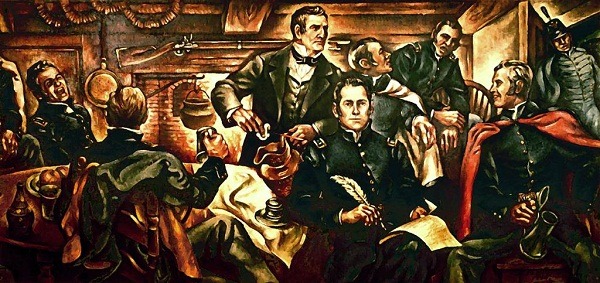
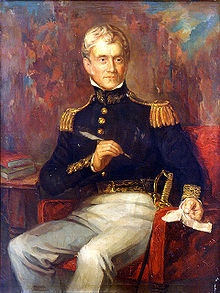
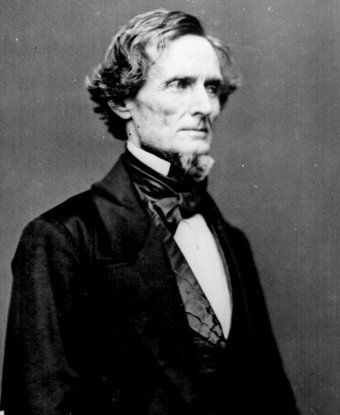
Today many colleges and universities have similar rules, and the cadets of West Point disobeyed those rules just like students do today. On Christmas Eve of 1826 the cadets decided that they wanted a bit of whiskey in their eggnog to celebrate the holidays. They turned to Cadet Jefferson Davis, future President of the Confederate States. Davis had contacts with the local saloons. He didn’t smuggle in a little bit of whiskey, he smuggled in four gallons of whiskey. Within a few hours, the North Barracks were awash in drunken parties and revelry.
The two officers on duty, Captain Ethan Allen Hitchcock and Lt. William A. Thornton tried to break up the wild parties, in the course of which they were threatened with swords, bayonets, and knives. Thornton was hit over the head with a wooden club while a drunken cadet pulled a pistol on Hitchcock and shot at him. Soon the situation broke down into a pitched riot a drunken cadets smashed glass windows, threw bedding and other materials out of the windows, broke furniture, ripped the banisters off steps, and generally all around trashed the place. There was a call to summon West Points garrison of regular Army troops to quell the riots, but in the end it was decided that it would be best to let the cadets sober up.
In the aftermath of the riots, 19 cadets were expelled from West Point. Many others were severely punished, among them Jefferson Davis and future Confederate General Robert E. Lee.

Did you know many African countries continue to pay colonial tax to France since their independence till today!
…France accepted only an “independence on paper” for his colonies, but signed binding “Cooperation Accords”, detailing the nature of their relations with France, in particular ties to France colonial currency (the Franc), France educational system, military and commercial preferences.
“the rock” church exterior entrance, lenoir mall, lenoir, nc, photograph taken circa 2011
there is that particular type of american protestant which looks approvingly upon the idea of a church located at a mall (however as you can see this photo is of the exterior-to-the-mall entrance) and with a mysterious name like “the rock” which does not announce its being a church to the casual observer indeed the only indication that this location was a church is the crossed t in the sign you can imagine that this church had a very modern style of ministry and there was a youth group that played exciting games the remarkable thing about this photograph is how the mysteries of religion and the mysteries of the mall are not at all incompatible and indeed one feels strongly the sense of the sacred in a well-designed mall and one is inclined to think on the mysteries of the divine in such a place but the efforts made to actually incorporate a designated explicit place of worship into a mall seem to have always fallen so short of their potentials

An “official pop album” “inspired by the late ’80s”. Eeehhhhhhhhhh, we’ll see.
yeah, I don’t know why I even doubted her
Eeh, on second thought, I just listened to Red straight through again and I was like “holy shit I forgot how much better an album this is”.
1989 was the first Taylor Swift album to really be conscious that This Is An Album By Taylor Swift, Biggest Star In America. And it didn’t really bear that weight well.
The “1989” theme… I mean, the fact that there even was a theme. Red had the switch from Nashville to LA but that was more subtext than theme. The “let’s go back to the ‘80s” thing isn’t even new, nouveau-electropop has been the thing for a while, so not really any points for that. But that’s always been the Taylor Swift thing, she’s not a trailblazer, she just does whatever other people have been doing, improved and polished perfectly for the mass market. And the 100% hooks pop thing really plays against her strengths - she’s a songwriter first and foremost and even there more lyricist than arranger, but with the pop feel the lyrics don’t bear as much weight and she dumps more of the arrangement off on her producers.
There aren’t many great singles - Shake It Off was a decent way to introduce the new sound, and Blank Space really is the standout on this album. But beyond that you have what? Style. She could get away with I Wish You Would and/or How You Get The Girl, but that’s pushing it. Maaaybe This Love as something the country stations who supported her all this time could feasibly play, or else a twangier soundtrack song.
(It was a good idea to release “Out of the Woods” and “Welcome to New York” as teasers but not radio singles - they’re on the bubble of good enough, pushed over with the bonus from OHMIGAWD NEW TAYSWIFT, but don’t really hold up to replay.)
Wildest Dreams is too transparently “look, a Lana Del Rey song”, Out Of The Woods is “look, a fun. song”, Shake it Off is a Max Martin song.
I mean, I’ve said that The Lucky One was really a Jenny Lewis song, okay, but that wasn’t a single, deeper on the album. And circa Red the kids weren’t exactly listening to Jenny Lewis, but the 1989 sources are more direct competitors. WANEGBT was with Max Martin and Shellback and a dubstep drop, but no one was going to confuse that for Skrillex. It was built around a fucking ska guitar riff, for one.
(I’m pretty sure I Wish You Would is invoking Jesus Jones’ “Right Here, Right Now”, though, which at this point is respectably left-field)
Eh. I prefer it to the self-titled debut, for what that’s worth. At this point I appreciate her more as a celebrity than a musician anyway. Which I think is kind of a conscious shift. And another post.
A well-chosen enemy is worth as much as a well-chosen friend; taking those who would never be your friend and making them into enemies can leave you in a stronger position.
In high school, one of my good friends shared almost none of my tastes. It wasn’t an interpersonal drama, or an obstacle; we just didn’t talk much about it. We talked about our lives, like friends do. There was only one circumstance where it became a problem: I never learned to drive. So if we had to go somewhere, we had to take her car.
There were sometimes things on that car stereo that we both liked. Tori Amos, yes; Bjork, yes. Shirley Manson was neutral territory. Outside of that, though, I was doomed to progress ever further on my journey to knowing every single one of the words to Britney Spears’ “Lucky,” and to explore the deep cuts of Spice Girl solo albums once that was over. She had a distinct preference on the matter of the Backstreet Boys v. N’Sync; she had a favorite N’Sync member. (Not the one you’re thinking.) There was nothing wrong with any of this. It was just disconcerting to slam from “Crucify” into “Barbie Girl” on the mixtape. We were two countries connected by a river; the water belonged to both of us, but if you got out on the wrong shore, no-one spoke your language.
I was the one who’d bought her the Amos CD, so I’d sometimes try to get new things into the rotation. Nothing huge or harsh or loud, but something that could fit into the general girly-and-glamorous mold while adding a little roughness around the edges. To Bring You My Love was an album for which I nurtured fond hopes.
One and a half tracks into To Bring You My Love: “Can we, like… stop this? Sorry. Can we stop it? Forever?”
“Why? It’s not that different from Garbage."
“Shirley Manson is cute, though! This woman sounds… I mean, no offense. But she sounds like a man.”
Oh, she’s so lucky, she’s a star, but she cries, cries, cries…
I liked this woman. I cared about her. So I didn’t give her shit, because she didn’t deserve to be shit on, and because it wasn’t my car. It’s basic road etiquette: She who paid for the vehicle picks the tunes. The ride would be over soon enough, and she was doing me a favor.
But I won’t lie: My entire experience of the 2010s has felt, very frequently, like being stuck in that car for five straight years. On my worst days, I start to think I can never get out of the car; that the ride never ends. Or it’s the feeling that everyone is stuck in someone else’s car, at this point in history. That no-one gets to drive; that no-one is driving. And that I’m the only sucker who took this long to figure it out.
*
Publication – is the Auction
Of the Mind of Man –
Poverty – be justifying
For so foul a thing
*
I worry that the world is getting worse as it gets easier. That we are entering a culture of the quick hit, the gut feeling, the easy response. And that important things, like truth or autonomy or self-definition, are being lost. It’s not a terribly original thought. Then again, one of the problems with this state of affairs is that it’s neither easy nor terribly important to do original thinking.
It’s a technology problem, in some ways; every part of culture can be translated into data, in ways that are more immediate and accurate than ever before. We don’t have to ask what’s “good” or “important” in any of the squishy, subjective, quasi-mystical ways people used to define and argue those terms; we know, factually and with good, hard math to back it up, what people want. We know the meaning of words like “friction” (the difficulty people find in adopting or understanding something) and “fluency” (the ease with which something can be understood and adopted, often because it is similar to what the consumer already knows). We begin to make the smart decision, the safe decision: The one that doesn’t cause friction. That just slides right in.
(btw Superworse is Sady Doyle & her consort - can’t think of a single time that girl’s picked the right side of a fight, but she’s one of the very few writers I consider my equal)