shrine to the prophet of americana

All posts (oldest first)

You know, I would love to see Iran defeat ISIS, using their homegrown weapons systems developed under embargo. Not so much for...

You know, I would love to see Iran defeat ISIS, using their homegrown weapons systems developed under embargo. Not so much for geopolitical reasons but because it would set up the perfect fucking headline:

“Islamic Tech Beats Islamic State”

Tagged: ISIS ISIL islamic state iran

Just got this month’s issue of American Rifleman, which is one of the magazines you can choose a subscription to with NRA...

Just got this month’s issue of American Rifleman, which is one of the magazines you can choose a subscription to with NRA membership (it’s the gun-as-gadget one, there’s also one focused on hunting, one on politics, and one for kids). Came wrapped in a secondary cover promoting their newest gun raffle and I just want to take a few minutes to describe all the various ways it’s brilliant.

First, the theme is the “‘Banned Guns’ Raffle”, which not only fits with their running themes and current betes noires but as a promotional idiom I am 100% sure is stolen from the ALA’s “Banned Books Week”, which is brilliant.

For two the NRA (or their technically-distinct-for-tax-purposes lobbying arm, the NRA-ILA) does raffles a lot. And part of it is that they solicit (but don’t require) donations with entries. But more of it is that they’re refining the data on their members for future solicitations and political campaigns - previous campaigns told them who’s willing to give $40 in response to a mailer yes, but even beyond that, from the people who don’t send in money, they know who’s willing to even open a piece of third-class mail, read three paragraphs at a 9th-grade level, spend 2 minutes filling out a form, put a stamp on it, and remember to mail it. This one tells them who’s willing to type in a 20-letter URL, who’s willing to donate and at what point over a more finely donation range - $5 to $60 - who will remember to keep returning that page daily over the course of a month, and who is willing to find and follow the method for submitting (multiple) entries without paying. Which is brilliant.

For three the NRA is as much if not more a gunmakers’ promotional organization - akin to say the Dairy Council - as it is a consumer-level gunlovers one. The raffles, and manufacturers voluneering prizes for them, are basically a way for manufacturers to promote themselves while funding the organization, a great two-for-one. Which is brilliant.

(Which is also to say, the ~editorial independence~ of American Rifleman is about on par with video game media outlets - it was really obvious how Kimber and Taurus were trying to establish name recognition by donating raffle prizes and buying ads and ~coincidentally~ getting cover features. The Taurus Judge Magnum feature coming like within a year of the basic Taurus Judge one, with a double-page ad spread, that was really blatant, guys.)

Ammunition manufacturers too, the raffles always have a few guns chambered in obscure calibers. I’d never even *heard* of .300 Blackout or .264 LBC-AR, but now, well, I just know 15 seconds skim worth of each, but that’s still infinity percent more than I did before. Brilliant.

I think the NRA might be the single most competent combine I’ve ever been part of.

Tagged: american rifleman nra national rifle association nra-ila gun raffle

tl;dr: Germany and their ally America won WWII in 1991

Pretty much every country that fought in WWII used it as a crucible in which to reforge their respective nations, and so it’s understandable that what we know now of the war is basically mythological. Not in terms of like, dates and names and locations, the who/what/when/where is mostly accurate, but in terms of meaning - the why.

In the last decade it’s becoming more and more of a mainstream understanding that America didn’t beat Germany in WWII, the fighting on the Western Front wasn’t nearly as important as the Soviet effort on the Eastern Front. Yes, yes, correct. More than that though, America barely even fought on the Western Front. Our contribution wasn’t in frontline combat but in logistics. Logistics is the least sexy (but most important) part of any war, and America was to the British Empire what the Urals were to the Soviet Union - an industrial base located beyond German bombing range.

Without American food, and the ability to build cargo ships with which to deliver food (including from the rest of the Empire - the British homeland hadn’t fed itself since the 18th century) faster than U-Boats could sink them, the British population would have starved, revolted, and deposed any government that refused to sue for peace. The idea that American wartime food rationing was necessary to feed “our boys fighting overseas” was a polite fiction, better for morale than the truth that it was to free up food for export to essentially bribe allied civilians to stay on-side.

Remember that one of the sore points of interwar Germany was that the German surrender came with the field armies in decent and even advancing strategic position, under pressure from hunger-stoked socialist rebellion on the homefront - the “stab-in-the-back” or Dolchstoß. Of course today you see that often dismissed as a myth, the “Dolchstoßlegende”. Dismissed, of course, by the mainstream historiographers aligned with the regimes which legitimized themselves against the regime that legitimized itself on it. (Let’s call it the “Dolchstoßlegendelegende”, and then call it a day.)

To the extent the Ukrainian famine of the 1930s was deliberately induced and targeted by Stalin, I think it would have to have been a prophylactic against a Soviet equivalent - preemptively liquidating potential fifth columnists, cutting the numbers of mouths to be fed, and denying any German occupation a source of recruits or agricultural workers.

(Of course, the notion that Ukrainians might turn against Russia and in favor of Western Europe, under the influence of fascist sentiment stoked by local elites for personal gain is properly considered just another of those legenden, no less ridiculous than the notion that Japanese-Americans might hold loyalty to the former portion of their hyphenation over the latter.)

I’m wandering a bit afield but I also want to say, when you hear said that Stalin’s purges of the military were so stupid, didn’t he know he was purging some of the best soldiers Soviet Russia had? Well, soldiers Russia had maybe, the question is in that counterfactual where they stuck around would, would Russia stay Soviet? The Russian Revolution was deliberately incited by Germany to knock Russia out of a World War.

Career army types - a lot of times, their loyalty is to the army. Maybe to the nation, but the government? Eh. A lot of the higher-ups purged had started off in the Imperial Army and had made one transition already. And lower ranks, well, their loyalty is to their superiors, as it should be, right? (The Russian Navy, by contrast, spent the early 1900s occasionally rebelling against everyone because their institutional continuity had been shattered by the near-total wipeout of the Russo-Japanese war.) Governments change, but any state needs an Army, after all. Vladimir Putin started off serving the Soviets.

Okay enough digression. Without American food, and Britain thus pressured to make peace, Germany not only could have shifted the resources, ground and air forces defending the Atlantic coast to the Eastern front but would have freedom of the seas, and thus access to supplies from the overseas colonies of Axis powers (including France and the Netherlands), and from the neutral countries of South America (which had considerable economic ties with Germany). It also would have been able to open fronts and supply troops from the Black and Levantine Seas, Persian Gulf, and Pacific coast of Russia.

Without American industrial production, the other Allies wouldn’t have enjoyed nearly as much functional range from their resource bases. This would suck in general, most particularly it would limit the British ability to sustain their Northern African forces, and of the Soviets to operate in Azerbaijan, Iran, and the ’stans. With these forces weakened, it was concievable that Axis forces could gain control of the Suez Canal (greatly degrading Britain’s connections with its colonies in India, Africa, and Oceania) and middle eastern oil fields (a huge coup, hydrocarbon shortages were the major limitation on German capabilities, resolving them would have allowed for significant gains in production and much improved ability to advance and supply forces eastward into Russia.)

So yes, to say that America’s role in the European theater of WWII was really about making and shipping, not fighting isn’t to short its contribution - it truly did provide the margin of victory. The Normandy landings and opening of a Western front of ground combat were dramatic, made for great stories, but they didn’t change the outcome of the war. At least not in the sense of “will Germany win” - that had already been decided in the negative. It just changed the details of who they lost to. And what difference did that make? Well…


People say WWII should be considered as a continuation of WWI. There’s something to that, there’s something to that.

Here’s another idea, though - WWII was continuous with the Cold War, and before even V-E Day, America had switched sides to fight with the Germans, and specifically the German right, against the Russians, and to a lesser extent France and the UK. It was a brilliant betrayal, the maneuver by which America came to rule the world.

I mean, we didn’t side with the Nazis, per se, except to the extent that under Gleichschaltung everything in Germany not specifically anti-Nazi was officially Nazi. Rather, their coalition partners - the Christian democrats, the Junkers, the Heer, the industrial capitalists who had allied with the volkisch streetfighters to fight socialism and were perfectly willing to switch allegiance to the American strong horse for the same purpose.

That explains why long after it was obvious the war was a loss the German forces kept fighting on the eastern front - to hold off the Russians long enough for the Americans to reinforce Germany, or to fight westward to link up with (“surrender to”) American armies.

That explains why America never really pulled the trigger on “denazification”, the attempt to purge German government and society of fascists and fellow travelers, and instead turned around and purged its own government and society of communists and fellow travelers in the Second Red Scare.

That explains the Marshall Plan - America rebuilt western Europe, because America had conquered it.

That explains Bretton Woods, pegging European currencies to the dollar, and thus subordinating their economies to the American economy. (and the “Eurozone” as successor, subordinating European economies to Germany). How do you know Germany lost WWI? Because the Treaty of Versailles imposed punishing reparations on Germany, redirecting its economic output to Britain and France. The result of WWII was the redirection of Britain and France’s economic output to America and Germany.

That explains American support for decolonization in Africa and Asia, most glaringly in the Suez Canal Crisis, where America used the whip hand on Britain and France to support Nasser’s move to pry the canal - and Egypt generally - from their hands. By choking off their colonial empires, America blocked their ability to return to parity through primitive accumulation.

This explains de Gaulle - pulling out from NATO, fighting to hold on to Algeria and Vietnam, pursuing French nuclearization for energy independence and military sovereignty - he was pushing back, and since the Soviet collapse France has been subtly reassembling its African empire - in any potential American/Chinese/Islamic struggle for Africa, they’re the wild card.

That explains the postwar American development of a conceptual vocabulary - “totalitarianism”, “authoritarianism”, “statism”, “central planning”, horseshoe theory, “human rights” - by which communism and fascism were positioned as varieties of a broader unitary category and America assured itself that it had always been at war with Eurasia.

(The “Cultural Marxist” meme, that the Frankfurt School and their ideas represented a communist attempt to subvert America, is particularly ironic. The Frankfurt School and their ideas were embraced and actively promoted by the core of mainstream America - the government, businesses, universities, the Protestant churches - because at core their ideology was - liberal, yes - anti-communism.)

This doesn’t, as far as I know, explain the (at the time, surprise) death of Franklin Roosevelt, and replacement by Harry Truman, a man whom power brokers had installed for the express purpose of lining up an anti-leftist succession. But wouldn’t it be wild if it did?

This doesn’t explain much about the Pacific theater - that was America and Japan competing over who would inherit the European imperial holdings in Asia. Japan did fight to the last, America did conquer it outright, and did purge it in the aftermath.

It does explain the later takeback of that purge in the name of anti-communism, and Truman’s decision to use nuclear weapons. Not only as a demonstration and warning to Russia, but to hasten its surrender. You hear it said it was to pre-empt the need for a costly and painful invasion, that’s not really true. America had total naval and air superiority and could have just starved Japan into submission - its infrastructure shattered, even with peace it was essentially in a state of famine until the late 1950s. America wanted Japan to surrender while they were still the only ones around to surrender to, rather than face a division with the Soviets like Korea and Vietnam.


So. All those teenagers from around the world who follow me for god only knows what, next time in History class you’re asked how WWII ended, now you know. Falling back in the face of Soviet advances, Germany peeled off America from the Allies, decisively sewing up the Western Front. After negotiating a tense decades-long armistice, they eventually starved (and subverted) Russia into submission in the early 1990s. This completed, they realized their long-held dream of eastward expansion and hegemony over continental Europe.
Tagged: history amhist wwii world war ii revisionist history

OK first you’re being a total dick right now,

thebsdboys:

OK first you’re being a total dick right now,

AT LEAST HALF THE ORGANIC MATTER YOU see on a walk in the forest is dead: dead leaves, deadwood, dead weeds, insect carcasses,...

AT LEAST HALF THE ORGANIC MATTER YOU see on a walk in the forest is dead: dead leaves, deadwood, dead weeds, insect carcasses, maybe even the stinking corpse of some higher animal if you’re lucky. There are massive die-outs: suddenly the cicadas are silent, and the husks of their bodies litter the trail. Great plagues sweep across the vegetable kingdom: plagues of viruses, plagues of herbivores, plagues of invading plants, as the monastery’s gardeners know only too well. And then all this carnage is brought to an abrupt halt by that biggest mass murderer of all, the first hard frost. The katydid’s song grinds to a halt, the dainty jewelweed shrivels and collapses into putrid slime, the birds get out while the going’s good. Autumn’s splendid tragedy unfolds, and we have the beauty of a dying world. The spectacle makes us pensive: we think of our own demise, our approaching winter.

Robert Genjin Savage

Death: As Common as Life

http://www.tricycle.com/special-section/death-common-life

(via zenhumanism)

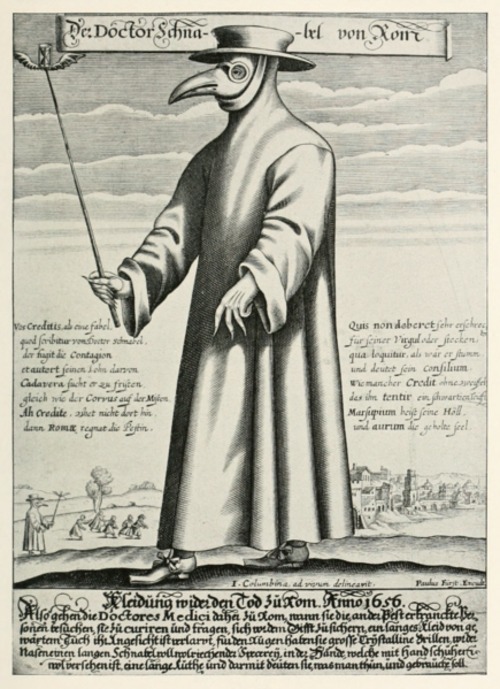
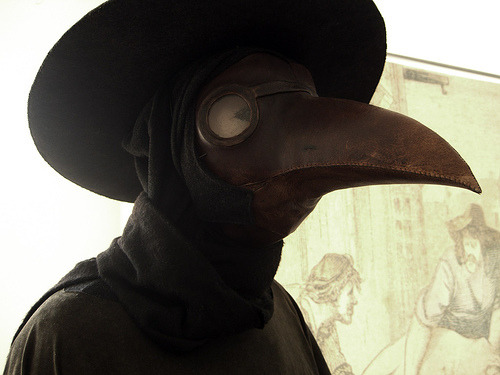
During the Bubonic Plague, doctors wore these bird-like masks to avoid becoming sick. They would fill the beaks with spices and...

zacharielaughingalonewithsalad:

cellarspider:

twinkletwinkleyoulittlefuck:

purrsianstuck:

During the Bubonic Plague, doctors wore these bird-like masks to avoid becoming sick. They would fill the beaks with spices and rose petals, so they wouldn’t have to smell the rotting bodies. 

A theory during the Bubonic Plague was that the plague was caused by evil spirits. To scare the spirits away, the masks were intentionally designed to be creepy. 

Mission fucking accomplished

Okay so I love this but it doesn’t cover the half of why the design is awesome and actually borders on making sense.

It wasn’t just that they didn’t want to smell the infected and dead, they thought it was crucial to protecting themselves. They had no way of knowing about what actually caused the plague, and so one of the other theories was that the smell of the infected all by itself was evil and could transmit the plague. So not only would they fill their masks with aromatic herbs and flowers, they would also burn fires in public areas, so that the smell of the smoke would “clear the air”. This all related to the miasma theory of contagion, which was one of the major theories out there until the 19th century. And it makes sense, in a way. Plague victims smelled awful, and there’s a general correlation between horrible septic smells and getting horribly sick if you’re around what causes them for too long.

You can see now that we’ve got two different theories as to what caused the plague that were worked into the design. That’s because the whole thing was an attempt by the doctors to cover as many bases as they could think of, and we’re still not done.

The glass eyepieces. They were either darkened or red, not something you generally want to have to contend with when examining patients. But the plague might be spread by eye contact via the evil eye, so best to ward that off too.

The illustration shows a doctor holding a stick. This was an examination tool, that helped the doctors keep some distance between themselves and the infected. They already had gloves on, but the extra level of separation was apparently deemed necessary. You could even take a pulse with it. Or keep people the fuck away from you, which was apparently a documented use.

Finally, the robe. It’s not just to look fancy, the cloth was waxed, as were all of the rest of their clothes. What’s one of the properties of wax? Water-based fluids aren’t absorbed by it. This was the closest you could get to a sterile, fully protecting garment back then. Because at least one person along the line was smart enough to think “Gee, I’d really rather not have the stuff coming out of those weeping sores anywhere on my person”.

So between all of these there’s a real sense that a lot of real thought was put into making sure the doctors were protected, even if they couldn’t exactly be sure from what. They worked with what information they had. And frankly, it’s a great design given what was available! You limit exposure to aspirated liquids, limit exposure to contaminated liquids already present, you limit contact with the infected. You also don’t give fleas any really good place to hop onto. That’s actually useful.

Beyond that, there were contracts the doctors would sign before they even got near a patient. They were to be under quarantine themselves, they wouldn’t treat patients without a custodian monitoring them and helping when something had to be physically contacted, and they would not treat non-plague patients for the duration. There was an actual system in place by the time the plague doctors really became a thing to make sure they didn’t infect anyone either.

These guys were the product of the scientific process at work, and the scientific process made a bitchin’ proto-hazmat suit. And containment protocols!

reblogging for the sweet history lesson

You know how malaria was defeated?

Well wait, you know what malaria is? It’s this mosquito-borne parasitic illness, you just get sick, and then you die. You know why swamps are considered places of death? Today we’re like “wetlands are critical verdant natural habitat, the kidneys of the world, and it’s important to protect them”. It’s because swamps had still enough water for egg-laying, so they were full of mosquitos, who were full of malaria, so if you hung around them you’d just fucking die.

What was the treatment? Well for thousands of years there wasn’t one. If enough generations of people lived in malarial areas they’d eventually be selected for resistance, because if they didn’t have it they’d die.

That’s why African-Americans have such high rates of sickle-cell anemia, because that comes from a recessive trait that codes for resistance, because they descend from slaves captured and exported from the wet western coast of Africa or inland along rivers, which meant mosquitos, which meant malaria.

They were imported from west Africa because the Caribbean and the Atlantic coasts of South America and the modern southern US were great climates for growing valuable cash crops that required intensive agricultural labor, but they were wet and malarial, and if you put a lot of people with ancestors from cool dry central-to-northern Europe there and had them work outside, especially in large groups, they would get malaria, and then they would die.

That’s why of all the places they “discovered” and colonized, the only places really thickly settled by Northern Europeans were Australia, South Africa, and the northern coasts of North America and southern coasts of South America, because they were drier temperate zones, or the mountainous/hilly highlands where it was cold and gravity made the rivers run fast, so they wouldn’t get malaria and die.

If you could kill the mosquitos that would help (that’s why DDT was invented and used in extermination campaigns everywhere), if you could drain the wetlands that would help (that’s why so many were destroyed, one of first things that set Rome off on the course to world-empire was draining the swamps around the city), eventually we finally developed drug treatments, the first one discovered was quinine.

You know how that was discovered? When Europeans were first establishing dominion in South America, a guy on the cold mountain highlands of the Pacific coast noticed the locals chewed this bark to keep from shivering. He was like “hmm, people with malaria shiver a lot, maybe this would treat malaria!” and it did!

It’s still not clear how quinine treats malaria, but it’s established that it has nothing to do with the mechanism by which it stops cold people from shivering. This was a complete fluke.

The father of the kid across the street that I played with when I was a kid ran a business. His business model was basically to comb through thousands of wild unsubstantiated claims of, basically, “alternative medicine”, which is what we call folk medicine as practiced by white people who live in subdivisions and watch TV. They’d try to find the few that might have potential, and then run them through initial tests, and taking the ones that showed some results and run them through further tests, in hopes of eventually finding something, most likely something that could be sold on to a pharmaceutical company who would have the resources to do further tests on the by this point maybe 20% chance it would do something and 5% chance it could be a profitable product.

His one big hit was Cold-Eeze. They were the Cold-Eeze guys. Someone was like “zinc is a miracle cure for my sickly child”, because, you know, resonant frequencies and homeopathy and chiropraxis (fuck “chiropractic”, that is not a well-formed noun). And so a ton of tests later, as far as they could tell zinc ions happened to be able to bind to the same sites on the nasal membrane where the cold virus would.

(except zinc tastes awful, and most of the flavorings you could use would bind to zinc salts in ways that they wouldn’t bind to those sites, but a particular patentable formulation - zinc gluconate glycine - would work without tasting like ass. And then as soon as the product got popular there were mass-market knockoffs that used other zinc formulations that didn’t do shit)

The problem with this business model, of course, was that most of the people pitching you ideas are either woo-woo quacks or snake oil sales/con-men, and thus if by random chance they hit on something that worked, you’d still be in business with woo-woo quacks or snake oil sales/con-men, who would take every opportunity to fuck everything up, but that’s another story.

Tagged: history malaria quinine afamhist

The thing about Africa, why it’s got so many parasites and viruses and bacterial diseases and crazy deadly animals is that...

The thing about Africa, why it’s got so many parasites and viruses and bacterial diseases and crazy deadly animals is that that’s where humans evolved, and that’s where proto-humans evolved, and that’s where the primates that proto-humans came from evolved, which means that the stuff there is co-evolved with humans. It survived ages and ages of contact with humans, a good deal of things there recognize humans as predators and have anti-human defenses, or worse yet recognize them as prey.

Like, as soon as humans got to the Americas they killed the megafauna. Wooly mammoths? They just ganged up on them with spears. African Elephants? You try to gang up on an elephant with spears, they will fuck you up. You just look shifty around a wild elephant, they will fuck you up. Elephants will fuck you up for the hell of it. Gunpowder finally tipped the balance in our favor.

American bison? As soon as guns were introduced to their environment they went from abundant as hell to nearly extinct. You would just walk up to a herd and pick them off one by one and they would be all “huh”? You ever heard of the Big 5, the classic safari set of all-time badass animals to hunt? Lion, elephant, rhino, leopard, buffalo. You know which one kills the most hunters? The buffalo. Because if one of those fuckers sees you get close it will immediately charge at you full speed to gore you.

The American alligator? Rednecks will wrestle those things for fun. The Nile crocodile? Count human children as favored prey.

Australia’s a bit different, everything’s deadly there because it’s so resource-poor, in water and minerals, so it’s heavily selected for incredibly efficient killers. One of the most efficient ways to kill, in terms of resource expenditure, is poison, which is why so many desert animals are poisonous, which is why everything in Australia is poisonous.

That’s why governments and meta-governments try to maintain such a strong taboo against chemical weapons, not so much that it’s a particularly horrible way to kill but because it’s such an efficient way to kill - anyone with access to 1880s-level technology can perform AoE attacks with a huge radius and near-100% lethality - and they’re trying to keep human power struggles from turning into Australia.

Tagged: history africa evolution

astronaut, digital cutting my teeth on after effects 

jenniferhom:

astronaut, digital

cutting my teeth on after effects 

Settled and Nomadic Religious Experiences

Settled and Nomadic Religious Experiences

geopolicraticus:

image

The religious modes of thought typical of settled peoples usually focus on orthodoxy, that is to say, unquestioned belief in particular propositions. A body of religious propositions to which all members of a society are expected to assent requires a priestly class…

Tagged: shamanism religion nomadism

That thing where people claim to be flattered for being carded for alcohol? I didn’t get that. I’m pretty levelheaded, I’m...

That thing where people claim to be flattered for being carded for alcohol? I didn’t get that.

I’m pretty levelheaded, I’m good at talking my way through tense situations, I’m decently massive, I know how to fight. And I’d love if things were arranged so I could just go out and strangers felt compelled to come talk to me.

People tell me I should be a bouncer. My roommate was a doorman. But when I was 13, I was infuriated by the way adults brushed off kids, didn’t take them seriously, tried to gatekeep them from the world. I swore I’d never take up the position of rejecting people for being too young. And I take my promises seriously.

Just went to Beulahland. There was a crowd outside, younger than usual. Don’t know if it was the holiday weekend, the kids back in town for college, what. Buff dude standing by the door with his arms crossed.

Ask him if he’s the door, he looks confused, then apologetic. No. Guy sitting by the side says he is. Go to get out my license and he laughs. “Yeah, you’re a grownup.”

I laugh, haha, look at us here. Go in. A second through the door, I stop. “Wait, fuck me.”

Tagged: ktm

When someone speaks ominously about playing with fire, keep in mind that that’s literally how cooking, brewing, smelting,...

When someone speaks ominously about playing with fire, keep in mind that that’s literally how cooking, brewing, smelting, smithing, the steam engine, and the Saturn V rocket were invented.

Tagged: playing with fire

I am constantly going through my notes (as a source of validation, duh) and noticing that I've left anywhere from letters to...

I am constantly going through my notes (as a source of validation, duh) and noticing that I’ve left anywhere from letters to whole words out of my best sentences.

(After they’ve been reblogged, obviously.)

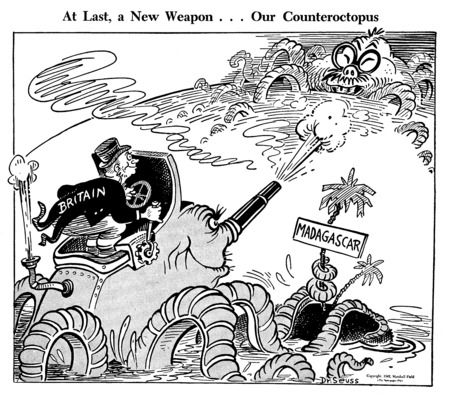
Ever since I saw this in like high school I've wanted to name a band Our Counteroctopus.

Ever since I saw this in like high school I’ve wanted to name a band Our Counteroctopus.

Tagged: our first album would be called Cable Rights on the Island of Yap dr. seuss wwii political cartoon our counteroctopus

There is weird, really fucking eerie dark mojo going down almost everywhere I look these past, say, two or three days or so.

There is weird, really fucking eerie dark mojo going down almost everywhere I look these past, say, two or three days or so.

Like, in what is possibly the pettiest manifestation of this, three times in the past 24 hours I have been out on the street and...

Like, in what is possibly the pettiest manifestation of this, three times in the past 24 hours I have been out on the street and some random person I’ve never seen before performed a literal drive-by shit-talking of me, twice from cars with me on a bike, once from a bike with me standing on the sidewalk, with the speed as such that I don’t think they could even have been been responding to any particular thing about me, they just either made an instantaneous decision to or just had it waiting in reserve for the first person they came across.

In Portland. Like, not even the methy part.

The other night I saw a light moving in a straight line in the sky that was no color I’ve ever seen up there - not starlight, not white or red/green plane lights, but the yellowish red of natural fire. It disappeared behind a tree and when I walked around to get a clear line of sight it wasn’t there anymore.

I hear Burning Man was practically rained out… holy shit, do you think they fucked up the wicker man sacrifice and failed to propitiate the gods?

Alternately, this could be some kind of disruption in the spirit realm, the... birth, or awakening of a new god? But what...

Alternately, this could be some kind of disruption in the spirit realm, the… birth, or awakening of a new god?

But what would there be a new god of?

The Internet, obviously.

What form would the god of the Internet take?

4chan, obviously. Which has, in recent days and especially right this moment been summoning as much human attention to itself as it can, and preparing to go do battle with its enemies.

Fuck fuck fuck fuck fuck fuck fuck I gotta go perform a ritual

"crab". The divination yielded "crab". Okay, then.

“crab”. The divination yielded “crab”. Okay, then.

Crab, like, "the cancer killing /b/", maybe? Like like a spider (via "world wide web"), but underwater?

Crab, like, “the cancer killing /b/”, maybe? Like like a spider (via “world wide web”), but underwater?

Forget the Myers-Briggs fucking personality assessment. I am dead tired of hearing if someone is an INFP or an ESLQ or whatever....

pipistrellus:

Forget the Myers-Briggs fucking personality assessment. I am dead tired of hearing if someone is an INFP or an ESLQ or whatever. I want to know if someone is melancholic or choleric. Bring back the four humors. I wanna see “Kaley, 16, phlegmatic” when I go to someone’s blog. Who is with me. Lets make this happen

I’ve got an excess of bile, but they call it “gastric reflux” these days.

Happy Labor Day

Happy Labor Day

People loved their work once, and it didn’t matter if they worked in the public sector or in the private one. The men who worked in the CCC would take their grandchildren to see the forests they planted, while the men from the auto plants would point out the cars they’d built as they passed them on the new interstate highway system. The women who fastened the engines on the wings would watch the B-17’s fly off to make a liar out of Goering, and the women who taught in the public schools would point with pride when one of their old students got elected mayor. Work was about making money, certainly. It was about feeding the family and keeping the roof where it was, and maybe having a little left over at the end of the day, or at the end of the week, for some amusement. Maybe a trip to Lincoln Park or White City or a hundred other places, where you could take a moment and enjoy the cool of the evening, music riding the nightwind from a dance pavilion down along the lake.
But it was also about Doing A Job, and doing it well, which was different than simply Having A Job. It was about making good cars and strong steel and sturdy furniture. It was about learning a craft, even if what you were doing wasn’t recognized as one. There was a craft in tightening rivets, or feeding the open-hearth furnace, or planing the wood just so. You had your craft, and the person next to you had theirs, and, when all the work was done, and all the craft was practiced, and practiced well, there was something you could look at with pride and say, that is something I have given to the world. Job well done, as they used to say. You could teach seventh grade civics and then, one day, you’re on a podium outside of City Hall. That kid right there, you could say. That kid is something I have helped give to the world. Job well done, as they used to say.
Unions were greatly responsible for the pride that people took in the work they did, especially in the middle of the last century, when unions helped build the most formidable middle class in human history.
-— -— -—

There was an autoworker, Ben Hamper, who wrote a column in the Flint (later Michigan) Voice, which was the alt-weekly Michael Moore first made his name by running. A lot of his columns got collected and repackaged in an excellent book, Rivethead that I read in college.
I read it in a class by Stuart Blumin, who was my favorite professor and de facto advisor. He was an American historian, focused on labor and class and the development of capitalism, you could tell he was heavily influenced by EP Thompson and the Communist Party Historians Group over in the UK.
He was quite open that he had expected Communism to ultimately triumph, and that he had been wrong about that, and in subtext that he had wanted it to ultimately triumph, and didn’t think he had been wrong about that.
Anyway, Rivethead. The story is that Hamper was born in 1956, a fairly clever kid growing up in Flint, Michigan, the chronological and geographic apex of American industrial unionism, where everyone’s dad worked for GM.
And he could have gone to college but he gets some girl pregnant and so he goes to work on the assembly line not even really out of obligation or Catholic guilt or whatever but because that seems as good a life course as any, it’s what every man he’s known does, under the mighty UAW the pay’s on par with the kind of “educated” jobs you could get anyway, why not.
And so he goes to work on the line and eventually he ends up writing a column about it, and he talks about the color of the factory culture, playing soccer with rivets for balls and cardboard boxes for goals, drinking mickeys of malt liquor in your car on lunch break, the absurd fursuited mascot “Howie Makem, The Quality Cat” that GM would feature at rallies and shop-floor tours, being laid off in economic downturns and put into the “job bank” where you get paid waiting to be rehired in the next upswing, developing a perfect rhythm with your partner, training into a rhythm so perfect you can each trade off doing the two-person job yourself for 4 hours while the other one goes out to a bar on the clock, the dignity and solidarity of the American worker.
And time goes on and eventually his marriage fails but he takes it in stride, and his column gets recognized and he takes pride in that and then eventually he has an epiphany, and a complete breakdown, which are basically the same thing. And the inciting incident is when an older line worker, some guy he’d looked up to as a model of quiet, philosophical stolidity, just shits himself and is barely coherent enough to even notice this and he realizes the guy hadn’t been a Zen master, he’d just been checked-out mindless drunk on the line every day.
And he realizes that the rivethead life is destroying him, that the only thing holding it together was a budding alcoholism, and that it’s doing the same to all his co-workers, and looks back and realizes it had done the same to every grown-up man he knew, his father and uncles that growing up he had looked up to as models of masculine strength and fortitude really had just had their spark snuffed out and the life beaten out of them long before, and whatever pride they took in the cars out on the road was a defensive attempt to locate in an external form the sense of self-value that had been exterminated within them.
When Marx talked about “alienation”, well.
And he went crazy, and couldn’t bear to work on the line anymore, and there’s no redemption, that’s where the book ends.
And that was a theme that cropped up again in Professor Blumin’s class, that there were two great working class traditions that echoed through the ages, and they were
1) avoiding work
and
2) drinking
Back in the premechanized age of small-group workshop manufacturing, workers would celebrate “Saint Monday”, which was to say just not showing up for work, hung over after the weekend.
(This was riffing off of Catholic feast days, or holy days, from which we take the word “holiday”, and as time went on counted an increasing share of the days of the year. There was a reason that poor workers were aligned with the Church, and nobility, in “Altar and Throne” coalitions resisting the development of industrial capitalist liberal democracy.)
In the ‘80s, the crap time of American auto manufacturing, one trick that was passed around (pre-internet, so by word of mouth largely) was to look at the codes stamped on car bodies, which would tell you what day of the week they were manufactured, and to avoid Mondays and Fridays. Because those days had the highest defect rates, because the workers tended to be drunk, or hungover, or absent.
And back in the workshop days, you’d drink at work. Apprentices would be sent out for growlers or buckets of beer, there were elaborate rules of who in the hierarchy of workers was expected to buy rounds for who and when. And there was hellacious resistance to attempts to get them to knock this off, as the industrial era kicked into swing.
Those great satanic mills, where women and children worked in shifts at great water- or steam-driven sewing and spinning machines, stories of little kids getting their hands mangled by the machinery? One of the major reasons women and children were preferred was because they would actually show up on time every day, and stay sober around all those hand-manglers.
And I mean, this maybe sounds like an argument for socialism. Though not of any actually-existing- variety, as capitalist propaganda will be glad to tell you, Soviet work culture, at least when the morale thrills of the Revolution and Great Patriotic War faded from personal to institutional memory, was all about shirking and vodka.
So those complaints about how America celebrates Labor Day instead of May Day, ignoring the true meaning of labor - solidarity - in favor of mindless distraction? Psssh. Labor Day is a celebration of the truest, most ancient, most fundamental traditions of labor: not working (especially on Mondays), and getting drunk.
Happy Labor Day!

Tagged: work: the curse of the drinking class history labor day labor rivethead +2 more